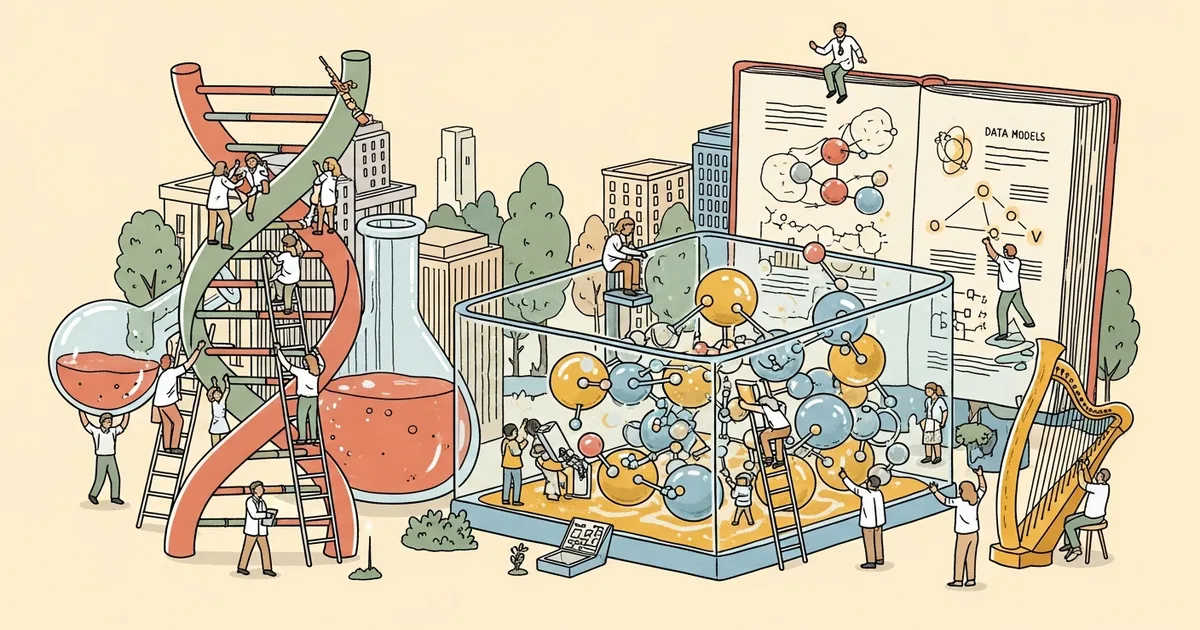
- SandboxAQ integrated its scientific AI models into Claude, putting drug-discovery and materials-science tools behind a conversational interface.
- The company’s large quantitative models (LQMs) are ‘physics-grounded’ — built on the rules of the physical world rather than patterns in text.
- SandboxAQ is a roughly 5-year-old Alphabet spinout chaired by former Google CEO Eric Schmidt, with over $950M raised.
- The integration targets the $50T+ quantitative-economy sector spanning biopharma, financial services, energy, and advanced materials.
What Happened
SandboxAQ has integrated its scientific AI models directly into Anthropic’s Claude, TechCrunch reported. The partnership puts powerful drug-discovery and materials-science tools behind a conversational interface that requires no specialised computing infrastructure to use. SandboxAQ Chief Operating Officer Nadia Harhen told TechCrunch: “For the first time, we have a frontier [quantitative] model on a frontier LLM that someone can access in natural language.”
Why It Matters
The framing — that the bottleneck in AI-driven drug discovery is the interface, not the models — is a meaningful repositioning of where value flows in scientific AI. SandboxAQ’s competitors Chai Discovery and Isomorphic Labs (Alphabet’s DeepMind spinout for drug discovery) have focused primarily on improving the underlying models. SandboxAQ’s framing puts the focus on who can actually use the tools — a bet that conversational interfaces will expand the addressable user base for scientific AI by several orders of magnitude.
The economics are striking. Drug discovery is one of the most expensive pursuits in modern industry; finding a single viable molecule can take a decade and cost billions, with most candidates still failing. SandboxAQ describes its target as “the quantitative economy, a $50+ trillion sector spanning biopharma, financial services, energy, and advanced materials.”
Technical Details
SandboxAQ’s large quantitative models (LQMs) are described as physics-grounded, built on the rules of the physical world rather than patterns in text. They can run quantum chemistry calculations and simulate both molecular dynamics and microkinetics — the study of how chemical reactions unfold at the molecular level. That capability tells researchers how candidate molecules are likely to behave before anyone sets foot in a lab.
SandboxAQ was founded roughly five years ago as an Alphabet spinout. The company counts former Google CEO Eric Schmidt as its chairman and has raised more than $950 million from investors. SandboxAQ has built multiple business lines including a cybersecurity practice; the Claude integration extends the company’s scientific-modeling work into a consumer-facing conversational surface.
Who’s Affected
Pharmaceutical and biotech researchers gain access to physics-grounded molecular modeling through a chat interface they can use without specialised computing infrastructure. Anthropic gains a scientific-AI partnership that strengthens Claude’s positioning in regulated-industry verticals. Isomorphic Labs and Chai Discovery face a competitor with a different go-to-market wedge — interface over model accuracy. Eric Schmidt’s portfolio gains another visible commercial integration. The $50+ trillion quantitative-economy framing is aspirational; near-term commercial traction will be measured through pharma-partner pilots and revenue disclosures.
What’s Next
SandboxAQ has not publicly disclosed specific pharma-partner deployments or revenue forecasts. The Claude integration is live in product surfaces accessible to Anthropic enterprise customers. Industry watchers should expect biopharma adoption metrics in the next two to four quarters. The broader scientific-AI category continues to be one of the most active in 2026 enterprise AI spending.