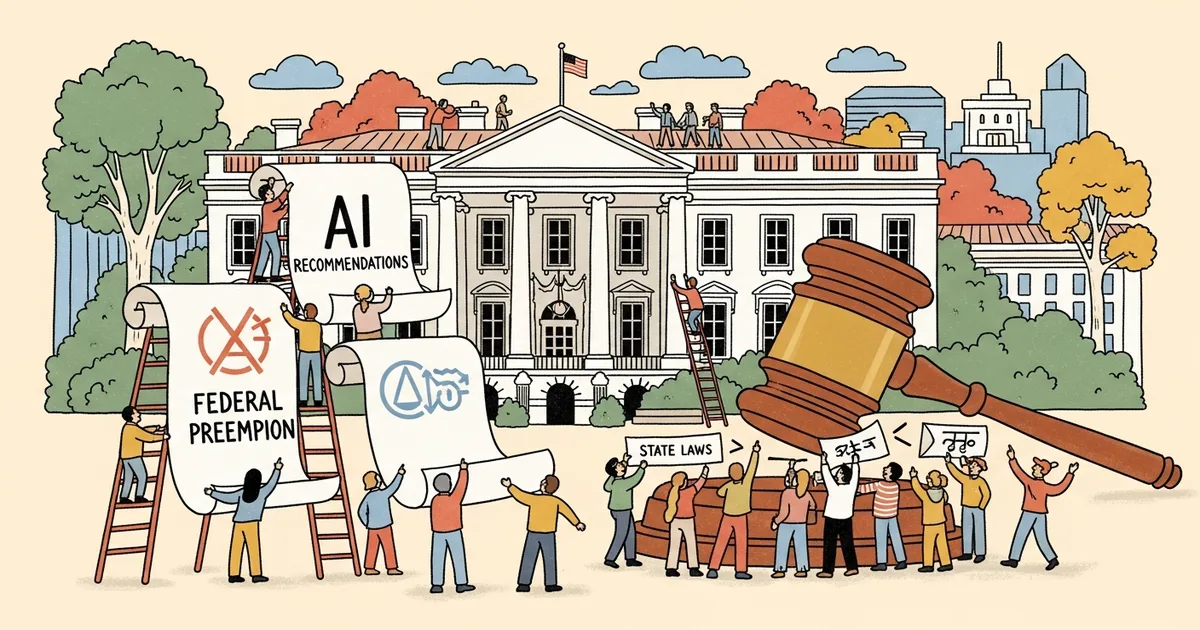
- The White House released AI policy recommendations that legal analysts say signal a move toward federal preemption of state-level AI regulations and new enforcement mechanisms.
- If enacted through legislation or agency rulemaking, federal preemption would override the growing body of AI laws passed or proposed by more than 40 states.
- The recommendations follow President Trump’s January 2025 executive order directing federal agencies to remove barriers to AI deployment and cement U.S. AI leadership.
- Legal analysts note the recommendations are non-binding but could shape congressional legislation and agency rulemaking in the near term.
What Happened
The White House released AI policy recommendations that signal a shift toward federal preemption of state-level AI regulations and the creation of dedicated federal enforcement mechanisms, according to a legal analysis published by JD Supra on April 16, 2026. The JD Supra analysis identifies the recommendations as a departure from prior federal postures that left states substantial latitude to regulate artificial intelligence systems and applications independently.
Under the framework being analyzed, federal standards would take precedence over the growing body of state AI laws currently in effect or under active consideration. The recommendations do not carry the force of law on their own—implementing federal preemption would require congressional action or, in narrower circumstances, agency rulemaking under existing statutory authority.
Why It Matters
The recommendations arrive as state AI legislation has accelerated sharply. Since 2024, more than 40 states have introduced AI-related bills covering algorithmic discrimination, automated decision-making, synthetic media disclosure, and high-risk AI use in hiring, lending, and healthcare. Federal preemption would override those laws and establish a single national compliance standard, eliminating the need for companies to navigate conflicting requirements across jurisdictions.
The development builds on President Trump’s January 20, 2025 executive order EO 14179, which declared it “the policy of the United States to sustain and enhance America’s global AI dominance in order to promote human flourishing, economic competitiveness, and national security” and directed agencies to remove barriers to AI deployment. The new recommendations appear to extend that policy directive into the architecture of domestic AI regulation.
Technical Details
The recommendations focus on two structural changes: establishing explicit federal preemption of state AI laws to prevent conflicting cross-jurisdictional requirements, and designating or creating federal enforcement authorities with specific jurisdiction over AI systems and their developers. Federal preemption in AI regulation would operate analogously to how the Supremacy Clause functions in telecommunications under the Communications Act, where federal standards displace state law across specified domains.
On enforcement, the JD Supra analysis highlights that current federal AI governance relies primarily on repurposed existing authority—particularly the Federal Trade Commission’s jurisdiction over unfair or deceptive trade practices—rather than AI-specific enforcement mandates with dedicated investigative and penalty authority. The recommendations propose filling that enforcement gap, though the specific agency vehicle and statutory authority for the proposed enforcement mechanism remain to be finalized through the legislative or rulemaking process.
Who’s Affected
AI developers, enterprises deploying AI in regulated industries, and state regulatory bodies would all face significant changes if the recommendations are enacted. Companies currently building state-by-state AI compliance programs—particularly in California, Colorado, Texas, and Illinois, each of which has active or recently enacted AI legislation—could see those obligations superseded by a federal standard.
State attorneys general and consumer protection agencies that have begun bringing AI-related enforcement actions under state law would lose jurisdiction over covered conduct if federal preemption takes effect. Civil rights and consumer advocacy organizations that have relied on state-level AI accountability mechanisms would need to redirect enforcement and advocacy efforts to federal channels and agencies.
What’s Next
Several pending federal AI bills that contain express preemption provisions are positioned as potential legislative vehicles for the White House framework. The JD Supra analysis frames the recommendations as a signal of the administration’s legislative priorities heading into the current congressional session.
Congressional activity on AI preemption legislation has picked up in both chambers, and industry lobbyists have indicated that an explicit White House endorsement of the approach could accelerate floor consideration of preemption-focused bills. The timeline for moving any such legislation remains contingent on the broader congressional calendar and committee markup schedules.