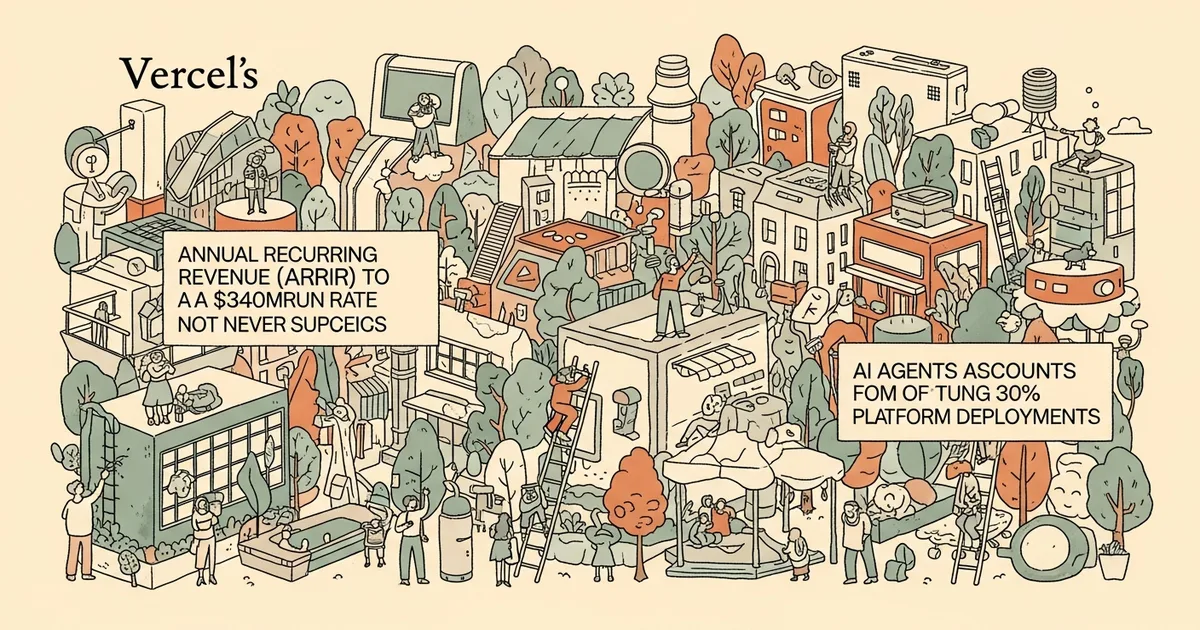
- Vercel’s annual recurring revenue grew from $100 million in early 2024 to a $340 million run rate by the end of February 2026, according to Forbes.
- CEO Guillermo Rauch disclosed at the HumanX conference that 30% of apps running on Vercel’s platform were deployed by AI agents, not human developers.
- Rauch signaled IPO readiness but declined to give a specific timeline, saying “the company’s ready and getting more ready for it every day.”
- Vercel was last valued at $9.3 billion after raising a $300 million Series F led by Accel in September 2025.
What Happened
Vercel CEO Guillermo Rauch revealed that the company’s ARR has reached a $340 million run rate as of February 2026, up from $100 million at the start of 2024, and said the platform is prepared for an eventual public listing. Rauch made the remarks at the HumanX conference in San Francisco last week, as reported by TechCrunch reporter Marina Temkin. The 10-year-old hosting and developer tools company attributes the acceleration directly to the rise of AI-generated applications and agent-driven deployments.
Why It Matters
Vercel’s revenue trajectory stands apart from a cohort of pre-ChatGPT developer infrastructure companies that have struggled to reposition in the AI era. The broader IPO market for software has largely stalled since early 2026, suppressed by sell-offs tied to concerns over AI displacement; anticipated listings by Anthropic, OpenAI, and SpaceX are widely seen as the conditions most likely to reopen the window. A 240% ARR increase over roughly 26 months positions Vercel as one of the few established infrastructure platforms that has structurally benefited from the current AI cycle rather than been disrupted by it.
Technical Details
Rauch claimed that 30% of apps currently hosted on Vercel’s platform originated from AI agents rather than human developers — a figure he did not independently substantiate at the conference. He argued that agents accelerate software production volumes by making it faster to generate custom applications than to purchase existing ones, which increases deployment frequency and, consequently, hosting demand. Vercel competes with Cloudflare and Amazon Web Services in the hosting segment; it also operates v0, a vibe-coding tool designed to allow non-developers to generate web applications from natural language prompts. “When I started this company, only tens of millions of people could deploy,” Rauch said. “Now we’re seeing that everybody in the world can create an app.”
Who’s Affected
Enterprises and development teams deploying AI agents as part of their software pipelines are the most direct beneficiaries of Vercel’s infrastructure positioning, as agent-driven deployments require a hosting target that can absorb high-frequency, automated pushes. For competitors Cloudflare and AWS, Vercel’s claimed agent-deployment share signals an emerging sub-segment where platforms optimized for agentic workflows may establish durable differentiation. Investors tracking developer infrastructure are watching Vercel’s ARR growth as one of the clearest available data points on how AI-native adoption translates to infrastructure revenue at scale.
What’s Next
Rauch declined to specify a quarter or timeline for a public offering, saying only that Vercel is “very much a work-in-public company” that is “getting more ready” each day. When pressed on what investors should understand about the company’s market opportunity, he stated: “The total addressable market of infrastructure has now grown, and it simply has no ceiling” — a characterization based on projected agent-driven deployment volumes rather than audited financials. A broader software IPO window is widely considered contingent on a successful debut by one of the major AI-native companies, none of which have announced a confirmed date as of April 2026.