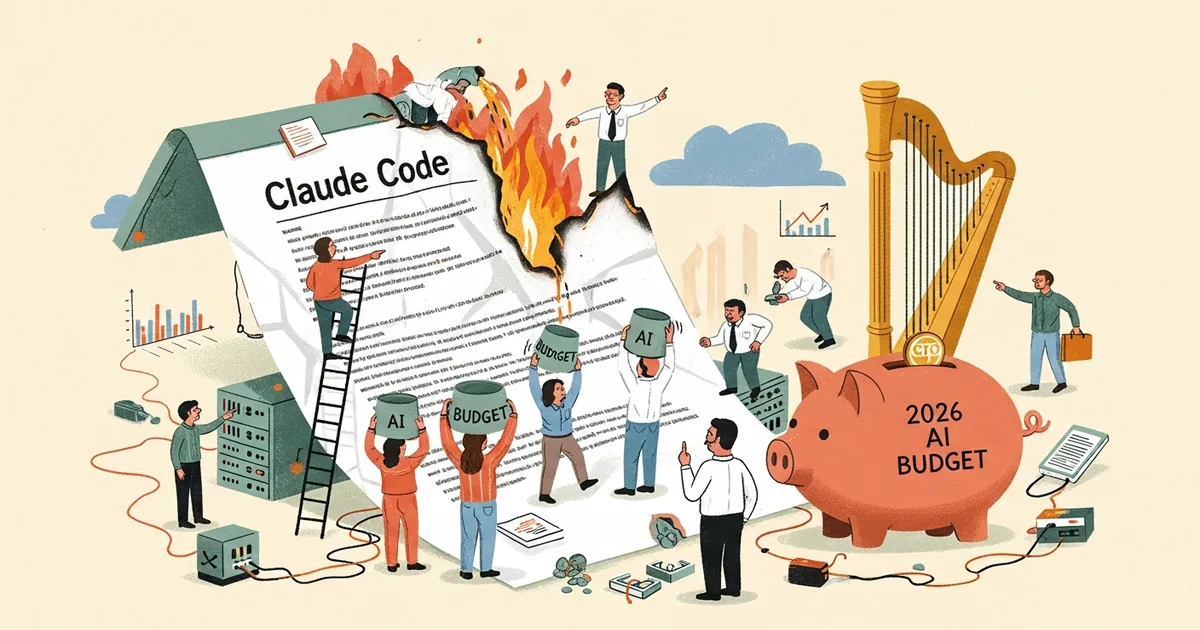
- Uber’s CTO disclosed that the company exhausted its entire 2026 AI budget in four months, with most spending going to Claude Code and Cursor.
- Engineer usage of Claude Code doubled between the December 2025 rollout and February 2026; by April the bill consumed the full annual allocation.
- Per-engineer monthly API costs reached $500 to $2,000, against Uber’s $3.4 billion annual R&D budget.
- 95% of Uber engineers now use AI tools monthly, with Claude Code dominating engineering workflows while Cursor adoption has plateaued.
What Happened
Uber’s CTO disclosed that the company spent its entire 2026 AI budget on Claude Code and Cursor in roughly four months, according to a report that surfaced on Hacker News on May 1, 2026. The budget burn forced Uber leadership to revisit AI cost allocation, with the CTO saying the company is “back to the drawing board” on AI budgeting at scale.
Why It Matters
Anthropic’s Claude Code and Anysphere’s Cursor have moved from optional productivity tools to mission-critical infrastructure inside large engineering organizations during 2026. Uber’s case is the clearest public datapoint of the cost-impact dynamic: engineers find the tools too valuable to ration, and per-seat API consumption scales faster than corporate procurement is built to handle. The signal extends well beyond ride-hailing — every engineering organization with a similar adoption curve faces the same forecasting failure.
Technical Details
Uber rolled out Claude Code access to its engineering team in December 2025. By February 2026, engineer usage had doubled as developers discovered Claude Code’s multi-step capabilities. By April 2026, the cumulative bill had consumed the entire annual AI budget. Per-engineer monthly API costs landed in a $500 to $2,000 range, the CTO disclosed.
Claude Code now dominates Uber’s engineering AI workflows, while Cursor adoption has plateaued. The reported figure that 95% of Uber engineers use AI tools monthly anchors the scale: against Uber’s $3.4 billion annual R&D budget, AI coding tools became a meaningful and unforecast line item in a single quarter. The disclosure does not include a final 2026 spend projection.
Who’s Affected
The most direct beneficiaries are Anthropic and Anysphere, whose flagship coding products are validated as infrastructure-tier rather than discretionary. Engineering CFOs and procurement leads at every comparable-scale company face the question Uber’s CTO is now answering: how to budget for tools whose marginal value to each engineer keeps individual usage growing faster than seat counts. Cursor’s plateau against Claude Code’s continued growth is also a concrete competitive datapoint — the two products have been treated as direct competitors but Uber’s data suggests they may be converging on different roles in real workflows.
What’s Next
Uber’s stated next step is to redesign its AI budgeting model. Likely outcomes include negotiated enterprise pricing with Anthropic and Anysphere, internal usage governance (rate limits, model-routing policies), and possibly self-hosted alternatives for high-volume routine tasks. Anthropic’s reported Q2 enterprise revenue numbers will be one of the clearest external indicators of whether other large engineering organizations are following Uber’s curve.