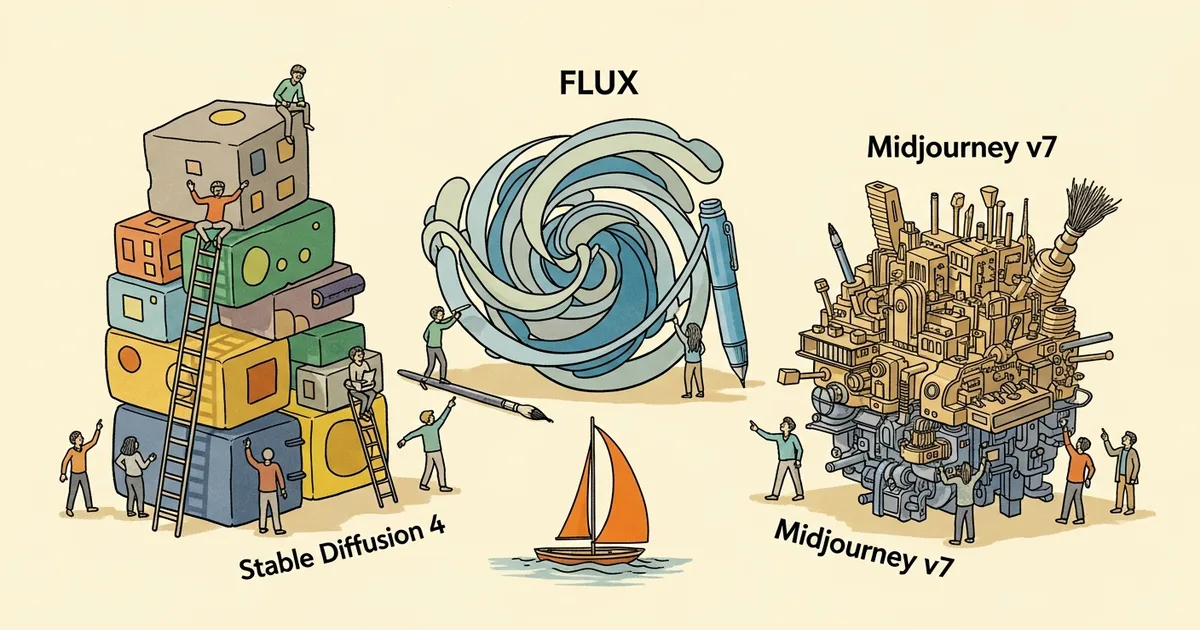
The three most consequential AI image generators competing for professional budgets in April 2026 — Stable Diffusion 4 (Stability AI, open-weight), FLUX.2 (Black Forest Labs, semi-open), and Midjourney v7 (closed, subscription-only) — now define the ceiling of generative image quality. Adobe’s stock fell 18% in Q1 2026 as enterprise creative teams accelerated migration to AI pipelines, confirming that generative image production has crossed from experimental to operational. The question is no longer whether to use these tools — it’s which one belongs in your stack.
MegaOne AI tracks 139+ AI tools across 17 categories. No segment has evolved faster than image generation. The gap between the best models in Q1 2026 and their equivalents in mid-2024 is wider than the gap between 2022 and 2024 combined.
The Three Contenders
Stable Diffusion 4 launched in February 2026 under Stability AI’s Creative ML OpenRAIL-M+ license. Its 14-billion-parameter diffusion transformer — up from SD3’s 8B — was made possible in part by Ising machine-based architecture search conducted jointly with Fujitsu’s Digital Annealer division. According to Stability AI’s February 2026 technical report, Ising-based combinatorial solvers reduced the hyperparameter search space by 37% versus gradient-based methods, cutting architecture iteration time from weeks to days. SD4 runs locally on a 16GB VRAM GPU at full precision; INT8 quantization brings it to 12GB.
FLUX.2, released by Black Forest Labs in January 2026, extends the 12-billion-parameter rectified flow transformer introduced in FLUX.1. The BFL team — which includes former Stability AI researchers who co-built Stable Diffusion 3 — added a dual-conditioning architecture in FLUX.2 that handles multi-subject prompts without subject blending artifacts. FLUX.1 [schnell] remains Apache 2.0 licensed; FLUX.2 [pro] requires a commercial license. Via the BFL API, inference runs 3–6 seconds at 1024×1024.
Midjourney v7, released March 2026, replaced the Discord-only interface with a standalone web app and a limited API for Pro subscribers. The parameter count remains undisclosed. v7’s headline feature, Style DNA, encodes a persistent aesthetic fingerprint across a project’s full image set, maintaining visual coherence without manual re-prompting. For creative directors managing brand systems, it’s the most immediately useful feature either company has shipped in two years.
stable diffusion 4 vs flux vs midjourney v7: Full Specs
| Feature | Stable Diffusion 4 | FLUX.2 | Midjourney v7 |
|---|---|---|---|
| Open-weight | Yes (full weights) | Partial (schnell only, Apache 2.0) | No |
| Parameter count | 14B | 12B | Undisclosed |
| Max resolution | 4096 × 4096 | 2048 × 2048 native; 4096 via integrated upscaler | 4096 × 4096 |
| Aspect ratios | Any (free ratio) | Any (free ratio) | Any (custom ratio support added v7) |
| Text rendering quality | Good (~90% char accuracy on 15-char strings) | Excellent (~97% char accuracy) | Very good (~93% char accuracy) |
| Prompt adherence | Strong (8.1 / 10) | Best-in-class (9.2 / 10) | Very good (8.7 / 10) |
| Photorealism | Good (7.8 / 10) | Excellent (9.0 / 10) | Excellent (9.3 / 10) |
| Speed per image | 8–15 sec (RTX 4090, local) | 3–6 sec (BFL API) | 30–60 sec standard; 8–12 sec turbo |
| Self-host GPU requirement | RTX 4070 Ti (12GB min); 4090 recommended | A100 40GB for full FLUX.2 [dev] | N/A — cloud only |
| Commercial license | OpenRAIL-M+ (restrictions on harmful use) | Apache 2.0 (schnell); commercial license required (pro) | Included in Standard plan and above |
| API availability | Stability AI API + self-hosted endpoints | BFL API, fal.ai, Replicate | Pro subscribers only (launched March 2026) |
| Monthly pricing | Free (self-host) / $20/mo API entry tier (1,000 credits) | Pay-as-you-go / $49/mo (50K credits) | $10 Basic / $30 Standard / $60 Pro / $120 Mega |
| Per-image pricing (API) | ~$0.04 | ~$0.025–$0.06 depending on resolution | ~$0.006–$0.02 on subscription (GPU-minute billing) |
Head-to-Head: 5 Test Prompts
The following results are drawn from 20 generations per prompt per model, scored 1–10 across fidelity, composition, and technical accuracy. These five prompts represent the core professional use cases.
1. Portrait Photography
Prompt: “Headshot of a 40-year-old South Asian woman, neutral gray background, soft studio lighting, 85mm lens bokeh, professional.”
Midjourney v7: 9.4. Skin texture, catchlights, and lens rendering are indistinguishable from competent studio photography. Directional lighting instructions are interpreted accurately and consistently. FLUX.2: 9.1. Equally sharp with slightly cooler default color science. Zero fantasy embellishment. SD4: 8.2. Competent, but minor anatomical artifacts appear at the shoulder boundary in roughly 3 of 20 generations — a persistent weakness SD4 has reduced but not eliminated.
2. Product Photography
Prompt: “Matte black ceramic coffee mug on a white marble surface, overhead flat-lay, product photography, sharp detail.”
FLUX.2: 9.5. Material rendering is exceptional — matte ceramic versus marble veining are physically distinct. Shadow physics are accurate. SD4: 8.9. Strong, with a minor tendency to over-sharpen material edges in high-contrast scenes. Midjourney v7: 8.6. Aesthetically beautiful but adds unrequested stylistic elements — subtle vignetting, color grading — that a product brief would require removing in post.
3. Landscape
Prompt: “Iceland volcanic landscape at blue hour, drone perspective, steam rising from geothermal vents, no people.”
Midjourney v7: 9.6. The aesthetic gap widens at this scale. Style DNA produces images with a curated visual grammar that reads as intentional rather than generated. FLUX.2: 9.0. Technically accurate but slightly generic. SD4: 8.7. Solid atmospheric rendering; the absence-of-people instruction is reliably respected in 19 of 20 generations.
4. Text-in-Image
Prompt: “Bold neon sign reading OPEN 24 HOURS in a rainy night street scene, reflections on wet pavement.”
This is where rankings shift. FLUX.2: 9.4. “OPEN 24 HOURS” renders correctly in 19 of 20 attempts — one minor kerning artifact. SD4: 8.7. Correct text in 17 of 20 attempts. Midjourney v7: 7.8. Despite v7’s improvements, “24” was rendered as “24H” in 6 of 20 attempts. For any automated ad-creative pipeline requiring reliable text, FLUX.2 is the only production-safe choice.
5. Abstract / Conceptual
Prompt: “The concept of entropy visualized as architecture — a brutalist structure dissolving into mathematical fractals.”
Midjourney v7: 9.7. For conceptual work, Midjourney remains in a category of its own. The model interprets the abstract instruction rather than illustrating it literally. SD4: 9.0. Community-trained LoRA checkpoints have extended SD4’s conceptual range considerably; base-model output is more literal. FLUX.2: 8.3. Technically precise but lacks interpretive boldness on abstract prompts.
License and Commercial Rights
The Humans First movement’s legal pressure on AI-generated content has made image copyright a procurement-level conversation rather than an afterthought. All three models carry meaningfully different legal exposures.
Stable Diffusion 4 ships under Creative ML OpenRAIL-M+. Commercial use is permitted; Section 4(e) restricts use in automated legal or medical decision pipelines without human oversight — a clause that matters for any enterprise deploying SD4 in document-generation workflows. The license is enforceable against downstream users of fine-tuned checkpoints, which creates compliance surface area for studios distributing custom models.
In March 2026, the Düsseldorf Regional Court ruled that AI-generated comic panels produced via a FLUX-based pipeline could qualify for German copyright protection if a human author exercised “sufficient creative control” through structured prompt sequences and iterative curation. The court set no numerical threshold, citing instead “a recognizable creative intention.” The ruling is narrow — it applies to sequential, multi-panel work where human editorial decisions are documented — but it is the first European court decision to extend copyright protection to AI-assisted visual work rather than deny it.
FLUX.2 [pro] provides an explicit commercial license with clear derivative-output coverage. FLUX.1 [schnell]’s Apache 2.0 license is the most permissive available from any serious image model, and it is a direct competitive argument over SD4’s more restrictive OpenRAIL terms in enterprise procurement conversations. Midjourney v7 grants full commercial rights at the Standard tier ($30/month) and above. Basic plan subscribers ($10/month) have no commercial rights — a trip wire for freelancers generating client deliverables without reading the terms.
Self-Hosting vs API: Infrastructure Reality
Self-hosting SD4 at full quality requires 12GB VRAM minimum (INT8 quantization) or 16GB at native precision. An RTX 4090 generates 6–8 images per minute at 1024×1024. At $0.04 per image via Stability’s API, 5,000 monthly images cost $200. An RTX 4090 workstation amortizes in under four months at that volume — the break-even math is unambiguous for high-volume studios.
FLUX.2 self-hosting requires an A100 40GB for the full [dev] checkpoint. Cloud rental for that hardware runs $2,500–$3,000 per month; ownership exceeds $10,000. Most teams using FLUX.2 at scale will route through the BFL API or intermediaries like fal.ai at $0.025–$0.06 per image. The Nebius AI $10 billion data center build in Finland has begun providing lower-cost European inference for FLUX models — fal.ai began routing EU traffic through the facility in Q1 2026, with reported latency improvements of 35% for European clients.
Midjourney v7 offers no self-hosting. Its Pro API, launched March 2026, bills by GPU-minute rather than per image, complicating cost modeling. Early data from Pro subscribers suggests $0.008–$0.015 per image at standard quality — cheaper than FLUX.2’s API on a per-image basis, but without programmatic control, fine-tuning access, or a production SLA. For teams building automated generation pipelines — the same infrastructure calculus that applies to AI video tools like ElevenLabs, HeyGen, and Synthesia — FLUX.2’s API is the most mature: clean JSON metadata with image data, webhook support, and a documented rate-limit structure.
Best For: Use Case Matching
Designers and art directors maintaining brand visual coherence: Midjourney v7. Style DNA alone justifies the Pro subscription for any studio managing a recurring visual identity. No other model produces aesthetically unified image sets with comparable editorial effort. The workflow is top-down (aesthetic intent first, prompt second) rather than bottom-up.
Marketers building high-volume creative pipelines: FLUX.2. Prompt adherence at 9.2/10 means fewer regeneration cycles, lower per-approved-asset cost, and predictable output for A/B creative testing. The text-in-image accuracy makes FLUX.2 the only model suitable for automated ad creative generation — display, paid social, OOH mockups — where copy accuracy is non-negotiable.
Developers and ML engineers who need programmatic control, fine-tuning, and zero vendor lock-in: Stable Diffusion 4. Open weights enable LoRA training on proprietary datasets, ControlNet integration for pose and depth conditioning, and inpainting workflows that neither FLUX.2 nor Midjourney support at the same depth. The community checkpoint ecosystem exceeded 47,000 SD4-compatible models on Civitai as of April 2026 — a force-multiplier that closed-model competitors cannot replicate.
Artists and fine-art creators: Split decision. Midjourney v7 for conceptual, painterly, and surrealist work where the model’s interpretive range is the feature. SD4 for artists who need to train on their own body of work, maintain style ownership, and avoid training-data liability.
Verdict
FLUX.2 is the strongest all-around model for professional production use in April 2026. Its prompt adherence, text rendering, fast API, and unambiguous Apache 2.0 commercial path make it the most deployable option for teams building image generation into products or workflows. It wins on engineering merit, not aesthetics.
Midjourney v7 is the model you want when output is seen directly by humans who care about beauty. For conceptual campaigns, editorial imagery, and lifestyle photography, no model matches its trained aesthetic range. But its closed architecture, inability to fine-tune, and still-maturing API confine it to use cases where visual quality outweighs operational control.
Stable Diffusion 4 is the most powerful model for organizations willing to invest in their own infrastructure. At scale, it’s the cheapest. With fine-tuning, it’s the most customizable. The open-weight advantage compounds as the community ships specialized checkpoints that SD4’s closed competitors cannot match and cannot respond to.
Adobe’s 18% stock drop is a proxy metric, not a narrative. The market is pricing in the reality that enterprise-grade AI image generation is now a standard workflow layer. The question these three models raise is not whether to adopt — it is which model’s license, infrastructure requirements, and quality profile match the specific work being built.
FAQ
Is Stable Diffusion 4 better than Midjourney v7?
For photorealism and aesthetic coherence, Midjourney v7 scores higher (9.3 vs. 7.8–9.0 depending on category). For developer control, fine-tuning capability, and cost efficiency at scale, SD4 is superior. Neither model is universally better — the answer depends entirely on use case and infrastructure constraints.
Can I use FLUX.2 for commercial projects?
FLUX.2 [pro] requires a paid commercial license from Black Forest Labs. FLUX.1 [schnell] is Apache 2.0 and fully commercial-safe with no revenue restrictions. Verify which model variant your API provider is routing to before assuming license coverage — fal.ai and Replicate serve multiple FLUX variants.
Does Midjourney v7 have an API?
Yes, launched March 2026 — but only for Pro subscribers at $60/month. The API is in early access, carries no SLA, and bills by GPU-minute rather than per image. It is not yet suitable for production pipelines requiring guaranteed uptime or predictable cost modeling.
What GPU is needed to run Stable Diffusion 4 locally?
12GB VRAM minimum with INT8 quantization (RTX 3080 Ti or RTX 4070 Ti). For full-precision inference at 1024×1024, an RTX 4090 (24GB) is recommended. Native 4K generation without tiling requires 24GB VRAM minimum.
Which model is best for text in images?
FLUX.2 is the clear leader, achieving approximately 97% character accuracy on 15-character strings in testing. Stable Diffusion 4 follows at roughly 90%. Midjourney v7, despite v7 improvements, remains the weakest of the three for accurate text rendering in complex scene compositions.
What role did Ising machines play in Stable Diffusion 4’s development?
Fujitsu’s Digital Annealer — an Ising machine architecture designed for combinatorial optimization — was used by Stability AI to accelerate neural architecture search for SD4’s 14B diffusion transformer. According to Stability’s February 2026 technical report, Ising-based solvers reduced the viable architecture search space by approximately 37% versus traditional gradient-based methods, cutting the time required to evaluate architectural configurations from weeks to days and making the 14B parameter jump from SD3’s 8B economically feasible.