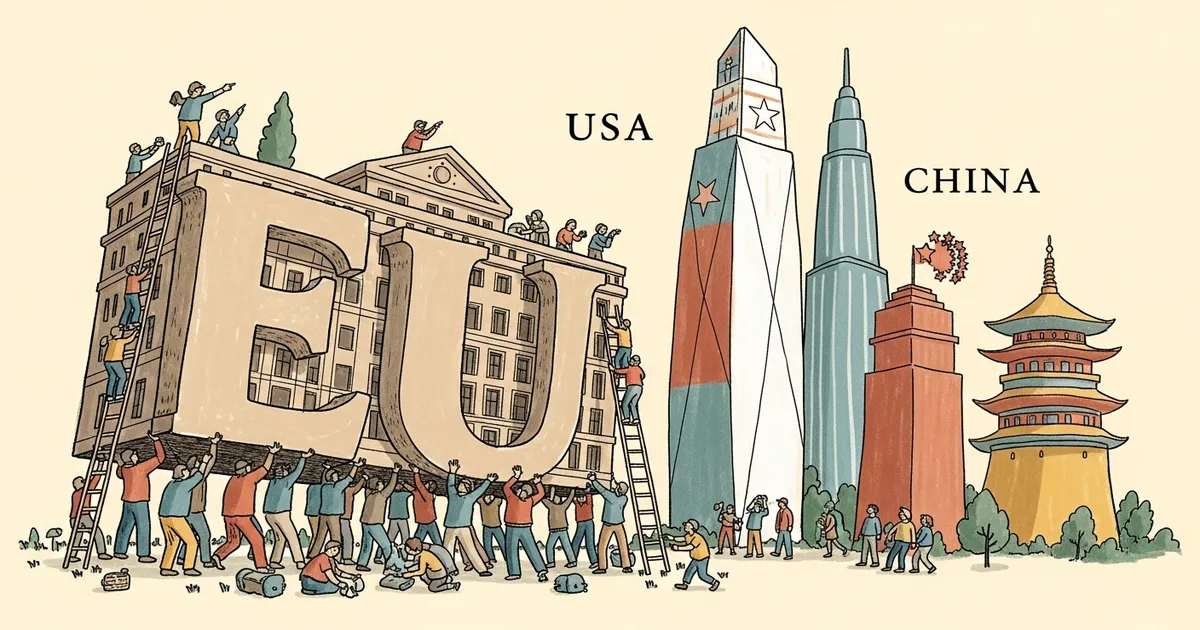
- Siemens AG CEO Roland Busch said the company would prioritize AI investment in the United States and China if the EU does not adapt its AI regulatory framework, according to Bloomberg.
- The warning arrives as the EU AI Act’s high-risk system compliance requirements approach their full implementation date of August 2, 2026.
- Industrial AI systems of the type Siemens deploys in manufacturing, energy, and infrastructure frequently fall under Annex III’s high-risk classification, triggering mandatory conformity assessments and oversight obligations.
- Violations of high-risk AI provisions under the Act carry penalties of up to €15 million or 3% of global annual turnover.
What Happened
Siemens AG Chief Executive Officer Roland Busch warned on April 20, 2026, that the company would redirect artificial intelligence investment toward the United States and China if the European Union fails to modify its AI regulatory framework, according to Bloomberg. Bloomberg reported that Busch stated Siemens would prioritize AI spending in regions with less restrictive environments if EU rules remain in their current form.
The statement is among the most explicit public ultimatums from a major European industrial manufacturer linking capital allocation decisions directly to EU AI governance requirements.
Why It Matters
The EU AI Act entered into force on August 1, 2024, establishing the world’s first comprehensive binding legal framework for AI, applying a tiered risk classification to all AI systems deployed in the bloc. Siemens’ warning arrives roughly four months before the Act’s most demanding provisions — those governing high-risk AI systems — take full effect on August 2, 2026.
Several US technology companies cited EU regulatory complexity in 2024 when scaling back European operations or delaying product launches. Busch’s statement indicates the same dynamic is now reaching large European industrial firms with substantial domestic operations.
Technical Details
The EU AI Act classifies AI systems into four tiers — prohibited, high-risk, limited-risk, and minimal-risk — with high-risk systems subject to mandatory conformity assessments, technical documentation, logging requirements, and human oversight obligations under Articles 8 through 15 of the Act. Annex III of the Act lists the categories that automatically trigger the high-risk designation, including AI used in critical infrastructure, safety components in products covered by existing EU product safety law, and systems managing road traffic and the supply of water, gas, heating, and electricity.
Siemens’ industrial AI portfolio — including its Siemens Xcelerator digital business platform, AI-integrated building management systems, and predictive maintenance tools — spans multiple Annex III categories. High-risk AI providers must register systems in the EU AI database and demonstrate conformity before deployment. Penalties for high-risk violations reach up to €15 million or 3% of global annual turnover; violations involving prohibited AI practices carry fines of up to €35 million or 7% of global annual turnover.
Siemens reported revenues of approximately €77.8 billion in fiscal year 2024, meaning material compliance failures could expose the company to nine-figure penalties under the Act’s upper thresholds.
Who’s Affected
European industrial manufacturers deploying AI in regulated sectors — manufacturing automation, energy management, critical infrastructure, and transport — face the highest compliance burden under the Act’s current structure. Siemens competes directly with ABB, Honeywell, and Rockwell Automation in industrial AI; a shift of Siemens R&D spending toward US or Chinese development centers would affect the broader supplier and software vendor network built around its European operations.
Smaller European AI developers contributing components to integrated Siemens workflows would also inherit provider-level obligations under the Act if their systems meet the high-risk threshold, compounding the compliance cost for the wider industrial AI supply chain.
What’s Next
The European Commission’s 2025 Competitiveness Compass, which drew on former ECB President Mario Draghi’s 2024 report on European competitiveness, acknowledged regulatory burden as a constraint on European AI development and committed to reviewing implementation details for industrial applications. Formal consultation processes on the high-risk provisions remain open ahead of the August 2026 deadline.
Siemens and other industrial technology companies are expected to engage with EU institutions through bodies including Digital Europe and CECIMO in the months before the high-risk provisions take effect. Whether the Commission will amend Annex III classifications or conformity assessment procedures before the August deadline has not been confirmed.