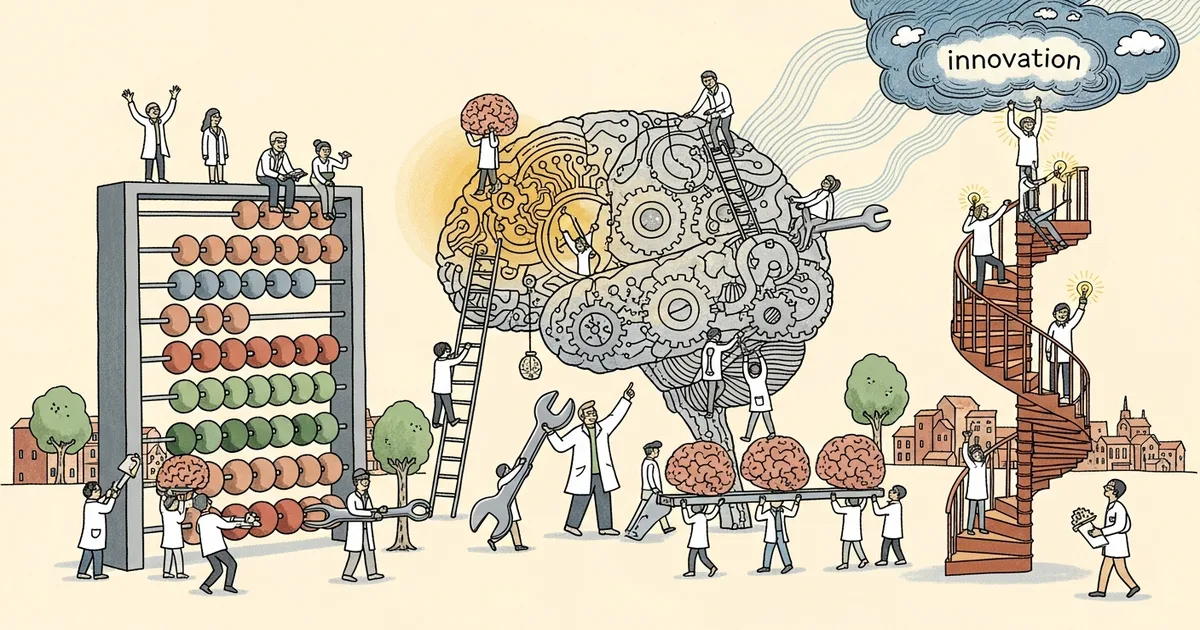
- Sakana AI launched the “Sakana AI RSI Lab,” focused on recursive self-improvement — AI that iteratively redesigns itself.
- The bet: evolutionary optimization, not ever-larger models, is the route past the compute arms race.
- The lab builds on prior work including the Darwin Gödel Machine and The AI Scientist, whose research was published in Nature in March 2026.
- Sakana laid out a four-phase roadmap toward AI agents that write code for their own architectures.
What Happened
Japanese startup Sakana AI has founded a dedicated research group, the Sakana AI RSI Lab, focused on recursive self-improvement (RSI) — the idea that AI systems can iteratively redesign and improve themselves in a compounding cycle, according to a report by The Decoder published June 6, 2026.
The company frames RSI as a path beyond the brute-force scaling that defines frontier-lab competition. Rather than training ever-larger models on massive compute, Sakana focuses on evolutionary optimization it argues is more efficient and more widely accessible.
Why It Matters
The thesis is a direct challenge to the prevailing strategy that treats scale as the primary lever — the same strategy underwriting the sector’s enormous capital spending, including the $155 billion in AI-infrastructure bonds issued in 2026. If self-improvement can substitute for raw compute, the economics of frontier AI shift.
Sakana, founded in 2023, has built its identity around evolutionary, adaptive systems rather than the dense-scaling approach favored by larger US labs.
Technical Details
Sakana points to several prior milestones as evidence the approach is already testable. LLM-Squared has language models design better training methods for other language models. The Darwin Gödel Machine generates, tests, and iterates on variants of its own codebase. ShinkaEvolve and ALE-Agent cover evolutionary program optimization and trial-and-error strategy discovery.
The most cited project is The AI Scientist, which automates parts of scientific research. A later version produced a paper that passed peer review, and the underlying research was published in Nature in March 2026.
Who’s Affected
The work targets frontier labs whose moats depend on compute scale, including the players whose model races we track across Claude Opus 4.8 and rival releases. If RSI matures, smaller, capital-constrained teams gain a credible alternative path.
Sakana presents these projects as evidence that recursive self-improvement is being tested in controlled research environments rather than remaining purely theoretical.
What’s Next
Sakana’s blog post outlines a four-phase transition from human-led optimization to self-improving systems, beginning with models built for open-ended agent tasks rather than chat. The company says it has already shipped early steps through The AI Scientist.
The open limitation is generalization: the milestones cited are controlled research demonstrations, not production systems, and Sakana has not published independent benchmarks showing RSI matching scaled models on broad tasks.