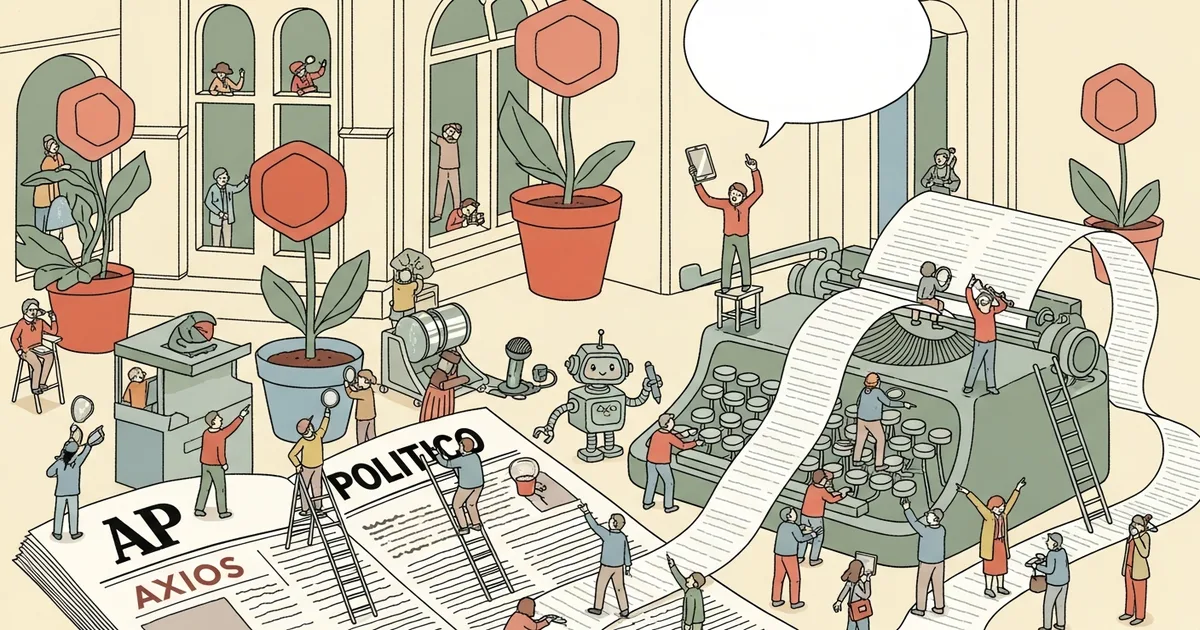
- OpenAI published a roundup of newsroom deployments in publishers’ own words, covering AP, POLITICO, Axios, The Philadelphia Inquirer, Axel Springer, Le Monde, PRISA Media, and The Daily Beast.
- The Associated Press uses the technology for image and video verification via upload tracing, geolocation, and chronolocation, and to turn thousands of Supreme Court filings into structured, searchable data.
- The Philadelphia Inquirer’s “Scribe” summarizes public-meeting transcripts across dozens of municipalities and ranks developments using a newsworthiness framework its own reporters built.
- OpenAI renewed support for the American Journalism Project, whose portfolio spans dozens of publications across 38 states.
What Happened
OpenAI published an account of how news organizations are using its technology on July 22, 2026, compiled from descriptions supplied by the publishers themselves. The post covers editorial, product, and business-side deployments rather than a single flagship use case.
Alongside the examples, OpenAI said it renewed support for the American Journalism Project, which backs dozens of local publications across 38 states, and continues to fund the Lenfest Institute for Journalism and a six-month WAN-IFRA programme on AI-native product development. The company writes that “while AI is an important tool, people remain at the very center of this work — from frontline journalism, to editorial direction, to critical business decisions.”
Why It Matters
The publishing industry’s relationship with OpenAI has been defined by licensing negotiations and litigation; this post documents the operational layer that has grown underneath those deals. It is also a marketing document — the examples are self-reported by partners, with no independent measurement of accuracy, error rates, or cost savings attached to any of them.
The pattern worth noting is where the tools sit. Almost every example is upstream of publication — document processing, verification, monitoring, translation, internal search — rather than automated article generation. That placement is the industry’s current answer to the question of what can be delegated without putting editorial judgment at risk.
Technical Details
The Associated Press describes the widest deployment: scanning overnight news and podcasts for reportable developments, supporting image and video verification through upload tracing, geolocation and chronolocation, converting thousands of Supreme Court filings into structured searchable information, surfacing potential stories in government datasets, building audience metrics reports, and converting articles into broadcast scripts.
Axios built a set of custom GPTs, including a “FOIA Refiner GPT” that helps reporters draft open-records requests specific enough to avoid denial or delay, an “O Caption! My Caption!” GPT for image captions, and an “Axiomizer” that reviews copy against the outlet’s Smart Brevity style. The Philadelphia Inquirer’s Scribe turns public-meeting transcripts from dozens of municipalities and school districts into categorized summaries, then scores and ranks individual developments against a newsworthiness framework created by Inquirer reporters and editors.
At Axel Springer, Business Insider uses the technology for one-tap listening and audience-comment analysis, while WELT applies it to niche newsletters and an additional CMS-level fact-checking layer. Le Monde, which launched Le Monde In English in 2022, encoded its translation style book into the models in 2025 to speed publication. PRISA Media runs a trend tracker built with Codex, country-specific World Cup audio briefings at Diario AS, and “Vera,” a conversational assistant answering EL PAÍS subscriber questions. The Daily Beast’s “Data Scouts” agents run mostly inside Slack and recommend next steps rather than only summarizing data.
Who’s Affected
Local newsrooms are the stated target of the funding side: the American Journalism Project portfolio spans 38 states, where staffing constraints make meeting-coverage tools like Scribe the highest-leverage application. Larger publishers named here — AP, Axel Springer, PRISA, Le Monde — already hold commercial arrangements with OpenAI, so their deployments run on licensed footing.
Publishers without such agreements are the group this post does not address, and the unresolved disputes over training data and attribution sit entirely outside its scope.
Inside the named organizations, the affected roles are not primarily reporters. Verification desks, data teams, translation staff, and audience analytics functions carry most of these deployments — the Daily Beast’s agents run in Slack for business teams, PRISA’s tooling covers content vectorization and image rights attribution, and Axel Springer’s newsletter production sits on the product side. That is where headcount effects, if any, would show up first.
What’s Next
None of the examples include published accuracy benchmarks, correction rates, or cost figures, which is the gap between this being a catalogue and being evidence. The verification workflows at AP and the fact-checking layer at WELT are the two deployments where an error rate would be most measurable — and most consequential — if either organization chooses to publish one.