Key Takeaways
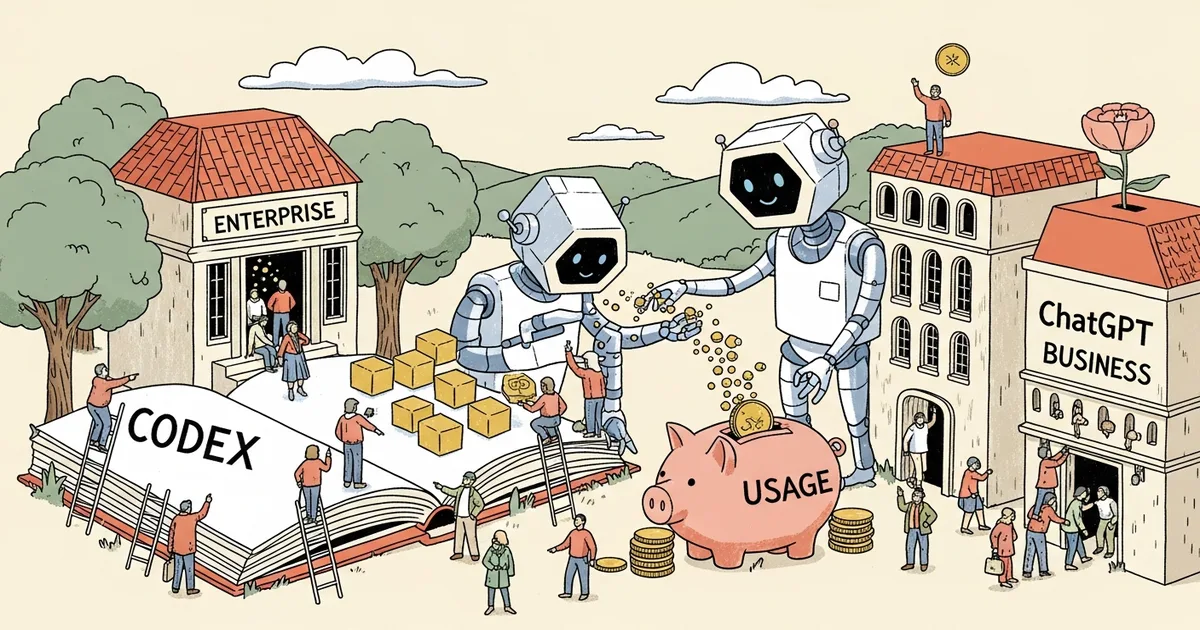
- OpenAI is switching to usage-based pricing for Codex in ChatGPT Business and Enterprise plans, eliminating the need for upfront per-seat licenses.
- Eligible Business customers can claim up to $500 in promotional credit per workspace during a limited-time promotion.
- Over two million developers use Codex weekly, with Business and Enterprise usage growing sixfold since January 2026.
- The move directly targets GitHub Copilot and Cursor, which still charge per-seat fees.
What Happened
OpenAI announced on April 3, 2026, that it is switching to usage-based pricing for Codex in its ChatGPT Business and Enterprise plans. Workspace admins can now enable free Codex access across their entire organization, with charges based solely on actual usage rather than per-seat licenses, according to The Decoder.
As part of a limited-time promotion, eligible Business customers can claim up to $500 in promotional credit per workspace. The pricing change is designed to lower the barrier for enterprise adoption by removing the upfront commitment that per-seat licensing requires.
Why It Matters
OpenAI’s pricing shift is a direct competitive move against GitHub Copilot and Cursor, both of which charge per-seat fees. Per-seat pricing creates friction for enterprise adoption because organizations must commit to paying for every developer before knowing whether the tool will see widespread use. Usage-based pricing removes that friction entirely.
“This model gives organizations a simpler way to support that motion inside a managed workspace,” OpenAI stated. The company is betting that once developers try Codex without cost barriers, sustained usage will follow. Coding tools typically spread organically from individual developers to full teams, and removing licensing friction accelerates that adoption curve.
The timing is strategic. Anthropic’s Claude Code is gaining market share in the AI coding space, and the industry-wide conversation around usage limits and pricing models has never been louder. By offering a pay-for-what-you-use model with $500 in free credits, OpenAI is making the lowest-risk entry point available in the market.
Technical Details
Under the new model, workspace admins enable Codex access at the organizational level. Individual developers do not need separate licenses or approval processes. Usage is tracked and billed per workspace based on actual consumption, though OpenAI has not published specific per-token or per-request rates for the enterprise tier.
The $500 promotional credit applies per workspace, not per user, which means larger organizations will consume the credit faster. The promotion is time-limited, though OpenAI has not announced an end date.
OpenAI reports that over two million developers use Codex on a weekly basis as of April 2026. Business and Enterprise usage has grown sixfold since January 2026, suggesting strong organic adoption even before the pricing change. The usage-based model is designed to accelerate this growth trajectory by making it cost-free for organizations to experiment.
Who’s Affected
Enterprise IT administrators and engineering leaders benefit most from the pricing change. They can now roll out Codex across their organizations without budget approval for per-seat licenses, which often requires justification and delays. The promotional credit further reduces the risk of experimentation.
GitHub Copilot faces the most direct competitive pressure. Copilot’s per-seat pricing of $19 per month for individual users and $39 per month for business users becomes harder to justify when OpenAI offers a try-before-you-pay alternative. Cursor, which charges $20 per month for its Pro tier, faces similar pressure.
Anthropic’s Claude Code competes in the same space but operates on a different model with subscription-based access. The contrast between OpenAI’s usage-based approach and Anthropic’s subscription model, which has faced recent criticism over unpredictable usage limits, gives OpenAI a positioning advantage for cost-conscious enterprises.
What’s Next
OpenAI will likely use the data from this pricing experiment to refine its enterprise AI coding strategy. If usage-based pricing drives the adoption growth the company expects, this model could become permanent and expand to other OpenAI products in ChatGPT Business and Enterprise plans.
The competitive response from GitHub, Cursor, and Anthropic will shape the market. Per-seat pricing is simpler for budgeting but creates adoption barriers. Usage-based pricing aligns costs with value but introduces unpredictability. The AI coding tool market is converging on a pricing model that balances these tradeoffs, and OpenAI’s move pushes the industry closer to usage-based as the default.