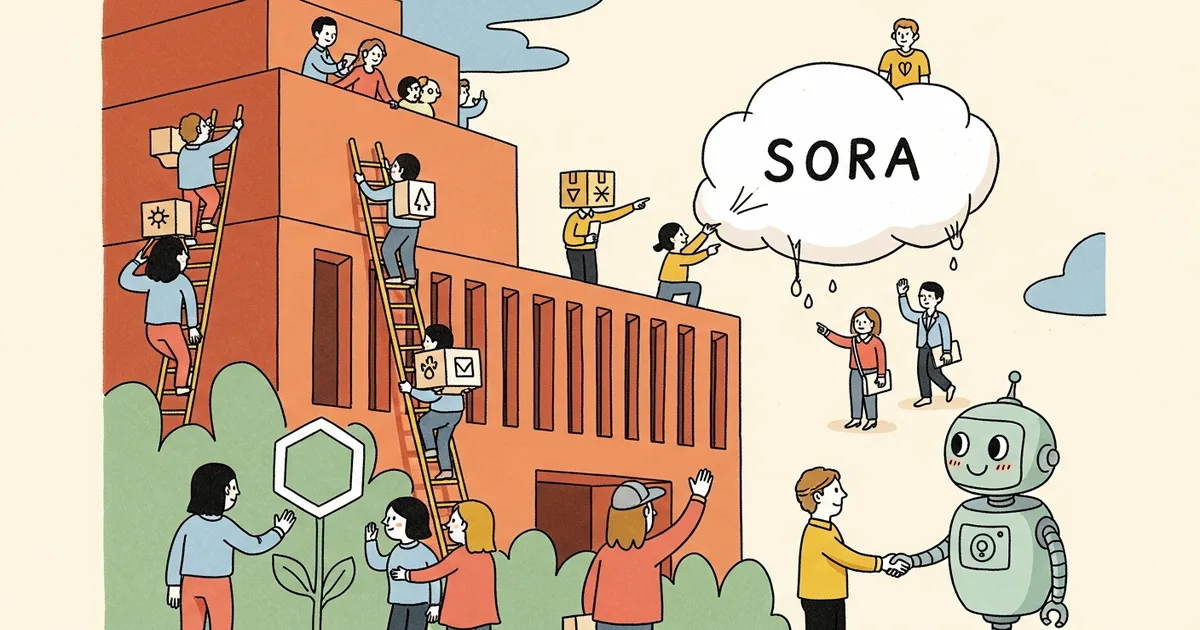
- Kevin Weil, who led OpenAI for Science, and Bill Peebles, the principal researcher behind Sora, both announced their departures from OpenAI on April 17, 2026.
- Sora was shut down in March 2026 after incurring an estimated $1 million per day in compute costs, according to TechCrunch.
- OpenAI for Science, formally launched in October 2025, is being dissolved into other internal research teams; its GPT-Rosalind model was released the day before Weil’s exit.
- Srinivas Narayanan, OpenAI’s chief technology officer of enterprise applications, is also departing, according to Wired.
What Happened
Kevin Weil and Bill Peebles announced their exits from OpenAI on April 17, 2026, according to TechCrunch. Weil had most recently served as head of OpenAI for Science, an internal research group dedicated to accelerating scientific discovery through AI. Peebles was the principal researcher behind Sora, OpenAI’s AI video generation tool, which was shut down in March 2026. Both programs have been wound down or redirected as the company consolidates around enterprise-facing products.
Why It Matters
The departures reflect a deliberate narrowing of OpenAI’s strategic priorities toward enterprise AI and a forthcoming consumer “superapp,” away from speculative research programs the company has internally described as “side quests.” Sora, despite significant public attention when it launched in early 2024, was shut down last month after generating estimated compute costs of $1 million per day. OpenAI for Science, formally announced in October 2025, lasted roughly six months before being absorbed into other teams.
Peebles argued in his announcement that Sora had a measurable effect on the broader industry, claiming the project ignited “a huge amount of investment in video across the industry.” That characterization is his own attribution.
Technical Details
Sora’s shutdown was driven by operational economics: the video generation model cost an estimated $1 million per day to run, according to TechCrunch. OpenAI for Science produced two distinct AI products — Prism, described as a platform to accelerate scientific discovery, and GPT-Rosalind, a model aimed at life sciences research and drug discovery. GPT-Rosalind was released on April 16, 2026, one day before Weil announced his departure.
The science initiative had a turbulent public record during its brief existence. Weil deleted a social media post claiming GPT-5 had solved 10 previously unsolved Erdős mathematical problems — a claim publicly disputed by the operator of erdosproblems.com, who stated the problems had not been resolved. The retracted post drew scrutiny to the group’s public communications about its research results.
Who’s Affected
Researchers within OpenAI for Science are being redistributed to other internal teams, per Weil’s announcement. Life sciences companies and academic institutions that had been tracking GPT-Rosalind’s development now face uncertainty about OpenAI’s commitment to science-focused model work. Enterprise customers are the stated priority, as OpenAI signals a reallocation of resources toward business-facing applications.
Srinivas Narayanan, OpenAI’s chief technology officer of enterprise applications, is also departing, adding to senior leadership attrition at the company. Wired reported that Narayanan announced his exit internally, citing a desire to spend more time with family.
What’s Next
OpenAI has not publicly detailed a roadmap for GPT-Rosalind or the Prism platform following the dissolution of OpenAI for Science. In his departure post, Weil wrote: “It’s been a mind-expanding two years, from Chief Product Officer to joining the research team and starting OpenAI for Science. Accelerating science will be one of the most stunningly positive outcomes of our push to AGI.” Peebles, in his own post, indicated a belief that exploratory research requires organizational distance from a company’s core product roadmap, writing: “Cultivating entropy is the only way for a research lab to thrive long-term.”