Key Takeaways
- MIT’s CSAIL tested 40+ AI models on 11,500 tasks from the U.S. Labor Department’s database, with workers evaluating over 17,000 AI-generated outputs.
- AI could complete roughly 50% of text-based tasks at a minimally acceptable level in 2024, rising to 65% by 2025.
- At current improvement rates, AI could handle 80% to 95% of text-based tasks by 2029 — but only at a “good enough” level, not high-quality or error-free.
- AI’s success rate varies widely by industry: 47% in legal work (lowest) to 73% in installation/maintenance/repair (highest).
What Happened
MIT’s Computer Science and Artificial Intelligence Laboratory (CSAIL) published new research in early April 2026 titled “Crashing Waves vs. Rising Tides,” finding that AI is advancing across the workforce more like a “rising tide” than a “crashing wave.” The study, reported by Axios on April 2, 2026, directly challenges predictions of sudden, sector-specific job wipeouts from AI automation.
The researchers took a fundamentally different approach from typical AI capability assessments. Instead of running benchmarks, they measured whether AI could produce work that real workers in those fields judged “good enough to use without edits” — a practical standard that reflects actual deployment requirements.
Why It Matters
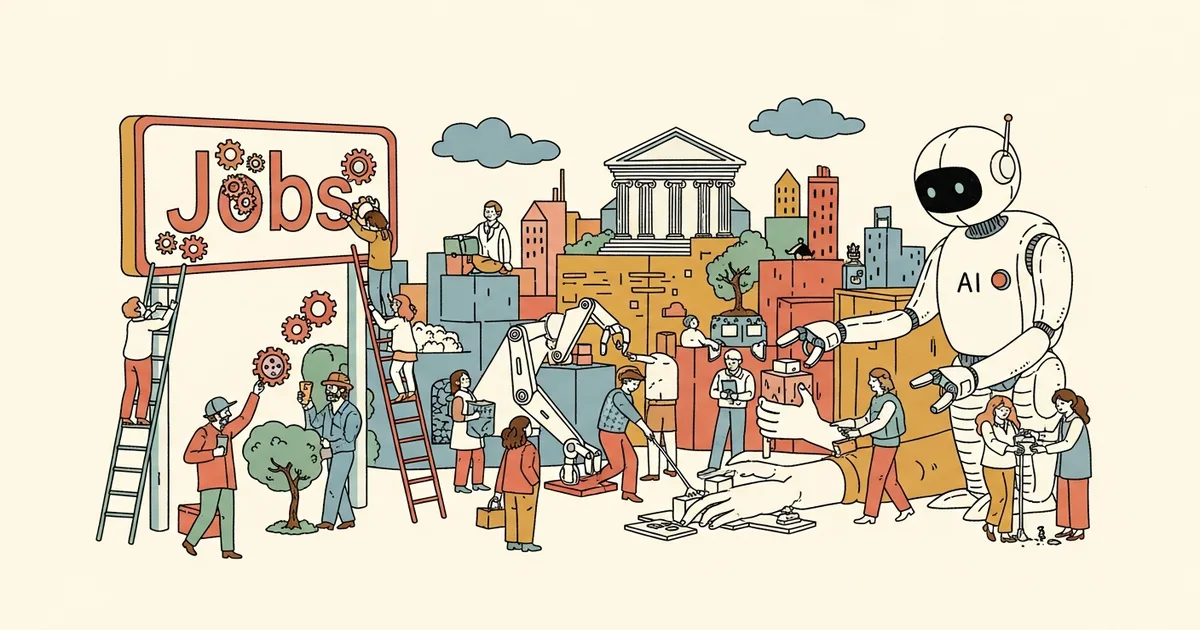
The study reframes the AI employment debate from “when do jobs disappear?” to “how quickly do tasks shift?” This distinction matters for policy, corporate planning, and worker retraining programs. A gradual transformation gives workers and organizations time to adapt, while a sudden wave would not.
The research pushes back directly on fear-based narratives from some AI industry leaders. As Axios reported, it “directly pushes back on fear-based narratives coming from some AI leaders,” including recent statements that have driven significant public anxiety about mass job displacement. The study provides data-driven counterweight to these claims.
Technical Details
The MIT researchers identified 11,500 tasks from the U.S. Labor Department’s occupational database and created multiple instances of each task. These were then run through more than 40 AI models using workplace-style prompts designed to simulate real working conditions rather than academic benchmarks.
Workers in the corresponding fields evaluated more than 17,000 AI-generated outputs, judging whether each was good enough to use without edits. This human evaluation methodology distinguishes the study from benchmark-only assessments that may not reflect real-world usability or professional standards.
The results showed steady but not explosive improvement: AI models completed roughly 50% of text-based tasks at a minimally acceptable level in 2024, rising to 65% by 2025. Extrapolating the current trajectory, AI could reach 80% to 95% by 2029, though the researchers emphasize this remains at a “good enough” level — not the error-free quality that professional work typically demands.
Industry-specific breakdown reveals significant variance:
- Legal work: 47% success rate — the lowest, due to requirements for precision, nuanced judgment, and strategic guidance
- Media, arts, and design: 55% — useful for drafting and ideation, lacking in higher-end creative execution
- Managerial tasks: 53% — adequate for planning, writing, and analysis, weak on coordination and decision-making
- Installation, maintenance, and repair: 73% — the highest, driven by AI’s ability to automate administrative aspects of manual work like troubleshooting guides and documentation
The “good enough” qualifier is critical context. High-quality, error-free work remains much harder to achieve, as demonstrated by real-world failures including Deloitte’s error-filled AI-generated report for a Canadian province and Klarna’s pullback from AI-led customer service operations.
Who’s Affected
The study’s findings affect workforce planning across every industry. Business leaders and HR departments can use the data to calibrate expectations: AI will change workflows, but the disruption will be measured in years of gradual adaptation rather than sudden displacement events.
Workers in legal, creative, and managerial roles have more time to adapt than some predictions suggested. Workers in administrative and documentation-heavy roles face faster task automation, though the study frames this as task shifting rather than wholesale job elimination.
In February 2026, AI was cited in 10% of job cuts, according to data from Challenger, Gray & Christmas. Some analysts have begun using the term “AI-washing” to describe companies blaming layoffs on AI to justify broader restructuring that would have occurred regardless of AI capabilities.
What’s Next
The gap between “good enough” and “reliable” remains the central challenge for real-world AI deployment in professional settings. The MIT study suggests organizations are several years away from AI achieving near-perfect success rates on most tasks, which means the human-in-the-loop model will persist as the dominant deployment pattern through at least 2029. Integration costs and the difficulty of redesigning workflows around AI tools continue to slow adoption, even in domains where the technology is technically capable of handling the work.