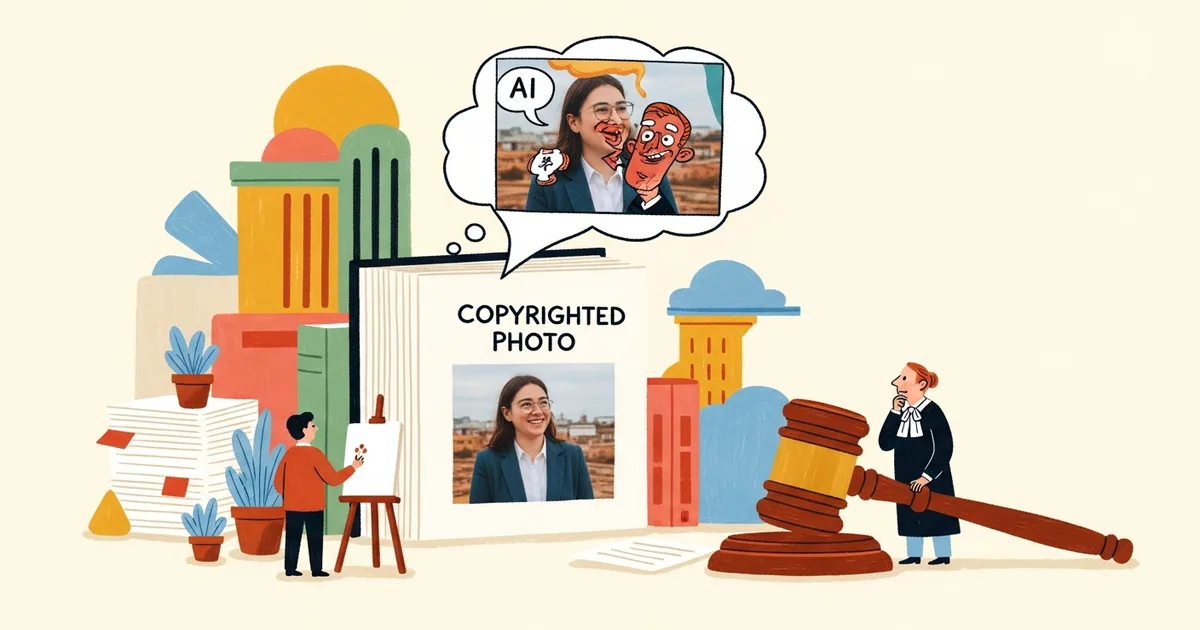
- Germany’s Higher Regional Court ruled on April 2, 2026 that an AI-generated comic derived from a copyrighted wildlife photograph did not infringe copyright because it reproduced only the unprotected motif, not the photographer’s specific creative choices.
- The court identified framing, camera angle, lighting, and focal sharpness as the protected elements — none of which appeared in the AI output.
- The ruling also held that AI-generated images do not qualify for independent copyright protection unless a human makes recognizably creative decisions beyond selecting AI suggestions or entering generic prompts.
- The decision aligns with earlier German court rulings and mirrors the U.S. Copyright Office’s position on AI authorship requirements.
What Happened
Germany’s Higher Regional Court issued a ruling on April 2, 2026 — case no. I-20 W 2/26 — finding that an AI-generated comic-style image derived from a copyrighted wildlife photograph did not constitute copyright infringement, according to The Decoder. The dispute arose between an animal photographer who sells underwater dog photographs commercially and a former business partner, who had fed one of her diving dog images into AI software and posted the resulting comic on a website.
The court denied the photographer’s appeal, concluding that the AI output did not reproduce the elements of the original photograph that copyright law actually protects.
Why It Matters
The ruling is one of the more substantive European appellate-level analyses of how traditional copyright doctrine applies when AI tools transform existing photographs into stylistically distinct outputs. Rather than applying a broad similarity test, the court adopted a framework grounded in a recent European Court of Justice ruling that asks whether an alleged infringing work reproduces the “recognizable specific creative elements” of the original — not merely its overall impression.
Relatively few AI-specific copyright disputes have reached appellate courts in Germany or elsewhere in the EU, making this decision a meaningful data point for how the region’s legal framework may treat AI-assisted derivative works going forward.
Technical Details
The court distinguished between two categories of content in the original photograph: protectable creative elements and unprotectable subject matter. The protectable elements were the photographer’s specific technical and compositional decisions — framing, camera angle, lighting conditions, and focal sharpness. The AI-generated comic, according to the court’s analysis, reproduced none of these.
What the comic did carry over was the motif: a dog photographed underwater in a diving pose. The court held that motifs and subjects are not themselves copyrightable, meaning their reappearance in an AI-generated output cannot by itself establish infringement.
On the separate question of whether the AI-generated comic could claim its own copyright, the court said no. As The Decoder reports, the court found that “picking an AI suggestion or typing generic prompts isn’t enough” to constitute the kind of recognizably creative human authorship that copyright protection requires — a position consistent with both earlier German rulings and the U.S. Copyright Office’s published guidance on AI-generated works.
Who’s Affected
Professional photographers and visual artists who license work commercially now have a clearer — though still narrow — understanding of what copyright protects: the specific technical decisions behind a shot, not the scene or subject captured. Businesses and developers using AI image-transformation tools in EU-adjacent markets can reference this ruling when assessing liability for features that stylistically rework third-party photographs, though the decision applies specifically to the facts of this case and is not binding across EU member states.
Platforms offering AI style-transfer or comic-generation features should note that the ruling’s favorable outcome for the business partner was tied to a finding that no protectable creative elements were reproduced — a factual determination that will vary case by case.
What’s Next
The decision does not resolve how courts will evaluate cases involving more elaborate human involvement in AI image generation — for instance, iterative prompt refinement, selective curation across dozens of outputs, or substantial post-generation editing. Those scenarios will likely require further litigation to define where “generic prompts” end and protectable creative authorship begins.
Germany’s courts may also revisit these questions as EU AI Act provisions on training data transparency and high-risk AI system classification come into fuller effect in the coming years.