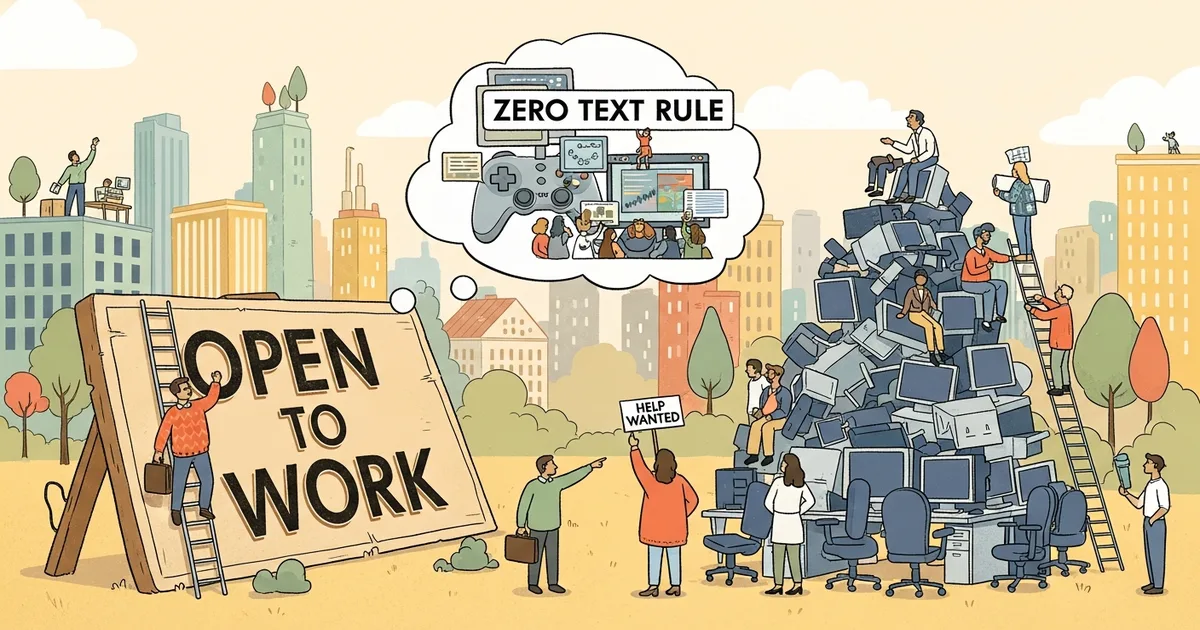
A blog post by game developer Darko that gained significant traction on Hacker News this week captures a sentiment spreading across the game development industry: LinkedIn is saturated with experienced developers displaying “Open to Work” badges, and AI tools are accelerating the displacement that began with post-pandemic layoffs.
The post traces the current crisis to the 2020-2021 hiring bubble. When global lockdowns drove a surge in gaming demand, studios hired aggressively. In Serbia alone, the author went from having access to a handful of Unity studios to fielding 15 interview requests simultaneously. New companies formed, investors deployed capital freely, and headcounts ballooned to meet what turned out to be temporary demand. When player engagement normalized and interest rates rose, the layoffs began — and they have not stopped.
AI tools have compounded the problem. Studios now use generative AI for concept art, dialogue writing, level prototyping, and quality assurance — tasks that previously required dedicated hires. A single artist working with AI image generation tools can produce concept variations at a pace that once required a small team. The same pattern holds for narrative designers, where large language models handle first-draft dialogue, and for QA engineers, where automated testing frameworks powered by AI reduce the need for manual testers.
The author notes that friends with more than ten years of experience are struggling to find positions, a shift from just a few years ago when senior developers could choose between multiple offers. Mid-level developers face the steepest challenge: junior enough that their experience premiums are modest, but senior enough that their salaries are targets for cost-cutting. Studios increasingly prefer a lean core team augmented by AI tools and short-term contractors over the large permanent staffs of the bubble years.
The game development industry’s contraction mirrors broader patterns in tech employment, but with a sharper edge. Unlike enterprise software, where AI tools primarily augment existing workflows, game development involves creative tasks where AI substitution is more direct and visible. The industry’s reliance on project-based work and contract labor also means displaced developers lack the safety nets available in more stable sectors. Whether the current surplus of experienced talent leads to a wave of independent studios — or a permanent reduction in the workforce — depends largely on how quickly AI tools mature from assistants to replacements for production-quality work.