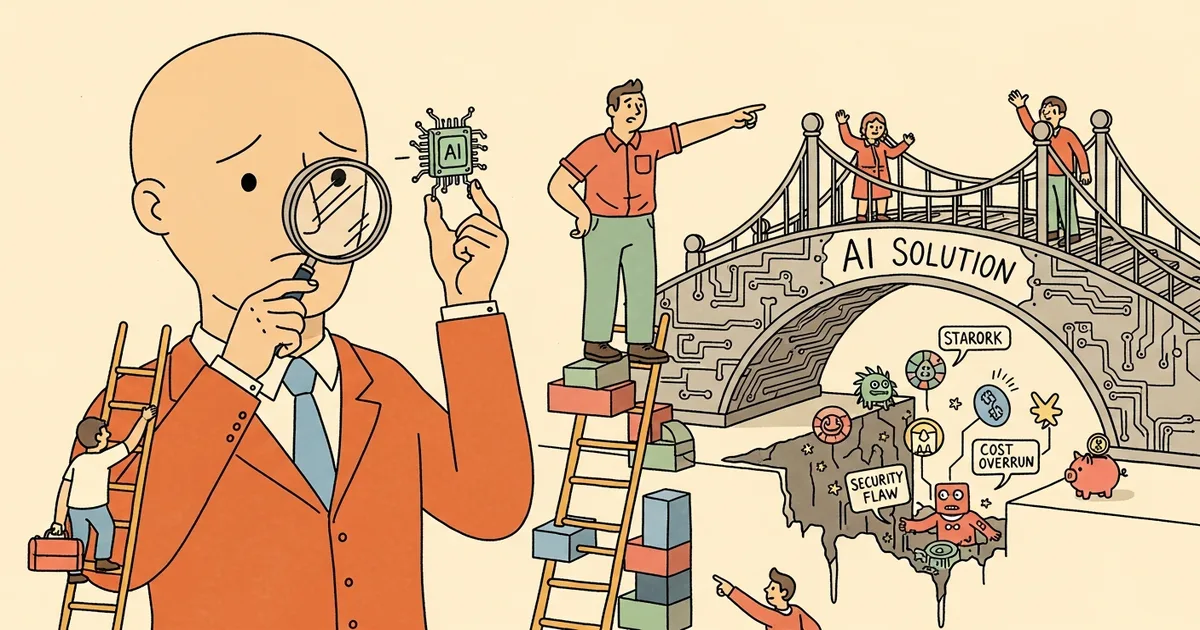
Software engineer John Wang published an analysis yesterday arguing that the stark divide between executives who embrace AI and individual contributors (ICs) who remain skeptical stems from fundamental differences in how each group approaches non-deterministic systems. Writing on his blog, Wang contends that executives are naturally comfortable with unpredictable outcomes while ICs are evaluated on deterministic task execution.
Wang observes this divide manifesting “everywhere from Hacker News comment threads to internal Slack debates about adopting coding agents,” with executives creating AI usage mandates while ICs express skepticism. His central thesis: “executives have always had to deal with non-determinism and focus on nondeterministic system design, while individual contributors are evaluated by their execution on deterministic tasks.”
According to Wang’s analysis, executives routinely manage unpredictable scenarios including unexpected employee absences, delayed project communications, and features built in ways that “don’t make sense with respect to the rest of the product, but do technically achieve objectives.” He argues this experience makes AI’s non-deterministic behavior familiar territory, noting that “LLMs generally continue their work and provide an output regardless of time of day, how difficult the task is, how much information is available.”
Wang characterizes AI systems as having “well defined failure modes” including hallucinations and poor performance without sufficient context, making them more predictable than human teams where “each person has a different set of strengths and weaknesses.” He suggests these properties make AI “incredibly attractive for an executive who is already used to this and likely has put a large amount of effort into adding determinism into their systems already.”
In contrast, Wang argues that ICs “are generally much more focused on particular problems that have specific inputs and outcomes” where “correctness is easier to determine, and how good you are at your job can largely be described by quality and speed.” He notes this changes at senior levels where staff engineers tackle “large, ambiguous business problems,” but maintains that most ICs operate in “relatively well defined” environments despite dealing with unclear requirements and shifting priorities.
Wang’s framework suggests the executive-IC divide on AI adoption reflects deeper organizational dynamics around risk tolerance and performance evaluation rather than technical capabilities or understanding of the technology itself.