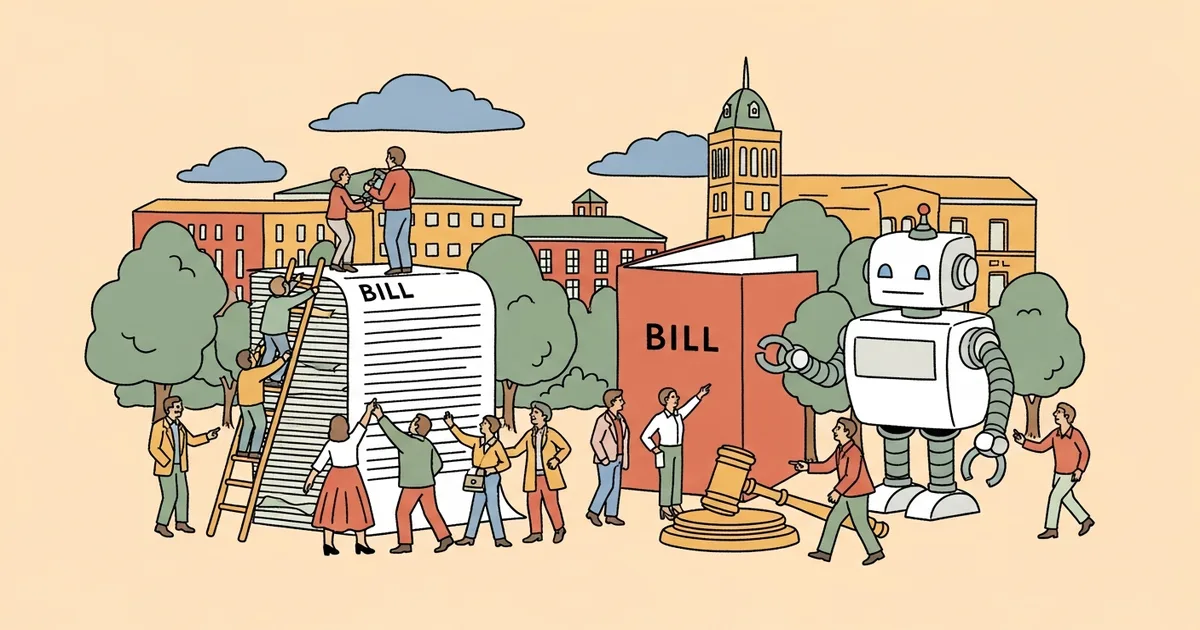
- Connecticut legislators are pursuing a cluster of targeted AI policy bills rather than a single comprehensive statute, focusing on data privacy, consumer protection, child safety, and workforce development.
- Senate Bill 5, a 97-page omnibus, covers AI subscriptions, chatbot transparency, automated decision-making in employment, and would establish a state Artificial Intelligence Policy Office.
- Senate Bill 86, introduced by the governor’s office, proposes an AI regulatory sandbox program focused on economic development.
- Sen. James Maroney and Attorney General William Tong announced the legislative push in February 2026, with the session entering its final weeks as of April 2026.
What Happened
Connecticut legislators are advancing multiple AI-related bills during the final weeks of the 2026 legislative session, as reported by CT Mirror on April 3, 2026. Rather than introducing a single comprehensive AI regulation bill, lawmakers are targeting specific areas including data privacy, consumer protection, child online safety, and AI workforce training. Sen. James Maroney (D-Milford) and Attorney General William Tong announced the legislative approach at a February 5, 2026, press conference, with an explicit focus on protecting Connecticut children and teens from AI-related harms.
The strategy follows Connecticut’s previous attempt to pass broad AI legislation, which stalled in 2025 amid opposition from the technology industry. Advocates of the new approach hope that targeted bills addressing specific issues will be harder for industry groups to block than a single sweeping statute that covers the entire AI landscape.
Why It Matters
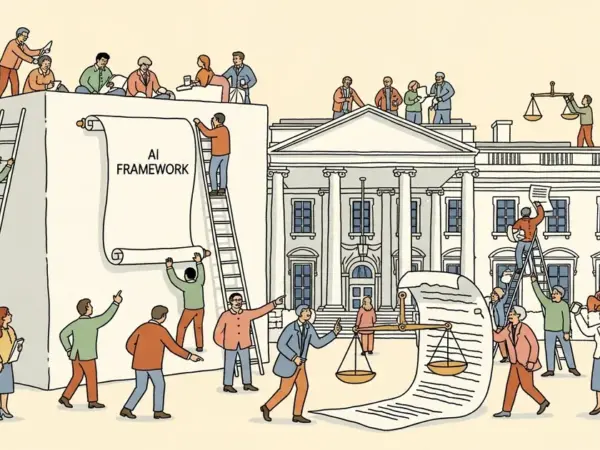
Connecticut’s approach reflects a broader national trend in state-level AI regulation. States have struggled to pass comprehensive AI bills, with Colorado being the only state to enact a broad AI governance law in 2024. The White House released its own National Policy Framework for Artificial Intelligence in March 2026, which recommends federal preemption of state AI laws that impose undue burdens on developers. Connecticut’s decision to pursue narrower, issue-specific bills may prove more durable if federal preemption eventually overrides broader state-level approaches.
The state’s experience also illustrates the tension between technology industry lobbying and legislative ambition. Connecticut’s 2025 AI bill was withdrawn after industry pushback, and the current session’s targeted approach is a direct legislative response to that experience. As the Future of Privacy Forum noted, Connecticut’s legislative efforts are being closely watched as a potential model for other states navigating the same political dynamics.
Technical Details
Senate Bill 5, titled “An Act Concerning Online Safety,” spans 97 pages and addresses AI subscriptions, chatbot transparency requirements, automated decision-making in hiring, and definitions of “catastrophic risks” in AI development. The bill would establish an Artificial Intelligence Policy Office under the Department of Economic and Community Development (DECD) to oversee AI research and recommend new policies. SB 5 also includes expansions to the Connecticut AI Academy for workforce training and anti-discrimination protections for individuals subject to AI-driven employment decisions, including disclosure requirements for companies using automated systems in hiring.
Senate Bill 86, introduced by the governor’s office, is titled “An Act Addressing Innovations in and the Responsible Use of Artificial Intelligence.” SB 86 focuses on economic development and proposes an AI regulatory sandbox program, which would allow companies to test AI products under relaxed regulatory conditions for a defined period before full compliance requirements apply. The sandbox model has been used in financial regulation in the UK and Singapore and is now being adapted for AI governance in several U.S. states.
Who’s Affected
Companies deploying AI systems in Connecticut, particularly in employment screening and consumer-facing applications, would face new disclosure and anti-discrimination requirements under SB 5. Technology companies that sell AI-powered subscription services to Connecticut residents would need to comply with chatbot transparency provisions. Connecticut workers whose employment decisions are made or influenced by AI systems would gain new protections, including the right to know when AI is being used in hiring, promotion, or termination decisions. The proposed AI regulatory sandbox in SB 86 would benefit startups and established companies seeking to test AI products with reduced regulatory friction.
What’s Next
The Connecticut legislative session is in its final weeks, and both SB 5 and SB 86 must clear committee votes and floor debates before the session ends. The outcome will depend in part on whether industry groups mount the same level of opposition that derailed the 2025 legislation. If Connecticut passes its targeted bills, it could serve as a model for other states seeking to regulate AI without triggering federal preemption under the White House framework. The interplay between Connecticut’s state-level action and the federal preemption debate will be a key dynamic to monitor through the remainder of 2026.