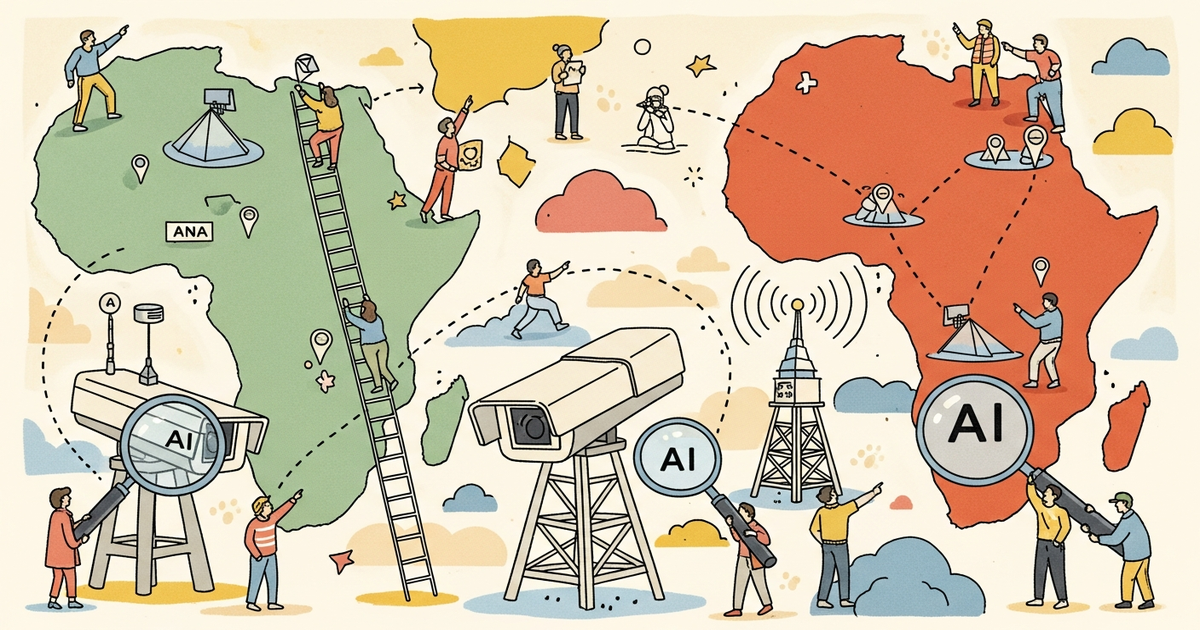
The Institute of Development Studies published its most expansive examination of Chinese-linked AI surveillance infrastructure in Africa on March 12, 2026. The report, titled Smart City Surveillance in Africa: Mapping Chinese AI Surveillance Across 11 Countries, covers Algeria, Egypt, Kenya, Mauritius, Mozambique, Nigeria, Rwanda, Senegal, Uganda, Zambia, and Zimbabwe — more than doubling the five-country scope of a prior IDS study published in September 2023.
- Published March 12, 2026, the IDS report is described as “the most comprehensive account to date of smart city surveillance in Africa,” covering eleven countries across North, East, West, and Southern Africa.
- The technologies under examination include facial recognition and vehicle number plate recognition systems deployed in public spaces, with data analyzed by AI at centralized control centers.
- The report traces surveillance continuity from colonial-era intelligence networks to present-day digitally enabled monitoring systems, identifying foreign technology companies and local private sector actors alongside government agencies as key implementation actors.
- Fourteen researchers with direct in-country expertise contributed country-level case studies, one per country across the eleven nations covered.
What Happened
Tony Roberts, a Research Fellow at the Institute of Development Studies, and co-editor Wairagala Wakabi released an eleven-country report on March 12, 2026 mapping Chinese-linked AI surveillance systems deployed in Africa, identifying government agencies, foreign technology companies, and local private sector firms as the key actors driving supply and implementation — with findings drawn from country-level case studies authored by researchers with direct local expertise.
The report was produced under IDS’s Digital Authoritarianism project, with support from the Open Society Foundations. It was co-authored by thirteen additional researchers: Afef Abrougui, Joseph Antwi-Boasiako, Jake Okechukwu Effoduh, Odeh Friday, Yosr Jouini, Victor Kapiyo, Roukaya Kasenally, Thobekile Matimbe, Richard Ngamita, Bulanda T. Nkhowani, Juliet Tembo, Dercio Tsandzana, and Assane Sy. Each contributor covered the country they have direct knowledge of, rather than applying a single external perspective across all eleven nations.
Why It Matters
The report situates current smart city surveillance deployments within IDS’s broader project on digital authoritarianism, drawing a direct historical line from colonial-era intelligence-gathering networks to the AI-powered public space monitoring systems now operating in countries including Nigeria, Kenya, Uganda, and Zimbabwe — a framing that contextualizes technology procurement decisions within longer patterns of state control.
The 2026 report expands significantly on an earlier IDS publication from September 2023, which mapped surveillance technology supply chains across five countries: Nigeria, Ghana, Morocco, Malawi, and Zambia. The inclusion of six additional countries — Algeria, Egypt, Kenya, Mauritius, Rwanda, and Senegal — reflects a widening of the research’s geographic scope and a deeper focus on how deployment models differ across regulatory and political environments.
Technical Details
The report focuses on two primary surveillance technologies deployed in public spaces across all eleven countries: facial recognition systems and vehicle number plate recognition. According to the publication, data from these systems is routinely processed using AI at centralized control centers — a configuration that concentrates both raw data collection and analytical functions within state-administered infrastructure.
The centralization of AI analysis at control centers, rather than at edge devices, means large volumes of visual data gathered from public locations are transmitted to and interpreted at a single point, where patterns can be identified across time and geography. The report does not specify which AI models power the analysis functions at each control center, but it names foreign technology companies — centered on Chinese suppliers, as the report title indicates — as primary actors in the supply chain alongside local private sector firms.
The report’s methodology distinguishes it from prior work on the subject: country case studies were each written by researchers embedded in or with specific knowledge of their respective countries, producing what IDS describes as “the most comprehensive account to date of smart city surveillance in Africa.”
Who’s Affected
The eleven countries covered — Algeria, Egypt, Kenya, Mauritius, Mozambique, Nigeria, Rwanda, Senegal, Uganda, Zambia, and Zimbabwe — represent a geographically and politically diverse set of nations where government departments and agencies operate the surveillance systems documented, with AI-processed data from public spaces flowing through state-controlled infrastructure.
Residents who move through monitored public spaces — including urban transport corridors, public squares, and areas covered by smart city camera networks — are the primary population subject to the systems documented. The report identifies government departments, foreign technology companies, and local private sector actors as the three categories of stakeholders involved in implementing these systems, each playing distinct roles in procurement, deployment, and operation.
What’s Next
The full report is available through IDS’s OpenDocs platform under DOI 10.19088/IDS.2025.068. The project’s expansion from five countries in 2023 to eleven in 2026 indicates the research program is broadening its geographic coverage, though the publicly available summary does not specify which additional countries may be addressed in future phases.
The publication does not outline specific policy recommendations in its publicly available summary. IDS has historically used research under the Digital Authoritarianism project to inform governance and advocacy discussions, and the report’s multi-author, in-country methodology may serve as a model for future surveillance audits elsewhere on the continent.
Related Reading
- Alibaba Cloud Leads $293 Million Round in Chinese AI Video Startup ShengShu Technology
- US Advisory Panel Warns China’s Open-Source AI Models Are Creating Self-Reinforcing Advantage
- Founders Fund Leads $2 Billion Valuation for Halter, an AI-Powered Cattle Management Startup
- 17 US AI Companies Have Raised $100 Million or More in 2026, Led by OpenAI’s $110 Billion
- Kandou AI Raises $225M from SoftBank, Valued at $1.8B for Edge Inference Chips