- Halter raised $220 million in Series E funding at a $2 billion valuation, led by Peter Thiel’s Founders Fund, making it one of the largest agtech rounds globally.
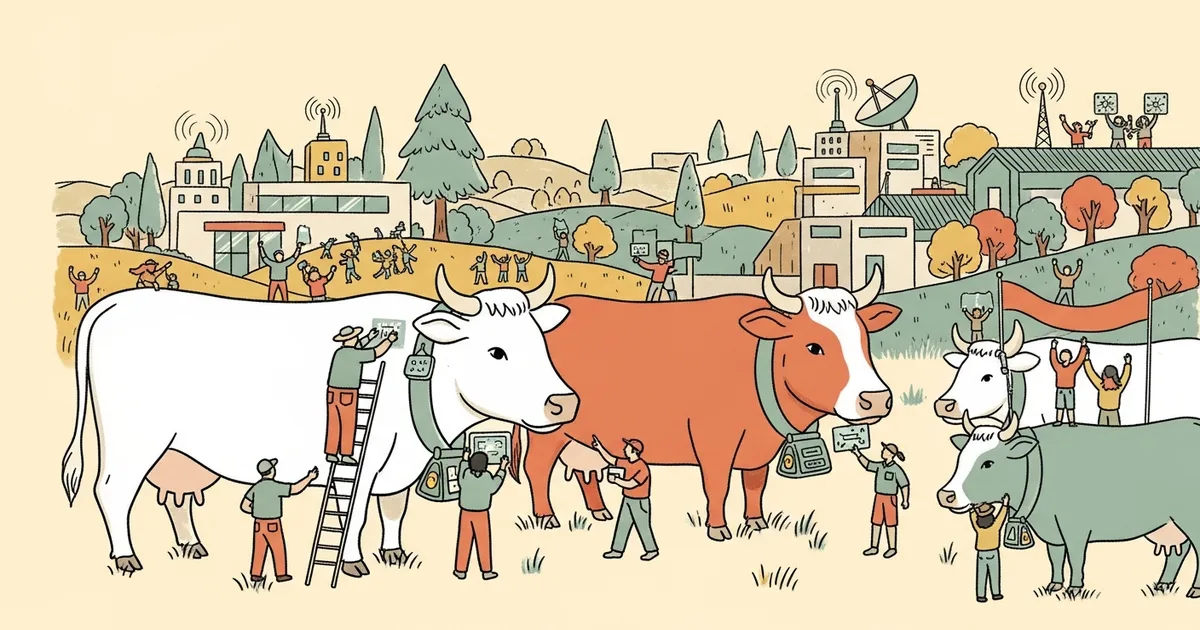
- The New Zealand-based company has sold one million solar-powered, GPS-enabled collars that create virtual fences for cattle across New Zealand, Australia, and the United States.
- Halter plans to expand into Ireland, the UK, Canada, and additional markets in North and South America, while hiring over 200 people at its Auckland headquarters.
What Happened
Halter, a New Zealand-based agricultural technology company founded by Craig Piggott in 2016, closed a $220 million Series E funding round that values the company at $2 billion. Peter Thiel’s Founders Fund led the round, with participation from Blackbird, DCVC, Bond, Bessemer, NewView, Ubiquity, Promus, and Icehouse Ventures.
The deal doubles Halter’s previous valuation of roughly $1 billion, which it reached in a $100 million round in June 2024 led by Bond. The round was reportedly oversubscribed, with investor demand exceeding the available allocation. The nine-month doubling in valuation marks one of the fastest value increases in agtech history.
Why It Matters
The Series E represents one of the largest funding rounds in global agtech history and signals growing investor confidence in precision agriculture. The broader precision agriculture sector is valued at approximately $9.5 billion in 2025 and projected to exceed $17 billion by 2031, driven by increasing demand for data-driven farming solutions.
Halter’s rapid growth also reflects a structural shift in how livestock operations are managed. Traditional cattle ranching relies heavily on physical fencing, manual labor, and in-person herd monitoring — infrastructure that is expensive to install, maintain, and move. Virtual fencing eliminates many of those costs while giving operators more granular control over grazing patterns and pasture utilization. The company now serves more than 2,000 ranchers and farmers across three countries.
For Founders Fund, the investment represents a bet on hardware-enabled AI in a sector that has historically attracted less venture capital attention than software-focused industries. The fund’s involvement brings additional visibility to agtech as an investment category.
Technical Details
Halter’s system centers on solar-powered, GPS-enabled collars that attach to cattle and create virtual boundaries without physical fencing. Ranchers manage herds remotely through a smartphone app, using audio cues and gentle vibrations to guide animals within digitally defined pasture zones. The collars are lightweight and ergonomic, designed for continuous wear.
The collars connect through a proprietary wireless tower infrastructure that operates independently of cellular coverage, allowing deployment in remote grazing areas where traditional connectivity is unavailable. The platform provides real-time data on animal location, pasture conditions, heat detection, and health alerts, enabling farmers to make management decisions without physically inspecting herds.
Since launching in the U.S. in 2024, American ranchers have established 60,000 miles of virtual fencing using the system. The company charges between $5 and $8 per animal per month for the service, a subscription model that replaces the capital-intensive cost of installing and maintaining wire fencing across large properties.
Who’s Affected
Cattle ranchers and dairy farmers in New Zealand, Australia, and the United States are the primary users. With one million collars now sold, Halter has established a significant footprint among the more than 2,000 operations currently using the technology. The system is particularly relevant for large-scale operations managing thousands of head across dispersed grazing areas.
Craig Piggott stated: “We started Halter because we believed technology could fundamentally change what it means to run a ranch, and enable ranchers to use innovation to build long-term futures on their land.” Corrigan Sowman, a Tasman-region farmer managing 1,020 cows, described the practical impact: the system acts as “another set of hands” that augments existing farming skills rather than replacing them.
What’s Next
Halter plans to use the new funding to expand into Ireland, the United Kingdom, Canada, and additional markets across North and South America. The company is also hiring more than 200 people across product, engineering, and customer-facing roles at its Auckland headquarters. Expansion into new geographies will require adapting the system to different terrain types, livestock management regulations, and connectivity conditions in each market. The company has not disclosed a specific timeline for entering each new region.
Related Reading
- Legal AI Startup Harvey Reaches $11 Billion Valuation After $200 Million Round
- Shield AI Raises $2 Billion at $12.7 Billion Valuation to Build Defense AI Foundation Model
- Nvidia-Backed Reflection AI Seeks 2.5 Billion Dollar Funding Round at 25 Billion Dollar Valuation
- Alibaba Cloud Leads $293 Million Round in Chinese AI Video Startup ShengShu Technology
- Kandou AI Raises $225M from SoftBank, Valued at $1.8B for Edge Inference Chips