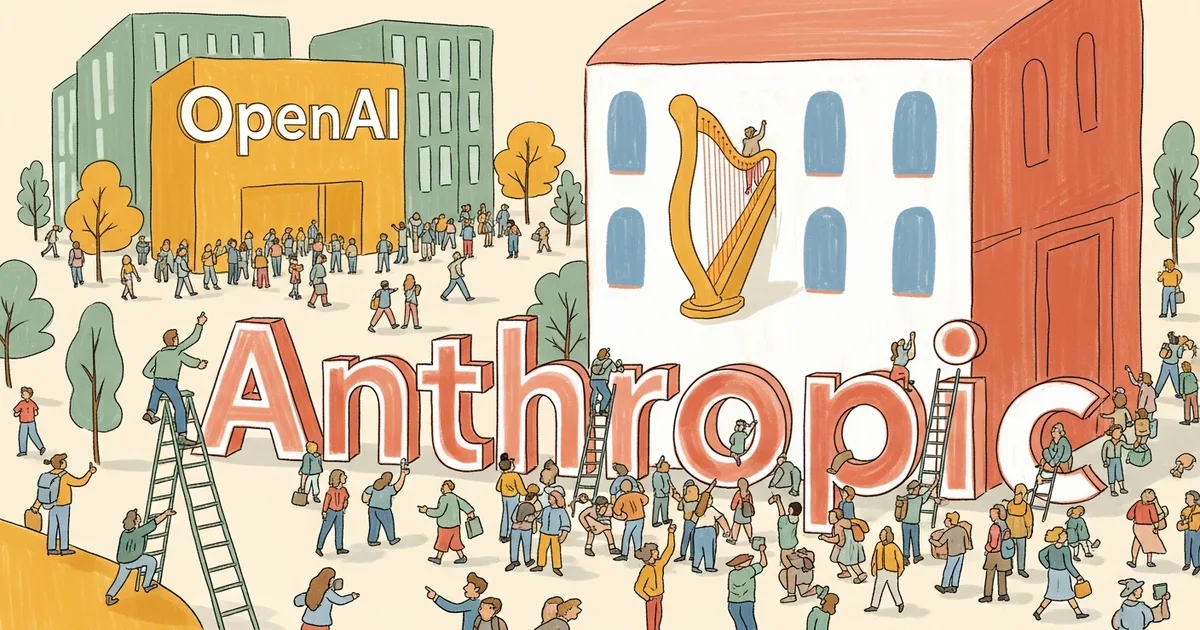
- Anthropic has become the most in-demand stock on secondary markets, with buyers indicating $2 billion in ready capital and virtually no sellers available.
- OpenAI’s secondary market position has weakened, with roughly $600 million in shares finding no takers.
- SpaceX’s anticipated IPO could pull significant capital out of the secondary market, potentially affecting valuations for AI companies.
- Rainmaker Securities president Glen Anderson describes the current secondary market as the most active he has seen since he began brokering private share trades in 2010.
What Happened
The secondary market for private AI company shares is experiencing a dramatic shift in demand, with Anthropic overtaking OpenAI as the most sought-after stock among institutional buyers. Glen Anderson, president of investment bank Rainmaker Securities, told TechCrunch that Anthropic is now “the hardest stock to source in our marketplace,” adding: “There’s just no sellers.” Anderson has been brokering trades in private company shares since 2010, and Rainmaker facilitates transactions in roughly 1,000 private stocks.
The shift comes as buyers have indicated to secondary market brokers that they have $2 billion in cash ready to deploy into Anthropic shares, while approximately $600 million in OpenAI shares remain unsold, according to figures cited by Bloomberg from Ken Smythe, founder and CEO of Next Round Capital.
Why It Matters
The reversal in relative demand between Anthropic and OpenAI on secondary markets reflects a material change in investor sentiment about the two leading AI labs. Anderson described the current environment as the most active the secondary market has ever been, with the number of institutional investors focused on late-stage private companies growing from what could be counted on two hands to thousands over the past 16 years.
Anthropic’s standoff with the Department of Defense earlier this year, which initially appeared damaging to the company, paradoxically boosted investor interest. Anderson argues the confrontation raised Anthropic’s public profile and signaled the company’s willingness to take principled positions on AI deployment, which resonated with a subset of institutional investors who view responsible AI governance as a long-term competitive advantage. The contrast with OpenAI, which has faced questions about its corporate restructuring and executive departures, has sharpened the demand divergence.
Technical Details
The secondary market dynamics are being shaped by several structural factors. Anthropic’s share scarcity is partly driven by the company’s relatively concentrated ownership structure and limited prior funding rounds compared to OpenAI, which has conducted multiple large tender offers that distributed shares more broadly. The demand imbalance has pushed Anthropic’s implied valuation higher on secondary exchanges, though specific transaction prices vary by deal size and buyer.
OpenAI’s softening demand coincides with its complex corporate restructuring from a capped-profit entity to a more traditional for-profit structure, ongoing executive turnover, and questions about the sustainability of its revenue growth relative to its cost structure. The $600 million in unsold OpenAI shares represents a significant overhang that could suppress prices if sellers become more motivated to accept lower valuations.
Anderson also highlighted the potential disruptive effect of a SpaceX IPO, which he says could absorb a substantial portion of the capital currently targeting private AI company shares. SpaceX represents one of the largest private company liquidity events in history, and its public listing would offer institutional investors a liquid alternative to the illiquid secondary market for AI shares, potentially draining demand from companies like Anthropic.
Who’s Affected
Current and former employees of Anthropic and OpenAI who hold equity are directly affected by these market dynamics. Anthropic employees holding shares face a favorable selling environment but appear reluctant to part with their stock, suggesting internal confidence in the company’s trajectory. OpenAI employees and early investors seeking liquidity face a more challenging market with fewer willing buyers. Institutional investors in private AI companies, including venture capital firms, family offices, and sovereign wealth funds, are recalibrating their portfolio allocations based on these shifting dynamics.
What’s Next
The secondary market landscape could shift further depending on the timing of SpaceX’s anticipated IPO and OpenAI’s own public market plans. Anderson suggested that a SpaceX listing could pull substantial capital from the secondary market ecosystem, creating ripple effects across AI company valuations. Anthropic has not publicly disclosed plans for an IPO, and its current demand-supply imbalance on secondary markets may persist as long as the company remains private and demand for AI exposure continues among institutional investors.
Related Reading
- 3 Protocols Are Fighting to Become the HTTP of AI Agents — Only 1 Will Win [MCP vs A2A vs ACP Compared]
- Your Brand Is Invisible on Claude But Mentioned 615x More on Grok — The AI Citation Gap Nobody Tracks
- Google AI Overviews Just Killed 58% of Your Organic Clicks — But the Survivors Convert 5x Better [Data]
- ChatGPT Now Handles 20% of All Search Traffic on Earth — Google’s Monopoly Has a Crack [2026 Data]
- OpenAI Just Raised $122 Billion — That’s More Than the GDP of 130 Countries