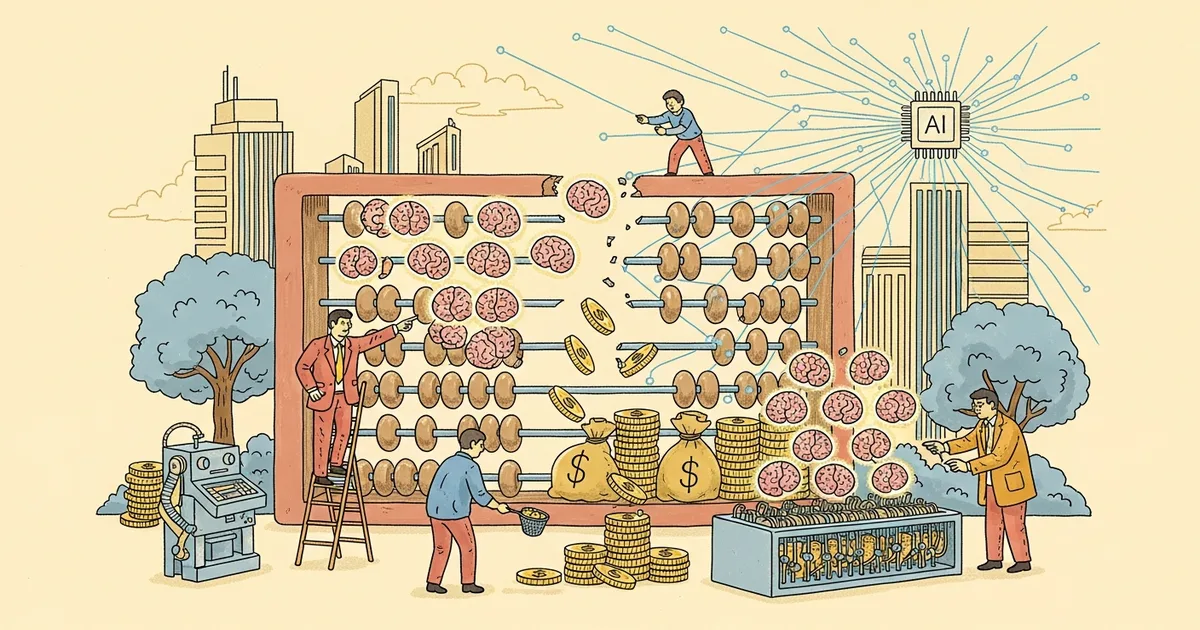
Economist Daniel Homola argues in a new essay that artificial intelligence is dismantling the historical connection between cognitive ability and wealth accumulation, potentially creating a permanent aristocratic class. The 54-minute analysis, published March 21, 2026, uses probability theory and mathematical modeling to predict the closure of what he calls the “bridge to wealth” within the next decade.
Homola’s central thesis rests on the mathematical distinction between inherited traits and inherited wealth. “Most of the traits you were born with – intelligence, conscientiousness, height, bone density, grip strength, resting heart rate – follow a bell curve,” he writes. “Wealth follows a power law.” He notes that the top 1% of American households holds more than the bottom 50% combined, with the mean being five times the median.
The essay traces how credential systems from the 19th and 20th centuries created an unprecedented connection between cognitive ability and wealth accumulation. “For the first time at scale, cognitive ability could escape the class it was born into,” Homola explains. This bridge operated through the pathway: “IQ → credentials → income → heritable wealth.” However, he argues that large language models now “match median professional performance on the routine tasks that constitute a large fraction of professional billing across legal research, financial analysis, software engineering, and diagnostic reasoning.”
According to Homola’s analysis, this technological shift is fundamentally altering labor market dynamics. “The IQ premium in the labour market is collapsing. The capital premium is not,” he states. “The coefficient on inherited wealth in the income equation is rising as the coefficient on cognitive ability falls – and the transition is measured in years, not decades.”
Homola predicts a narrow window for individuals to leverage AI capabilities before the opportunity closes permanently. He identifies “deep domain knowledge combined with AI fluency” as currently scarce in a way that “inherited wealth cannot buy – it is gated by speed and expertise, things a person with ability and modest starting wealth can actually have.” He estimates this window at “the next five to ten years,” after which “the legal inheritance system runs alone.”