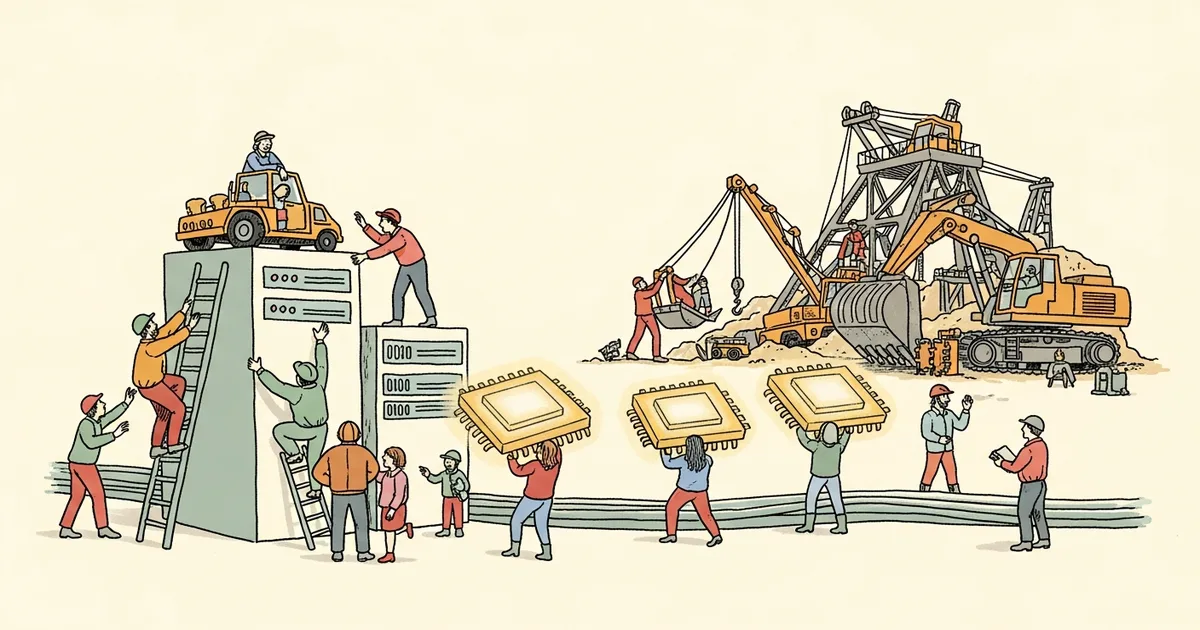
- AI data centers and power grid expansion are increasing US copper consumption at a time when domestic mine output has been roughly flat for two decades.
- Rio Tinto’s Resolution Copper project in Superior, Arizona — one of North America’s largest undeveloped copper deposits — has faced regulatory and permitting challenges for over 20 years, with first production unlikely before the mid-2030s.
- The US currently imports approximately 35 percent of its copper needs, with Chile the dominant supplier; China controls an estimated 40 percent of global copper refining and smelting capacity.
- A structural lag of 15 to 20 years between mine discovery and production means near-term supply increases will depend on imports and recycled copper rather than new domestic mines.
What Happened
Bloomberg reported on April 19, 2026 that surging electricity demand tied to artificial intelligence infrastructure is intensifying US reliance on imported copper, a metal critical to data center wiring, power transformers, and grid expansion. The report features on-the-ground coverage of Rio Tinto and BHP’s jointly owned Resolution Copper project in Superior, Arizona, framing it as a case study in both the scale of untapped domestic copper resources and the structural obstacles blocking their development.
Rio Tinto has stated in federal permitting documents that a fully operational Resolution mine would supply “up to 25 percent of US copper demand” — a projection that has taken on new relevance as technology companies accelerate data center construction across the American Southwest and Southeast.
Why It Matters
US copper mine output has held roughly steady at approximately 1.2 million metric tons per year for the past two decades, according to US Geological Survey data, even as domestic demand from electrification programs, electric vehicle adoption, and now AI compute infrastructure has grown. The energy transition has placed copper alongside semiconductors and lithium as a material subject to direct industrial policy attention.
Chile produces approximately 25 percent of global copper output, followed by the Democratic Republic of Congo and Peru. China controls an estimated 40 percent of global copper refining capacity — a concentration that US policymakers have characterized as a strategic vulnerability, particularly as Beijing has moved to restrict exports of other processed critical minerals since 2023.
Technical Details
The copper intensity of AI infrastructure is substantially higher than conventional data center construction. High-density AI server clusters operate at power densities of 30 to 100 kilowatts per rack, compared to 5 to 10 kilowatts per rack for standard servers, requiring proportionally larger power distribution systems, transformer windings, and bus bars — all copper-dependent components. A single hyperscale AI facility drawing 100 to 300 megawatts of IT load may use between 4,000 and 15,000 metric tons of copper across its electrical systems, cooling loops, and cabling infrastructure.
The Resolution Copper deposit, located approximately 60 miles east of Phoenix, is estimated to contain roughly 1.8 billion metric tons of ore at commercially viable grades, with a projected mine life of approximately 40 years, according to Rio Tinto’s project disclosures. Developing the deposit requires sinking a production shaft to a depth exceeding 6,000 feet — among the deepest planned hard-rock mining operations in North America.
A federally mandated land exchange with the San Carlos Apache Tribe, whose members consider the Oak Flat area of the project site sacred, was revoked by the Biden administration in January 2021. A panel of the Ninth Circuit Court of Appeals ruled in June 2024 that the land exchange could proceed, but full regulatory approvals and environmental review remain ongoing as of April 2026. Rio Tinto has not announced a revised construction start date.
Who’s Affected
Technology companies engaged in large-scale data center construction — including Microsoft, Google, Meta, and Amazon — face indirect exposure to copper price volatility and procurement lead times as the buildout scales. Copper prices on the London Metal Exchange exceeded $10,000 per metric ton in 2024 and have remained elevated, reflecting both current demand and anticipated supply deficits from delayed mine development globally.
US electrical contractors and grid operators face more immediate pressure. Lead times for large power transformers, which use significant quantities of copper wire in their windings, have extended to three to four years in some US markets, constraining the pace of both utility-scale grid upgrades and commercial data center commissioning. Arizona-based Freeport-McMoRan, the largest US copper producer by volume, is the primary domestic beneficiary of any sustained pricing upside; the company operates the Morenci and Bagdad mines roughly 150 miles north of the Resolution site.
What’s Next
Resolution Copper’s earliest realistic production timeline remains the mid-2030s, contingent on permitting completing without further legal challenges. The Trump administration has identified domestic critical mineral development as a policy priority, and executive orders issued in early 2025 directed federal agencies to accelerate environmental reviews for mining projects on federal lands — though it remains unclear how that directive will interact with the ongoing tribal and environmental litigation specific to Oak Flat.
In the near term, the US will remain dependent on copper imports from Chile, Peru, and Canada. The Copper Development Association has noted that secondary supply — recycled copper from demolition, electronics, and manufacturing scrap — accounts for roughly 35 percent of US copper consumption and could be expanded through targeted collection and processing investments, though recycling alone cannot close a deficit driven by net-new infrastructure at the scale the AI buildout represents.