- 85% of organisations say they want to be agentic within three years; 76% say their current operations and infrastructure can’t support that change.
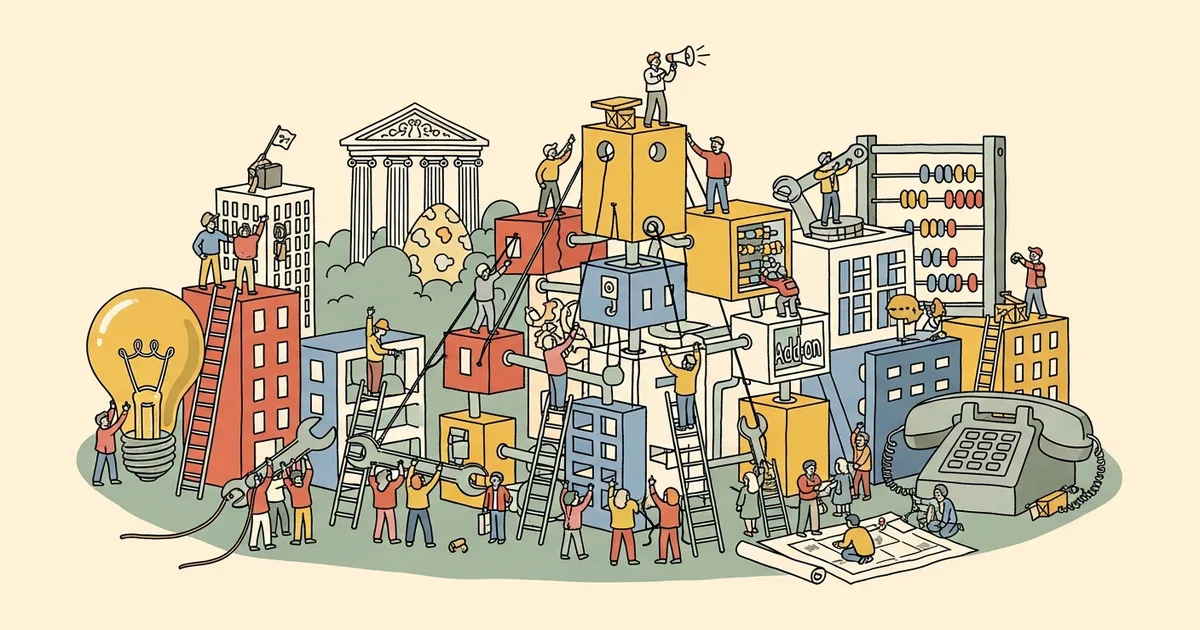
- PwC and Ema describe enterprises ’embedding AI employees into what is a human operating model’ — adding sticky tape to a breaking operating model.
- At scale, agentic AI could accelerate business processes by 30-50% and cut low-value work by 25-40%.
- Ema and HFS Research coined ‘agentic business transformation’ (ABT) as a framework for the required systems-level change.
What Happened
For agentic AI to deliver material enterprise benefits, organisations must approach it as systems-level change rather than layering AI agents onto existing operations, MIT Technology Review argued in a sponsored piece with Ema. The article cites a disconnect: 85% of organisations say they want to be agentic within three years, but 76% acknowledge their current operations and infrastructure cannot support that change.
Why It Matters
The 76%-can’t-support figure is one of the cleanest empirical measurements of the gap between enterprise-AI ambition and execution. Prasun Shah, global CTO for workforce consulting and chief AI officer at PwC UK Consulting, framed the problem directly: organisations are “embedding AI employees into what is a human operating model.” Layering agents onto existing structures — Shah’s metaphor — is “like adding sticky tapes to parts of an operating model that is breaking.”
The framing connects directly to PwC’s Anthropic alliance announced May 22, which committed to training 30,000 PwC professionals on Claude and launching a new Office of the CFO business unit anchored in Anthropic technology. KPMG’s parallel 276,000-employee Claude rollout the same week is the workforce-scale variant of the same approach.
Technical Details
Per the article, early proving grounds across customer service, HR, and sales show that AI agents could accelerate business processes by as much as 30-50% and cut low-value work time by 25-40% when deployed at scale. The full unlock requires what Ema and HFS Research call “agentic business transformation” (ABT) — a framework coined in 2024 to provide enterprises a vocabulary for the required systemic rewiring.
The ABT framing has three core principles per Ema: (1) the value lies in agents executing entire workflows with limited human input, (2) agents must coordinate complex tasks, make independent decisions, adjust to changing conditions, and iterate performance, (3) this capability requires rethinking what “work” means rather than mapping it onto existing job roles. The Anthropic Code with Claude conference in London on May 19-20 — where roughly half of attending developers had shipped a Claude-written pull request that week — is the developer-side variant of this transformation.
Who’s Affected
Chief operating officers, chief technology officers, and chief AI officers across mid-and-large enterprises face the operating-model rewiring question. PwC and other major consultancies (Deloitte, EY, KPMG, Accenture) gain a structured framework for delivering ABT engagements. Anthropic, OpenAI, Google, and Microsoft compete on which agentic platform supports the underlying capability. Enterprise software vendors — Salesforce (Agentforce), Microsoft (Copilot Studio), ServiceNow (Now Assist), Workday — face the question of whether their products extend naturally to ABT or whether new vendors will be required.
What’s Next
HFS Research and other industry analysts will likely publish refined ABT frameworks through 2026. Enterprise pilots that demonstrate the full 30-50% process-acceleration gain (versus the current sticky-tape-equivalent gains) will be among the most-watched proof-of-concept disclosures. Expect parallel pieces from Bain, McKinsey, BCG, and other consultancies positioning their own variants of the same framework.