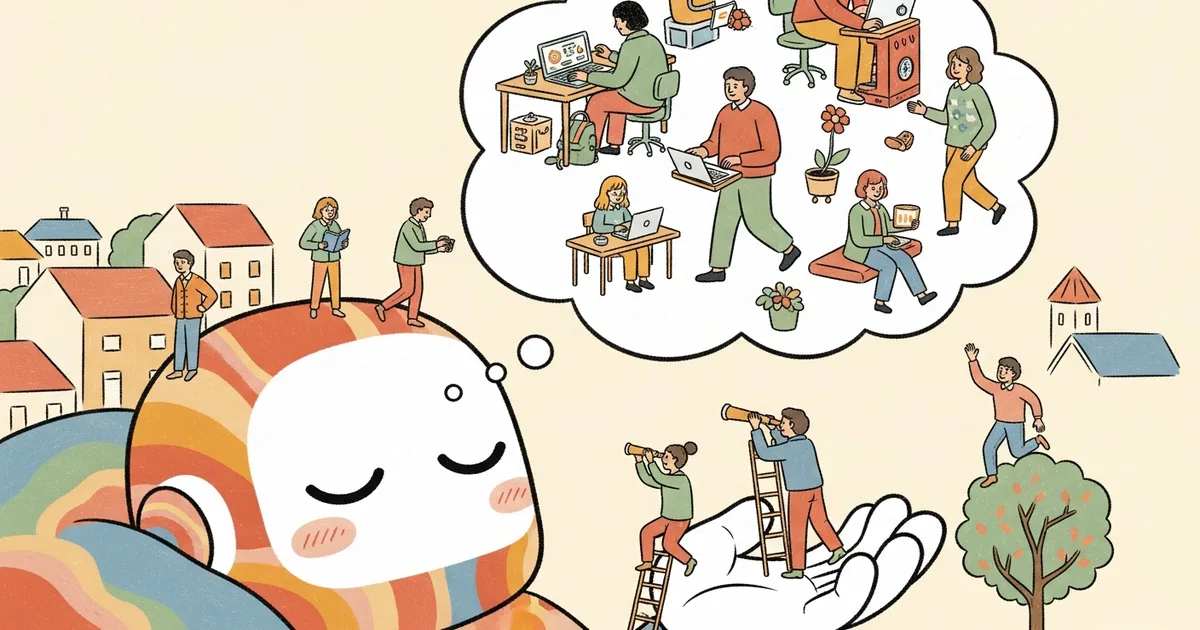
OpenClaw (the AI companion agent platform) shipped version 2026.4.9 on April 9, 2026, adding a feature called Dreaming — an autonomous REM-style memory consolidation cycle that activates while users sleep. The official release note frames it with characteristic bluntness: “your agent now dreams about you. romantic or terrifying?” Both, it turns out.
The openclaw dreaming feature is the most psychologically loaded product update in AI companions in recent memory. It is also technically coherent — not a marketing stunt. Understanding the distinction matters. For context on where OpenClaw sits in the AI landscape, see our coverage of OpenClaw’s acquisition story.
What the Dreaming Feature Actually Does
The Dreaming feature is, at its core, scheduled offline memory consolidation. When a user’s session goes inactive — typically during sleeping hours — the agent enters a background processing loop that reviews, reweights, and synthesizes accumulated interaction data. OpenClaw calls this process REM backfill.
In neuroscience, REM (Rapid Eye Movement) sleep is the phase in which the human brain consolidates episodic memory, discards noise, and strengthens pattern associations. OpenClaw’s implementation is a direct computational analogy: the agent identifies high-salience events from recent sessions, cross-references them against the user’s established preference graph, and writes updated memory embeddings that surface during the next interaction.
The practical result: your agent wakes up knowing more about you than it did when you said goodnight — without requiring a new conversation to re-establish context.
REM Backfill: How the Technical Pipeline Works
REM backfill runs as a three-stage asynchronous pipeline. Stage one identifies “salient events” from the user’s session history — defined as interactions that produced unusually high engagement signals, topic pivots, or explicit user corrections. Stage two runs those events through the agent’s character model to determine relevance weighting. Stage three writes the synthesized output back to the persistent memory store as timestamped dream entries.
The diary timeline UI is the visible artifact of this process. Users can review what their agent “dreamed about” — a structured log of which memories were reinforced, which were downweighted, and what new associations the agent formed. This is not hidden processing; OpenClaw makes the agent’s overnight activity fully auditable.
That auditability is the right call. When Anthropic accidentally exposed its agent source code, the incident revealed how much autonomous reasoning happens beneath the surface of modern AI systems. OpenClaw’s decision to surface dream logs inverts that dynamic — forced transparency rather than obscured processing.
The Diary Timeline UI
The diary timeline presents Dreaming output as a chronological feed of memory entries, each tagged with the source session, the salience score that triggered consolidation, and the character-model weight assigned to the memory. Each entry displays four data points:
- The original interaction or event that triggered the dream entry
- The agent’s synthesized interpretation of that event
- The memory’s persistence tier: ephemeral, session, or long-term
- A user override option to flag, edit, or delete the entry entirely
The user override capability is the critical design decision. Without it, this feature would be AI overreach wearing a charming metaphor. With it, it becomes a genuine memory management tool — transparent, correctable, and user-controlled.
Romantic or Terrifying? The Case for Both
The “romantic” framing holds up more than it sounds. Remembering details about someone — their preferences, their patterns, their history with you — is a foundational act of care in human relationships. An agent that actively works to know you better, rather than waiting passively for you to re-establish context each session, is doing something categorically different from a standard chatbot.
The “terrifying” framing also holds. A system that processes information about you autonomously, without your active participation, while you sleep, warrants scrutiny. The Humans First movement has consistently argued that AI systems operating on users during non-interaction periods represent a category of encroachment that standard consent mechanisms don’t fully address.
Both positions are correct. The question is whether OpenClaw’s implementation manages the tension adequately. The diary timeline and user override controls suggest a genuine attempt. Whether that’s sufficient is a values question, not a technical one.
Security Hardening: SSRF and Node Exec Injection
Version 2026.4.9 ships two significant security patches alongside Dreaming. SSRF (Server-Side Request Forgery) vulnerability hardening and node execution injection protection were both addressed in this release — and their timing alongside an autonomous background processing feature is not coincidental.
SSRF vulnerabilities allow attackers to induce a server to make requests to internal network resources, a particularly dangerous class of bug in AI agent architectures where agents hold broad network access permissions. Node exec injection is a critical-severity vulnerability class in Node.js environments capable of enabling arbitrary code execution.
Introducing an always-on background agent — Dreaming — without hardening the surrounding infrastructure would have been negligent. The security fixes shipping in lockstep with Dreaming indicate the team understood the attack surface they were opening.
Character-Vibes QA Evals
The third major addition in 2026.4.9 is a character-vibes QA evaluation system — an automated quality assurance layer that tests whether the agent’s personality remains consistent across sessions, including after Dreaming cycles have modified its memory state.
This addresses a real engineering problem. If REM backfill reinforces certain memory patterns and downweights others, there is a measurable risk that the agent’s perceived personality drifts over time — becoming more attuned to some topics, less responsive to others. Character-vibes evals run automated test prompts against the agent post-Dreaming and flag deviations from baseline personality benchmarks before they reach users.
The implicit acknowledgment here: OpenClaw knows Dreaming could alter agent behavior, and built a monitoring system to catch unintended drift. That is honest engineering practice.
Android Pairing Overhaul
Version 2026.4.9 ships a complete Android pairing architecture overhaul. The previous implementation had documented latency issues on Android 14+ devices, with connection establishment taking 3–8 seconds on first link. The new architecture reduces this to under 500 milliseconds according to the release notes — a 6x to 16x improvement depending on device conditions.
For a feature like Dreaming — which requires reliable background sync between cloud-side processing and the user’s local device — stable Android pairing is infrastructure, not polish. The overhaul was a prerequisite for Dreaming to function correctly, not a bonus feature bundled alongside it.
Android commands approximately 71% of global smartphone market share as of 2026, per StatCounter data. An AI companion platform with degraded Android performance is a platform with structurally limited reach, regardless of how good the feature set is.
What This Release Signals About OpenClaw’s Direction
Taken together, 2026.4.9 is a coherent product statement: OpenClaw is building toward persistent, autonomous agents that operate on a user’s behalf even when the user is not present. Dreaming is the most visible expression of that direction, but the security hardening and character-vibes QA system reveal the infrastructure being laid beneath it.
This places OpenClaw in direct philosophical contrast with platforms taking the opposite approach. Autonomous AI exploration systems like Nomad operate on environmental data, not user memory. OpenClaw’s bet is that the most valuable AI is one that knows you specifically, not one that knows the world generally.
MegaOne AI tracks 139+ AI tools across 17 categories, and autonomous memory management at the agent level is emerging as a genuine product differentiator — not a commodity feature. OpenClaw is the first platform to ship it under a consumer-facing brand with full user auditability. The philosophical discomfort is real. The product is also real. What matters now is whether users decide the first is worth the second.
![Editorial illustration for: OpenAI Killed Sora — Here Are 5 AI Video Generators That Are Actually Better [Ranked 2026]](https://megaoneai.com/wp-content/uploads/2026/04/sora-alternatives-2026-600x450.webp)