- OpenAI hit $25 billion in annualized revenue by February 2026, growing 17% in just two months from $21.4 billion at year-end 2025.
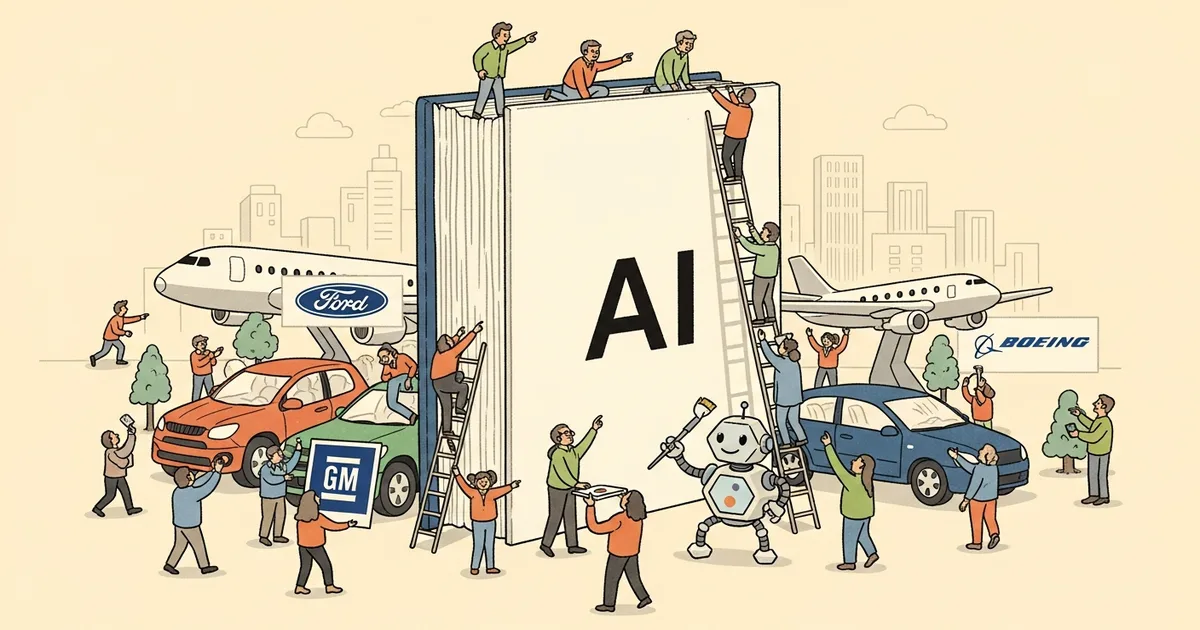
- At its latest $840 billion valuation, OpenAI is worth more than Ford ($46 billion), General Motors ($69 billion), and Boeing ($153 billion) combined.
- Anthropic is closing the gap fast, reaching $19 billion in annualized revenue compared to OpenAI’s $25 billion.
- Both companies remain unprofitable despite massive revenue, with OpenAI projecting $14 billion in losses for 2026.
What Happened
OpenAI crossed $25 billion in annualized revenue at the end of February 2026, according to a report from The Information. The figure represents 17% growth in just two months, up from $21.4 billion at the end of 2025. By April 2026, the company reported $2 billion in monthly revenue and 900 million weekly ChatGPT users.
On February 27, 2026, OpenAI closed the largest private funding round in history: $110 billion at a $730 billion pre-money valuation, bringing the post-money valuation to roughly $840 billion. SoftBank led the round.
Why It Matters
At $840 billion, OpenAI’s implied valuation exceeds the combined market capitalizations of Ford ($46 billion), General Motors ($69 billion), and Boeing ($153 billion), which together total approximately $268 billion. OpenAI is worth more than three times these three industrial giants combined.
The comparison highlights a fundamental reordering of how markets value companies. Ford, GM, and Boeing employ hundreds of thousands of workers, operate factories and assembly lines worldwide, and generate hundreds of billions in revenue collectively. OpenAI, a company founded in 2015, has surpassed all of them on valuation with a fraction of the workforce and physical infrastructure.
Sam Altman is steering the company toward what could be the largest IPO in stock market history, with a target valuation of $1 trillion. The contrast with legacy industries is stark: Ford employs roughly 177,000 people and operates factories on six continents, yet its market cap is less than 6% of OpenAI’s implied value.
Technical Details
OpenAI reached the $25 billion revenue milestone faster than Google, Salesforce, or Facebook ever did. The growth is driven by ChatGPT subscriptions, API access for developers, and enterprise contracts. The company now serves 900 million weekly active users across its consumer and enterprise products.
Meanwhile, Anthropic has surged to $19 billion in annualized revenue, roughly 14 times higher than a year earlier. The gap between OpenAI and Anthropic has compressed to just $6 billion, down from a much wider margin in 2025. “The AI race is increasingly a two-horse race at the top,” noted analyst commentary from WinBuzzer.
Revenue growth at this scale is historically unprecedented for a technology company. OpenAI reached $25 billion in annualized revenue within roughly three years of launching ChatGPT, faster than Google, Salesforce, or Facebook achieved similar milestones. The growth is driven by a combination of ChatGPT Plus and Team subscriptions, API access for developers, and enterprise contracts with large organizations.
Who’s Affected
Enterprise customers and developers building on OpenAI’s API are the primary stakeholders. A potential IPO would also open OpenAI shares to retail investors for the first time. Competitors including Anthropic, Google DeepMind, and Meta AI face pressure to match OpenAI’s commercial traction, though Anthropic’s rapid revenue growth suggests the competitive landscape is far from settled.
For traditional industrial companies, the valuation gap underscores how capital markets are repricing entire sectors. Boeing, despite generating over $77 billion in annual revenue, carries a market cap that is roughly one-fifth of a company that did not exist a decade ago. Whether this reflects genuine value creation or speculative excess remains one of the defining questions in technology investing.
Investors in the $110 billion funding round, led by SoftBank, are betting that OpenAI can convert its revenue growth into eventual profitability, something neither OpenAI nor Anthropic has achieved yet. The company’s ongoing transition from a nonprofit to a for-profit corporate structure adds further complexity for early backers and new investors alike.
What’s Next
OpenAI is projecting $14 billion in losses for 2026, driven primarily by compute infrastructure costs that continue to scale with demand. The company has added $111 billion to its cash burn forecast as AI training and inference costs spiral beyond initial projections.
The IPO timeline remains unclear, and OpenAI’s transition from a nonprofit to a for-profit structure is still underway. Whether the current valuation holds will depend on the company’s ability to sustain revenue growth while narrowing losses. For investors comparing AI valuations to traditional industry benchmarks, the Ford-GM-Boeing comparison may eventually look either prescient or like a peak marker for AI hype.