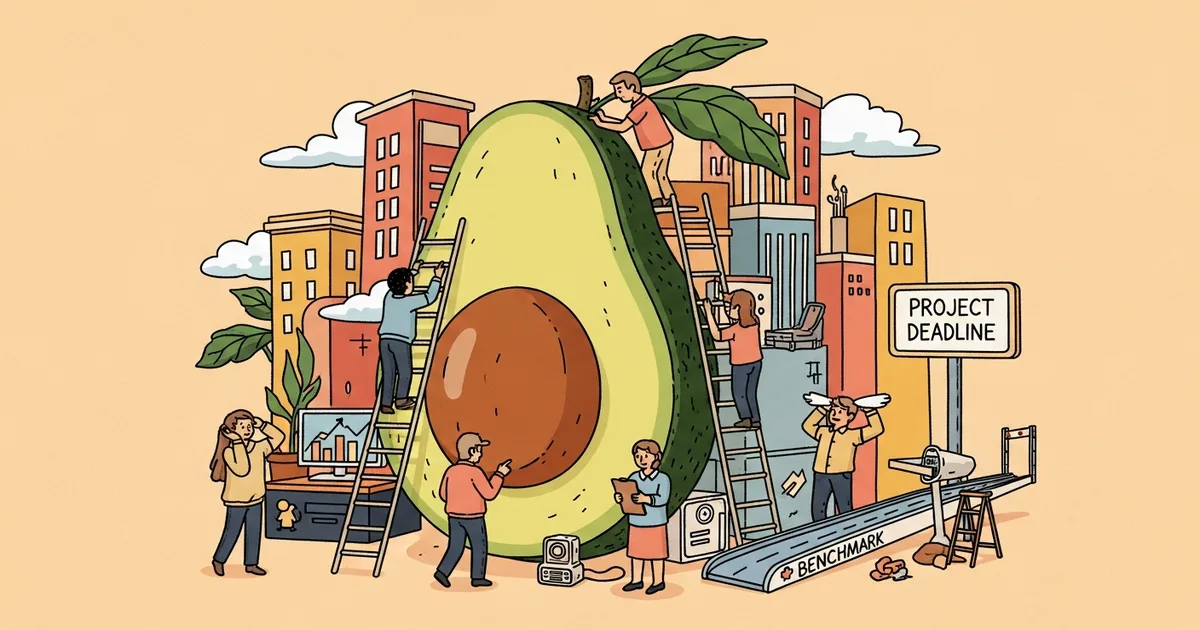
- Meta has postponed the release of its next-generation AI model codenamed “Avocado” to at least May 2026 after internal benchmarks showed it underperforming Google’s Gemini 3.0 in complex reasoning tasks.
- The company is reportedly considering a temporary licensing agreement with Google to use Gemini models while continuing to refine Avocado internally.
- Meta has committed $115 billion to $135 billion in capital expenditure for 2026 to support its AI strategy, yet its flagship model has now been delayed multiple times since an original 2025 target.
- Avocado currently benchmarks between Google’s Gemini 2.5 and Gemini 3.0, failing to establish a clear advantage over current industry leaders from Google, OpenAI, and Anthropic.
What Happened
Meta has pushed the launch of its next-generation AI model, internally codenamed “Avocado,” to no earlier than May 2026. The delay, first reported by The New York Times and confirmed by multiple outlets, follows internal testing that revealed the model underperforming against competitors from Google, OpenAI, and Anthropic in key benchmarks.
The timeline has shifted repeatedly. Avocado was originally targeted for release in 2025, then moved to early 2026, and has now been pushed to May at the earliest. Meta’s leadership decided against releasing a model that did not demonstrate clear advantages over existing alternatives in the market.
Why It Matters
The delay is significant given Meta’s massive financial commitment to artificial intelligence. The company has projected $115 billion to $135 billion in capital expenditure for 2026, much of it directed at AI infrastructure, data centers, and the pursuit of what CEO Mark Zuckerberg has described as “superintelligence.” Despite that spending level, Meta’s flagship model cannot yet match the performance of Google’s current leading offering.
Perhaps more striking is the reported consideration of licensing Google’s Gemini models as a temporary measure. Such a deal would allow Meta to maintain AI-powered features across Facebook, Instagram, and WhatsApp while continuing to develop Avocado behind the scenes. For a company that has positioned itself as an AI leader and invested heavily in building its own model stack through the open-source Llama series, relying on a competitor’s model — even temporarily — would represent an unusual strategic concession.
The situation also highlights the increasing difficulty of achieving meaningful differentiation at the frontier of AI model development. As top models from multiple companies converge in capability, the performance gaps that justify delays and additional investment become harder to close.
Technical Details
Internal benchmarks placed Avocado’s performance between Google’s Gemini 2.5 and Gemini 3.0, the latter of which launched in November 2025. While the model showed clear improvements over previous Meta Llama iterations in reasoning, coding, and creative writing tasks, it failed to secure a definitive edge in complex multi-step reasoning capabilities against current state-of-the-art competitors.
The specific areas where Avocado underperformed include complex reasoning benchmarks and advanced coding evaluations. Meta has not disclosed the model’s parameter count, training data composition, or architectural details. The company’s internal quality bar reportedly requires that new models demonstrate tangible advantages for the ecosystem of developers and enterprise users before proceeding to public release.
If Meta pursues a Gemini licensing arrangement, it could use Google’s models as a performance floor for consumer-facing AI features while redirecting internal engineering resources toward final-stage optimization of Avocado.
Who’s Affected
Meta’s billions of users across Facebook, Instagram, and WhatsApp stand to be affected if the delay slows the rollout of new AI-powered features on those platforms. Developers building applications on Meta’s open-source Llama ecosystem are also waiting for the next-generation model to enable more capable downstream applications and fine-tuned variants.
If Meta proceeds with a Gemini licensing arrangement, it would affect the competitive dynamics of the AI model market and could establish a precedent for cross-licensing among major AI companies that are simultaneously competing and cooperating.
What’s Next
Meta is targeting May 2026 for a potential Avocado release, though the timeline could shift again depending on benchmark progress and competitive developments. The company continues to allocate substantial resources to model training and optimization. Whether Meta ultimately licenses Gemini as a stopgap, delays its consumer AI features until Avocado is ready, or pursues a hybrid approach remains an open question. Neither Meta nor Google has publicly confirmed any licensing discussions.