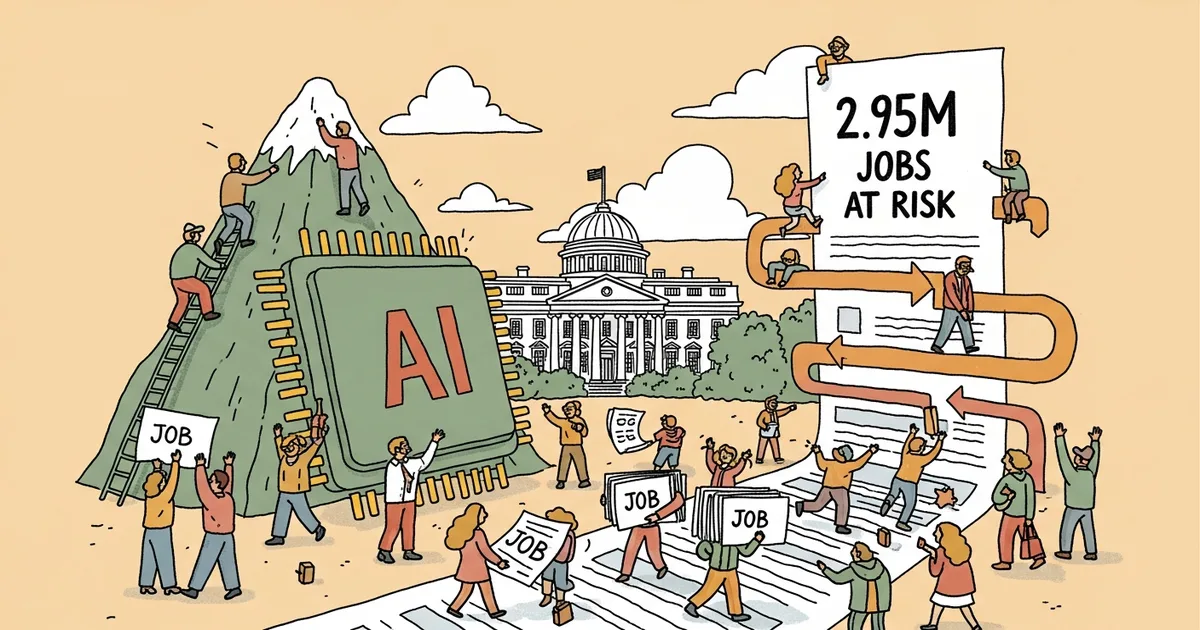
The White House Office of Management and Budget’s Chief Information Officer has directed federal agency heads to begin preparing for large-scale artificial intelligence deployment across government operations, Bloomberg reported on April 17, 2026. The directive is the clearest operational output yet of Trump’s December 2025 executive order mandating a white house ai federal agencies deployment framework — with all 2.95 million civilian federal workers now inside the blast radius of that transition.
This is not a feasibility study. This is infrastructure-level preparation, coordinated at the highest administrative level, with a legal architecture already being built around it.
What the White House AI Directive to Federal Agencies Actually Says
According to Bloomberg’s reporting, the OMB’s CIO has briefed government officials that federal agencies should expect to integrate AI into core operational workflows — not in pilot programs, but at scale. Bloomberg did not publish the full internal directive, but its reporting indicates the scope of preparation is unprecedented in federal IT history. The OMB controls the budget and management framework for all executive branch agencies; a directive from its CIO is not advisory. Agencies are obligated to comply.
The timing is deliberate. The December 2025 executive order gave OMB 90 days to coordinate AI adoption across all executive branch agencies — a deadline that expired in mid-March 2026. Bloomberg’s reporting is the downstream consequence of that deadline being met.
The December 2025 Executive Order That Set the Legal Foundation
On December 15, 2025, President Trump signed an executive order establishing what the administration termed a “minimally burdensome national policy framework” for artificial intelligence. The order’s defining characteristic was what it omitted: no mandatory safety evaluations, no civil rights impact assessments, no worker notification requirements. It tasked OMB with accelerating AI adoption across the executive branch while explicitly deprioritizing regulatory friction.
The contrast with the Biden administration’s October 2023 AI executive order — which mandated safety evaluations, equity reviews, and civil rights protections — is structural, not stylistic. The Trump order inverts the framework entirely: efficiency first, consequence management later. That inversion is now becoming operational policy across 430-plus federal agencies.
Which Federal Job Categories Face the Highest Exposure
The federal government’s 2.95 million civilian workforce spans roles with dramatically different AI displacement profiles. Based on task composition and current AI capability benchmarks, four categories carry the most exposure:
- Administrative and clerical support — The Office of Personnel Management estimates roughly 400,000 federal employees work in roles that overlap directly with what large language models now perform: document summarization, data entry, correspondence drafting, and records management.
- Benefits determination and adjudication — The Social Security Administration, Department of Veterans Affairs, and Department of Labor process millions of standardized eligibility decisions annually. AI systems trained on regulatory code handle these in seconds at a fraction of the staffing cost.
- IT operations and help desk — AI agents capable of tier-1 and tier-2 technical support have been commercially deployed since 2024. The federal government employs approximately 80,000 IT support specialists.
- Translation and language services — The State Department and DHS employ thousands of translators and interpreters. A 2025 NIST evaluation found AI translation now achieves parity with human performance on most language pairs for government document types.
At 10% task displacement across the full civilian workforce, that represents roughly 295,000 roles fundamentally restructured. At 20%, the figure approaches 590,000. Neither threshold requires futuristic AI — it requires AI that already exists and is commercially available today.
DOGE’s Fingerprints Are All Over the Federal AI Push
The Department of Government Efficiency — an advisory body operating with extraordinary executive access since January 2025 — has systematically catalogued federal workforce inefficiencies. DOGE’s published efficiency reports have identified the IRS, Social Security Administration, and Department of Health and Human Services as agencies where labor costs exceed private-sector benchmarks by 40 to 60 percent. The explicit conclusion in those reports: AI is not a supplement to human workers, it is a replacement for redundant ones.
This mirrors the posture of the private AI industry, where major AI companies have spent hundreds of billions of dollars positioning for enterprise and government contracts. The difference is that federal workers operate under civil service protections the administration has been working to dismantle in parallel — most notably through the revival of Schedule F, which reclassifies large portions of the federal workforce from protected civil servants to at-will employees. The AI deployment push and the Schedule F expansion are the same policy in two different vocabularies.
AFGE and Federal Unions Are Preparing for a Legal Fight
The American Federation of Government Employees, representing 750,000 federal and DC government workers, has been the most organized institutional opposition. AFGE President Everett Kelley stated in March 2026 that the union would challenge any mass-displacement action through arbitration and federal court, citing the Civil Service Reform Act of 1978 and existing collective bargaining agreements as the primary legal shields.
Labor attorneys note the collision is real but asymmetric: unions can slow implementation through grievance procedures and injunctions, but cannot block executive-branch administrative reorganization indefinitely. The legal fight buys time — measured in months, not years — while the underlying policy moves forward.
The Humans First movement, which has grown from a fringe labor coalition into a mainstream political force with cross-partisan support, has organized rallies in 14 cities since March 2026, drawing over 200,000 participants. Its legislative agenda — a federal moratorium on AI deployment in government roles pending independent impact assessment — has 47 co-sponsors in the House but no path to a floor vote under the current majority.
The DOJ AI Litigation Task Force: Neutralizing State-Level Resistance
The Department of Justice’s AI Litigation Task Force, announced in February 2026, functions as the legal enforcement arm of the federal AI deployment push. Its mandate is to challenge state-level AI laws that conflict with federal policy — an active preemption campaign, not a passive legal defense posture.
Illinois SB 3444, which would have required employers deploying AI in employment decisions to demonstrate bias-free validation, was among the first targets. The DOJ filed an amicus brief arguing the state law imposed unconstitutional burdens on interstate commerce in AI services. The bill’s outcome will establish precedent for how far executive authority extends in blocking state worker protection legislation — and signal to every other state legislature weighing similar laws what kind of federal opposition they face.
SB 3444 also contains a provision receiving less scrutiny than it warrants: a partial liability shield for AI vendors whose systems are deployed by federal contractors. Under its current language, AI developers would face reduced legal exposure for erroneous automated decisions — including wrongful denial of disability benefits, misclassification of security clearances, and automated termination of federal employment. The Congressional Budget Office has not scored the fiscal impact of that provision.
The Infrastructure Reality: What Mass Federal AI Deployment Actually Costs
Deploying AI at scale across more than 430 federal agencies is a multi-year capital project, not a software rollout. The SSA still operates COBOL systems written in the 1970s. The IRS maintains mainframe architecture that predates TCP/IP. Modernizing these systems to accept AI integrations requires capital expenditure the current federal IT budget cannot absorb without supplemental appropriations from Congress — appropriations that have not been requested.
MegaOne AI tracks 139-plus AI tools across 17 categories, and enterprise deployment costs for frontier models currently run $15 to $50 per user per month. Applied to 2.95 million federal workers, full deployment costs between $530 million and $1.77 billion annually in licensing alone — before infrastructure modernization, systems integration, security clearance requirements, or workforce retraining. The private sector is already racing to build the compute infrastructure this scale of deployment demands, and federal procurement timelines move at a fraction of private-sector velocity.
The gap between the administration’s deployment ambition and the federal IT estate’s readiness to receive it is the most underreported constraint in this story. The policy timeline is moving faster than the technical infrastructure can support — which means the first wave of AI deployment will concentrate in agencies that already have modern cloud infrastructure: DoD, intelligence community components, and Treasury. Agencies serving the most vulnerable populations — SSA, VA, HHS — have the oldest systems and will face the longest implementation timelines, regardless of what OMB directs.
Federal workers, unions, and state legislators have roughly one federal budget cycle to define the terms of AI deployment before it becomes operational fact. After that, the leverage shifts entirely to the agencies holding the contracts — and the vendors who wrote the systems running them.