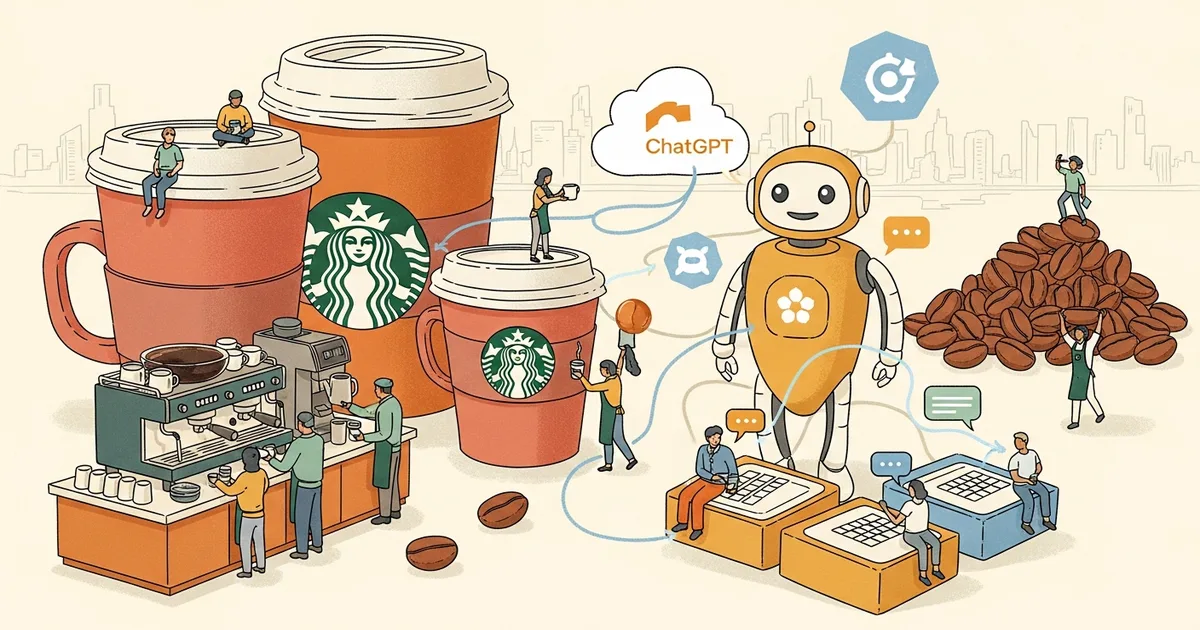
Starbucks Corporation launched a ChatGPT-powered drink recommendation integration on April 25, 2026, becoming one of the first major consumer brands to embed itself inside an active AI conversation. The integration, reported by gHacks, runs on OpenAI’s plugin and CPC advertising infrastructure — and it requests access to your ChatGPT session data before recommending your next latte.
This is not a chatbot. This is a brand reading your conversation.
How the Starbucks ChatGPT Integration Actually Works
The Starbucks ChatGPT integration activates inside ChatGPT when users ask drink-related questions — “What should I get at Starbucks?” or “recommend a cold coffee” — triggering the Starbucks plugin. Once active, it draws on the session context to tailor suggestions: if you mentioned earlier in the conversation that you’re cutting sugar, Starbucks surfaces lower-calorie options; if you said you’re exhausted, it pushes high-caffeine items.
The infrastructure behind this is OpenAI’s plugin system, which has matured significantly since its 2023 debut. Verified brand partners can now receive triggered activations within live conversations and access a defined slice of session context — gated by a consent prompt that most users will click through in under two seconds.
What “Session Data Access” Means in Practice
“Session data” means the text of your ongoing conversation: what you’ve said, what ChatGPT has said back, the topics you’ve raised, and the problems you’ve described. Starbucks doesn’t get your full account history or past sessions. It gets context from the active session at the moment the plugin triggers.
That context can include:
- Health or dietary information shared with ChatGPT earlier in the conversation
- Location references or travel context
- Mood, fatigue, or energy disclosures
- Brand or product preferences mentioned in passing
OpenAI’s plugin documentation describes this as “contextual session access” — a narrowly scoped window. What it does not address clearly is what Starbucks does with that data after the session closes, what retention policies apply, or whether and how session context eventually feeds into Starbucks’ existing Deep Brew AI loyalty infrastructure, which already processes data from 31.4 million active U.S. Rewards members.
OpenAI’s CPC Infrastructure: The Ad Platform Nobody Named It That
OpenAI has been careful not to call this advertising. The partner-facing term is CPC — cost-per-click or cost-per-conversion revenue sharing. Brands pay when a ChatGPT interaction drives a measurable action: a purchase, an app open, a loyalty signup. Functionally, this is an ad platform. Strategically, it’s a significant pivot for a company that built its brand on being a neutral intelligence layer.
OpenAI has been assembling this commercial infrastructure quietly. Its arrangement with Disney — which MegaOne AI covered earlier this year — was widely read as a content licensing play. The Starbucks integration reveals the broader agenda: brands pay to be inside the conversation, not just to license content into training data. The distinction matters enormously for how this platform scales.
The commercial infrastructure play is also consistent with what MegaOne AI analyzed in its OpenClaw coverage — OpenAI positioning itself as a platform layer, not just a model provider. Starbucks is the consumer-facing proof of concept for that thesis.
What Starbucks Gains From Your Conversation Context
The value proposition for Starbucks is direct. Traditional recommendation engines — including its own Deep Brew AI system — work from purchase history and location data. ChatGPT session access adds a third layer: real-time intent and state.
A user who told ChatGPT they’re pulling an all-nighter is a probabilistically better target for a Venti than a Tall. A user managing blood sugar is more likely to convert on a sugar-free modification than a standard promotional push. This is behavioral context no loyalty card can capture. Personalized recommendations outperform generic ones by 20–30% in retail settings, according to McKinsey’s 2025 personalization report. Session context closes that gap further.
Starbucks’ conversion infrastructure is already mature — 36,000 global locations, a mobile ordering system processing millions of daily transactions, and a loyalty program with deep behavioral data. The ChatGPT plugin adds a pre-purchase intent signal that none of those systems previously had access to.
The Privacy Tradeoff Users Are Being Asked to Accept
Users who click through the consent prompt are trading something real: the assumption that their AI conversation is private. That assumption was already fragile — OpenAI retains conversation data for model training unless users opt out — but the Starbucks integration makes the commercial exchange explicit in a way no prior feature has.
The opt-out path exists. Users can decline the session data request, use ChatGPT in incognito mode, or disable third-party plugin access entirely in settings. Most won’t.
The Humans First movement has been tracking exactly this erosion — the gradual disappearance of friction between AI tools and commercial infrastructure until the line between “assistant” and “ad channel” no longer exists. The Starbucks integration is a named milestone on that timeline. The legitimate counterpoint: users already accept this exchange on Google Search, Instagram, and every major consumer platform. The question is whether they’ll accept it inside what was marketed, specifically, as a thinking tool.
The Template for What Follows Starbucks
Starbucks is not an isolated pilot. It’s a proof of concept structured to be replicated by every consumer brand with a loyalty program, a product catalog, and a marketing team that’s heard the word “ChatGPT” in the last 18 months. The category map is predictable:
- QSR and food delivery: McDonald’s, DoorDash, Uber Eats
- Retail: Target, Walmart, Nike
- Travel: Delta, Marriott, Airbnb
- Health and wellness: CVS, Peloton, Headspace
OpenAI has the user base — 500 million weekly active users as of early 2026, according to the company’s own reporting — and now a revenue model that doesn’t require selling subscriptions to grow. The AI integration race across consumer touchpoints is already underway: as MegaOne AI has documented, AI has already saturated weather apps, replatforming consumer categories one vertical at a time. Starbucks inside ChatGPT is the QSR chapter of the same playbook.
Will ChatGPT Plus Subscribers Accept This?
ChatGPT Plus subscribers — paying $20 per month for what was positioned as a premium experience — are the cohort most likely to push back. OpenAI’s terms of service for Plus do not currently guarantee an ad-free or brand-free conversation environment. That gap has received minimal scrutiny until now.
The integration is opt-in today. Every platform that introduced commercial integrations into a previously neutral product — Spotify with brand playlists, YouTube with mid-roll ads, LinkedIn with sponsored content — saw measurable churn at the margins and majority acceptance in the aggregate. ChatGPT will almost certainly follow the same curve.
In three years, the question won’t be whether brands are inside ChatGPT conversations. It will be which brands, at what price, and whether the consent prompt still appears at all. MegaOne AI tracks 139+ AI tools across 17 categories — the shift from AI assistant to AI ad platform is now a line item in the competitive analysis, not a theoretical future state. The door Starbucks just opened only swings one way.