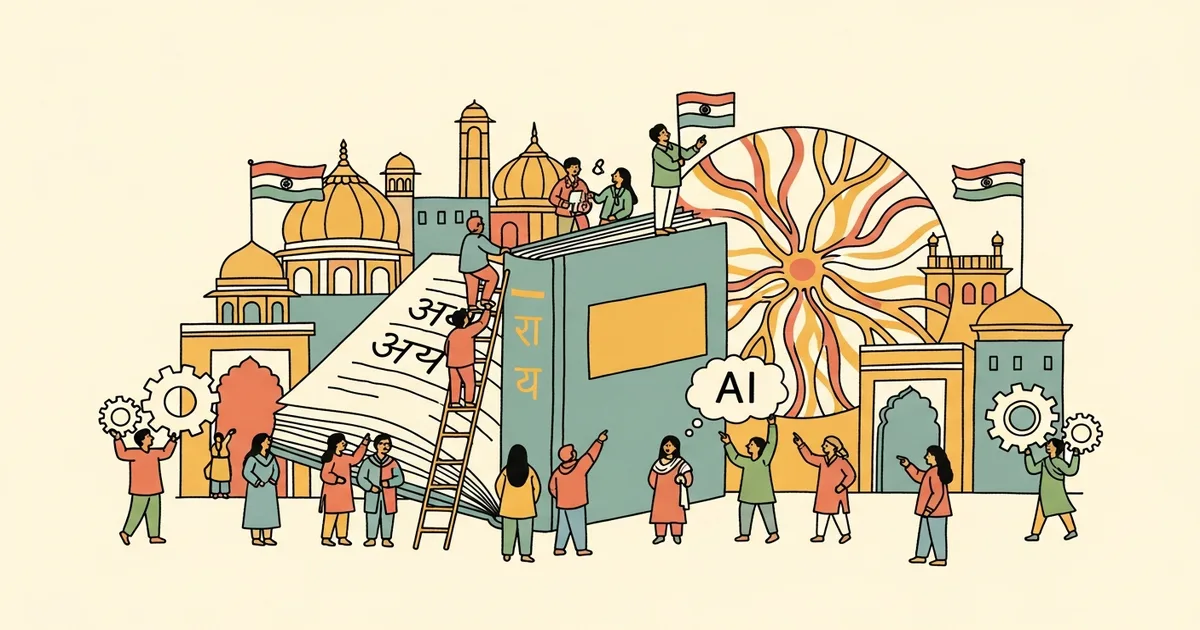
Sarvam AI, the Bengaluru-based multilingual AI startup founded by Vivek Raghavan and Pratyush Kumar, closed a $350 million Series B funding round in April 2026 at a $1.5 billion valuation — backed by Lightspeed Venture Partners and Khosla Ventures. The capital arrives alongside Sarvam AI’s release of a 105-billion-parameter frontier model that the company claims outperforms global competitors on Indic language code-switching benchmarks. It is the largest private funding round ever secured by an Indian AI company building indigenous foundation models.
This is not a localization play dressed up as innovation. It is a structural bet on a gap that US frontier labs have consistently underinvested in — and one that now has serious institutional backing behind it.
What the Sarvam AI Funding Round Actually Signals
Lightspeed Venture Partners and Khosla Ventures co-led the raise. Khosla, which made early bets on OpenAI, is now diversifying its frontier model exposure into non-English markets — a signal that demand for AI sovereignty is becoming a durable venture thesis, not just a policy talking point. The $1.5 billion valuation represents a roughly 7x step-up from Sarvam AI’s estimated valuation at its $41 million Series A in early 2024.
The speed of that jump tracks with India’s government AI commitments. The IndiaAI Mission — a ₹10,372 crore ($1.25 billion) government program announced in 2024 — explicitly targets development of Indic-language foundation models, and Sarvam AI is one of its primary beneficiaries. Access to government compute infrastructure and early public-sector contracts changes the risk profile of this investment considerably.
That government backstop is what separates Sarvam AI from a typical AI startup bet. European AI infrastructure company Nebius is committing $10 billion to sovereign compute in Finland for similar reasons: governments globally are treating AI infrastructure as a strategic asset, not a commercial service to be imported. India is running the same playbook with more urgency.
The 105B Model: What the Code-Switching Claim Actually Means
The technical claim at the center of Sarvam AI’s announcement is a 105-billion-parameter model that outperforms international competitors on Indic code-switching — the practice of flipping mid-sentence between Hindi, English, and regional languages like Tamil or Marathi that defines how 200 million-plus urban Indians actually communicate. This isn’t an edge case. It’s the default mode of written Indian social media, customer service, and commerce.
Most frontier models are trained on data that is over 90% English. Hindi, spoken natively by approximately 530 million people and as a second language by another 250 million, accounts for less than 0.1% of Common Crawl — the primary training corpus for most large language models, according to data from the BigScience research project. The consequence is systematic degradation on Hinglish, the dominant mode of written urban Indian communication.
Sarvam AI’s architectural response was to pre-train from scratch on a corpus spanning 22 Indian languages, rather than fine-tuning an English-dominant base. The company collected over 4 trillion tokens of Indic-language data — much of it from transcription of spoken audio, speech recognition outputs, and regional media that don’t appear in Western training datasets. That data collection moat, not the 105B parameter count, is the defensible asset. Parameter counts are replicable. Proprietary training data is not.
A Track Record That Precedes the Model
Sarvam AI didn’t arrive at a 105B frontier model cold. The company spent its first years on automatic speech recognition and text-to-speech for Indian languages — products where the performance gap between Indian users and English-speaking users was most immediately visible and commercially urgent.
Publicly available ASR benchmarks show word error rates running 2–3x higher on Indian-accented English than on American-accented English across standard recognition systems. Sarvam AI’s Bulbul ASR model and Shuka TTS system targeted this gap directly, building both the training data infrastructure and the architectural know-how that now underlies the 105B parameter model. That bottom-up trajectory — starting with speech and perception, building upward toward reasoning — is the inverse of how most US frontier labs approached multilingual capability, which was to add language support as an afterthought to English-first models and watch performance degrade accordingly.
India’s Sovereign AI Push: Geopolitics Meets Model Architecture
Sarvam AI’s raise is the most prominent private-sector expression of an explicit government policy commitment. India’s concern about AI sovereignty is strategic: a country that relies on US-based AI infrastructure for healthcare records, banking, and government service delivery is exposed to supply chain risk, extraterritorial data access, and cultural misalignment embedded in the models themselves.
The IndiaAI Mission’s structure makes the support concrete. Participating companies receive access to approximately 10,000 GPUs from the government’s compute pool — meaningful infrastructure for training runs that otherwise cost tens of millions of dollars — in exchange for releasing model weights to benefit the domestic ecosystem. Sarvam AI participates in this arrangement while building proprietary commercial products on top. The structure mirrors how Taiwan and South Korea built semiconductor industries: government-backed capacity creation followed by private-sector commercialization at scale.
Even as OpenAI pursues aggressive enterprise expansion globally, regional language gaps are producing structural openings that English-first labs are architecturally constrained to close. Fine-tuning does not fix a training data gap. It papers over it.
The Competitive Map: Krutrim, Google, and the B2G Angle
Sarvam AI’s primary domestic competitor is Krutrim, the AI subsidiary of ride-hailing company Ola, which claimed India’s first AI unicorn status in early 2024. Krutrim is focused on consumer-facing AI products and vertical enterprise applications. The two companies are targeting adjacent, not identical, markets — for now.
Google remains the dominant structural threat. Gemini‘s Indian language capabilities have improved through targeted training investment, and Google’s Android distribution puts Gemini pre-installed on hundreds of millions of Indian smartphones. That consumer distribution advantage is real and not easily overcome by a startup.
Sarvam AI’s counter-positioning is B2B and B2G. The strategy is to be the API infrastructure layer for Indic-language AI — the model that enterprises, government departments, and developers build on — rather than compete for the consumer assistant market that Google controls. That positioning means the valuation case rests on enterprise contract value, not consumer metrics, which requires a fundamentally different go-to-market motion.
Where the 0 Million Gets Deployed
Sarvam AI’s stated priorities are compute, data, and distribution. The 105B model requires continuous training runs on expensive GPU infrastructure; the $350 million provides runway to sustain those cycles without full dependency on government compute allocation. Three verticals represent the near-term revenue concentration:
- Government and public sector: India’s digital public infrastructure stack — Aadhaar, DigiYatra, ONDC, the Ayushman Bharat Digital Mission — generates persistent demand for Indic-language NLP at scale. Single department contracts run to tens of millions of dollars annually and carry multi-year commitment periods.
- Banking and fintech: India’s UPI ecosystem processed over 16 billion transactions per month as of early 2026, according to the National Payments Corporation of India. Financial services companies need language-native AI for customer support, fraud detection, and document processing across customer bases that are largely non-English.
- Healthcare documentation: Indic-language speech recognition for clinical records is a high-margin, underserved vertical with regulatory tailwinds from ABDM digital health mandates pushing toward structured clinical data capture.
Developer API access — per-token pricing for Indic-language inference — adds a long-tail revenue stream that compounds as the developer ecosystem around Indian-language AI matures.
The Broader Signal: AI Is Fragmenting Along Language Lines
The most significant implication of Sarvam AI’s raise is what it reveals about global AI market structure. English-dominant frontier models built in the US have a structural ceiling in markets where the majority of the population isn’t English-fluent. India has roughly 130 million fluent English speakers out of 1.4 billion people, according to the EF English Proficiency Index — leaving approximately 1.27 billion people as users of AI products that US models serve poorly by design.
Multiply that dynamic across Southeast Asia, the Arab world, Latin America, and sub-Saharan Africa, and the addressable market for language-native AI infrastructure exceeds the US frontier model market by a substantial margin. The ongoing debate about who AI actually serves has focused predominantly on labor market disruption in wealthy, English-speaking countries. The more structurally durable question is whether AI infrastructure will be built by and for the 5 billion-plus people who are not fluent English speakers — or built elsewhere and retrofitted inadequately.
Sarvam AI, Mistral in France, Falcon from the UAE’s Technology Innovation Institute — these are not outliers. They are the early nodes of a fracturing frontier model landscape in which language sovereignty is a genuine competitive differentiation, not a political preference. The companies that control native-language pre-training data will have moats that English-first players will find expensive to replicate regardless of parameter count or compute spend.
The bottom line: Sarvam AI’s $350 million raise is a credible, well-structured bet on a gap that global AI infrastructure has consistently underserved. The technical thesis is correct — training data determines language capability, and no English-first lab will close the Indic language performance gap with post-hoc fine-tuning. The execution risk is real: converting model quality into enterprise revenue at a scale that justifies $1.5 billion requires sales infrastructure and government relationships that compound slowly. The government contract pipeline over the next 12 months is the actual performance indicator — not benchmark scores.