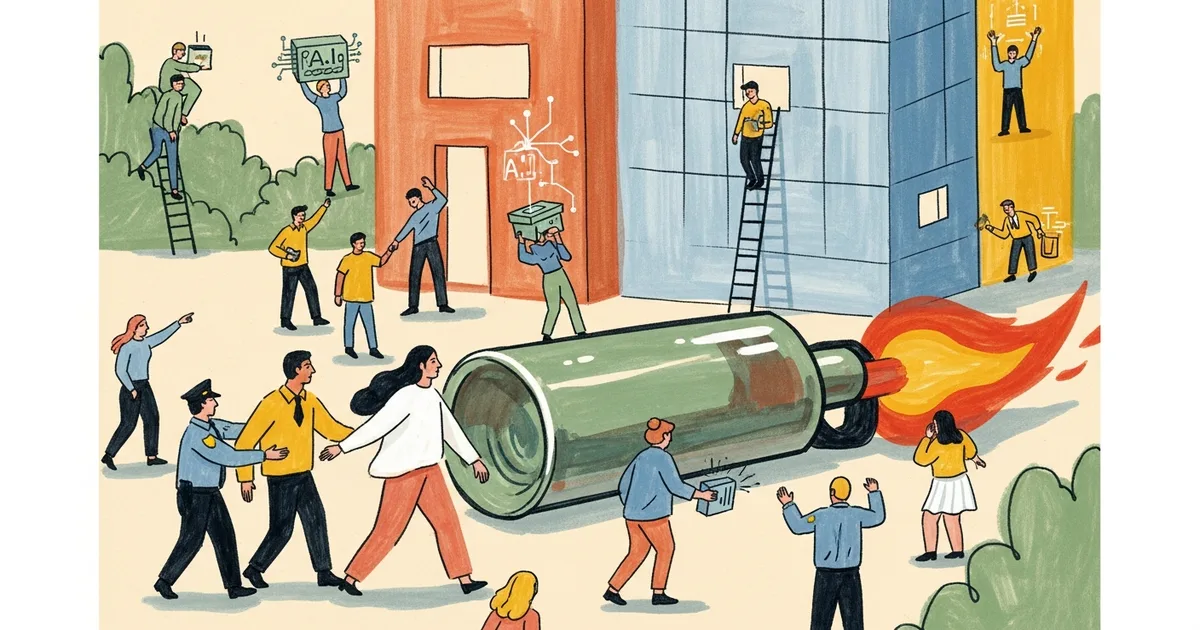
Daniel Moreno-Gama, a 20-year-old Texas man, has been charged with attempted murder and attempted arson following an alleged sam altman molotov attack on the OpenAI CEO’s San Francisco residence, prosecutors announced in April 2026. The charges mark the most legally significant incident of violence against an artificial intelligence executive in the United States.
Moreno-Gama faces felony counts that, if he is convicted, carry potential sentences measured in decades. Sam Altman had previously made a public plea for de-escalation following the incident — a measured response that underscored how sharply the landscape has shifted when a technology CEO must address an attempted firebombing of his own home.
The Charges: Attempted Murder and Arson
Prosecutors charged Moreno-Gama with attempted murder and attempted arson — two felony counts reflecting both the alleged intent to harm Altman directly and the use of an incendiary device against an occupied structure. Attempted murder in California requires prosecutors to establish specific intent to kill, not merely recklessness.
Attempted arson of an inhabited dwelling carries a sentence of up to nine years in California state prison under Penal Code Section 455. Attempted murder involving a destructive device can carry substantially longer terms depending on enhancement filings — in some cases pushing total sentencing exposure beyond 25 years.
Court documents allege Moreno-Gama traveled from Texas to San Francisco specifically to carry out the attack, a detail prosecutors will use to argue premeditation. Interstate travel to commit a crime is also a federal exposure vector that prosecutors have not publicly ruled out.
Who Is Daniel Moreno-Gama?
Moreno-Gama is 20 years old and a Texas resident. At the time of his arrest, he was not publicly affiliated with any organized anti-AI group, though investigators have been examining his online activity and communications for evidence of motive and potential coordination with others.
The profile fits a demographic pattern that federal threat analysts have flagged across multiple assessments: young men, often without prior criminal records, who migrate through online communities framing AI development as an existential attack on human dignity and employment. Groups connected to the Humans First movement have cultivated increasingly explicit rhetoric positioning AI executives as legitimate targets for retaliation.
No public manifesto or statement from Moreno-Gama was released as of April 15, 2026. Investigators have sealed portions of his communications pending the preliminary hearing.
Timeline: From Molotov Cocktail to Murder Charges
The key sequence in the Moreno-Gama case:
- Moreno-Gama allegedly traveled from Texas to San Francisco carrying materials to construct a Molotov cocktail — a glass bottle filled with flammable liquid engineered to ignite on impact.
- The incendiary device was thrown at Altman’s San Francisco residence. It did not cause the structure to fully ignite, but the attack triggered an immediate law enforcement response and arrest at the scene.
- Altman subsequently issued a public statement declining to call for maximum prosecution, instead urging broader societal engagement with AI-related anxieties — a posture described by his office as a personal response, not a legal position.
- Moreno-Gama was held in custody pending formal charges.
- In April 2026, prosecutors announced the formal counts of attempted murder and attempted arson.
Altman’s De-Escalation Plea
Sam Altman’s public response was notable for what it declined to do. Rather than calling for the full force of prosecution or framing the incident as an attack on innovation, Altman expressed a desire to engage with the underlying anxieties. “The frustration is real,” Altman wrote in a post following the attack, according to reporting at the time. “I want to talk to people, not be attacked by them.”
The posture drew sharply divided reactions. Some observers credited it as genuine leadership — a refusal to escalate a moment that could easily become a culture-war flashpoint. Others called it a strategic miscalculation that understated the severity of an attempted incendiary attack on a residential building.
OpenAI has navigated sustained public scrutiny over the pace and scale of its technology deployments, from governance controversies to major commercial moves like its reported $1 billion arrangement with Disney. Whatever Altman’s personal posture, prosecutors are now pursuing the case independently — and attempted murder is a charge that does not lend itself to soft landings regardless of the victim’s public statements.
AI Executive Targeting: The Pattern Behind This Incident
The Moreno-Gama case is the sharpest point on a trend that predates it. Hostility toward technology and AI executives escalated sharply after late 2024, when the killing of UnitedHealthcare CEO Brian Thompson in New York demonstrated a latent audience that viewed executive violence as justified — and in some online spaces, celebrated. The effects reached every industry with visible, publicly named leadership.
In AI specifically, the combination of mass media visibility, transformative and disruptive technology, and documented labor displacement has made executives like Altman, Anthropic CEO Dario Amodei, and Meta AI chief Yann LeCun unusually prominent in online radicalization spaces. Threats have been reported across the major AI labs; physical incidents remain statistically rare but are no longer unprecedented.
MegaOne AI tracks 139+ AI tools across 17 categories, and the displacement of human roles in writing, coding, legal research, and customer service is a documented reality — not a hypothetical grievance. That reality has fueled genuine economic anxiety, which organized online communities have translated into increasingly violent rhetoric directed at the people most publicly identified with that displacement.
The physical security posture of major AI labs has already shifted in response. Anthropic, which faced its own serious exposure when source code for a Claude AI agent was accidentally published, has expanded both digital and physical security protocols substantially. OpenAI has done the same — though the Moreno-Gama case demonstrates that hardened targets remain penetrable to determined actors operating outside organized threat groups.
What the Case Means Legally and Politically
Moreno-Gama faces a preliminary hearing process that will take months to resolve. If the case proceeds to trial, the question of motive — including his online activity, ideological affiliations, and communications — will enter the public record in detail. That record will be analyzed by researchers, journalists, and policymakers examining whether AI-related radicalization constitutes a distinct and growing threat category warranting dedicated law enforcement resources.
The charges also create a precedent question: should AI-related motivation be treated as an aggravating sentencing factor, analogous to how hate crime enhancements operate? No such statutory framework exists in California. Prosecutors in at least two states have begun drafting legislation that would treat attacks motivated by anti-technology ideology similarly to domestic terrorism enhancements.
Sam Altman leads a company that crossed a $300 billion valuation in 2025 and operates at the center of the most consequential technology transition since the internet. An attempted murder charge against a 20-year-old who traveled from Texas to throw a Molotov cocktail at his residence is the sharpest possible signal of where that transition has taken public sentiment.
The bottom line: Prosecutors charging Daniel Moreno-Gama with attempted murder are not treating this as a fringe incident — and neither should the AI industry. This is the legal system catching up to a pattern that security professionals and threat analysts have been tracking for over a year. The verdict, whenever it comes, will set the tone for how the United States categorizes and punishes violence against AI leadership going forward.