Sam Altman, Chief Executive Officer of OpenAI, disclosed in April 2026 that his home was physically attacked — and used the moment not to demand sympathy, but to demand that the AI industry stop feeding the conditions that produce this kind of escalation. The statement landed in a climate where anti-AI rhetoric has moved from conference panels to front lawns.
OpenAI is simultaneously at the height of its commercial power and the center of a widening cultural backlash. Altman’s public reflection — covering personal regrets, OpenAI’s trajectory, and the industry’s inflammatory language — is one of the more candid statements any AI executive has made in a period defined by corporate defensiveness.
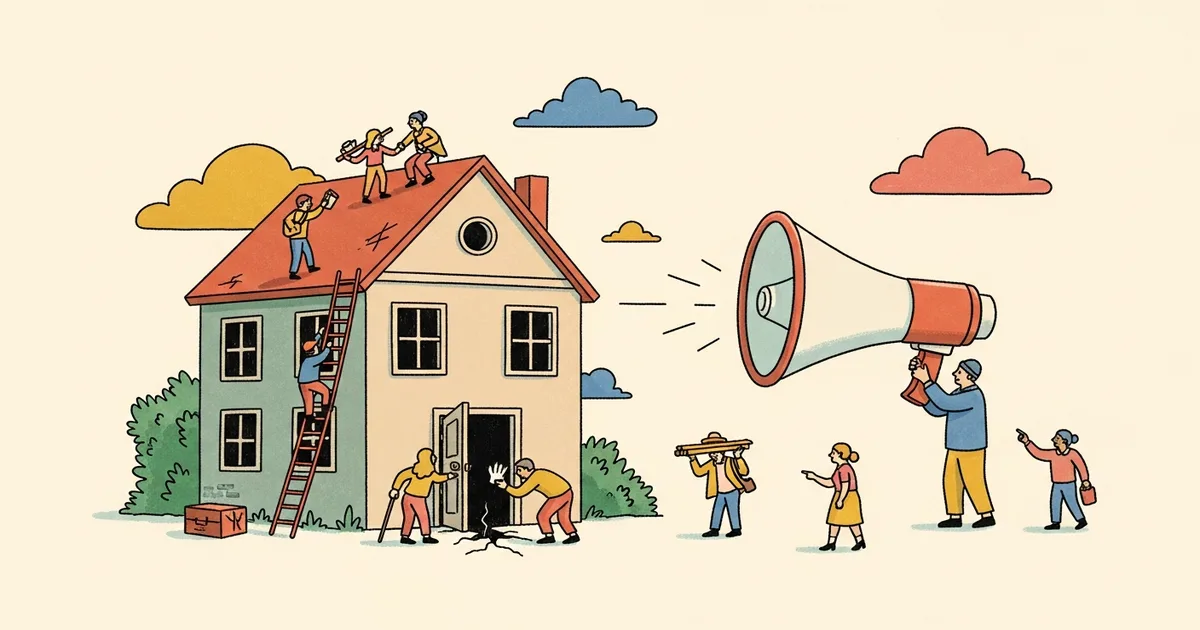
What Happened: The Sam Altman House Attack
Details of the attack on Altman’s residence remain limited by design — law enforcement confirmed an incident, and Altman acknowledged it publicly without sensationalizing the particulars. That restraint was itself a message.
This is not the first time an AI executive has faced physical targeting. The pattern across the industry — vandalism, credible threats, organized demonstrations at private addresses — has accelerated in parallel with AI’s commercial expansion. What changed in April 2026 is that the CEO of the world’s most visible AI company named it plainly and asked for it to stop.
Altman’s Statement: A Plea for Proportionality
Altman’s public response avoided victimhood framing. He acknowledged the attack, expressed that he holds no personal animus toward critics of AI, and made a specific ask: that the language used by both AI advocates and detractors return to proportionality.
“The rhetoric has to come down,” Altman stated. He drew a line between legitimate criticism of AI development — which he called necessary and valuable — and dehumanizing language that, in his framing, gives permission for physical action.
He also reflected on personal regrets, declining to fully itemize them but signaling that OpenAI’s growth has not been without internal cost. This kind of candor is unusual for a sitting CEO of a company valued in the hundreds of billions. It reads less like crisis management and more like someone who has thought seriously about what the last few years have cost.
OpenAI at Peak Power, Peak Scrutiny
OpenAI currently operates at a scale that makes it structurally impossible to stay out of political and cultural debates. The company’s annualized revenue crossed $5 billion by early 2026, its enterprise partnerships span healthcare, media, and government, and its models underpin tools used by hundreds of millions of people daily.
Recent moves — including a $1 billion content partnership with Disney that blindsided competitors — have expanded OpenAI’s footprint into culture industries where AI skepticism runs deepest. Each expansion generates new critics, and the critics have increasingly coordinated. The competitive pressure from Meta and other players has also intensified the public narrative around AI consolidation. When a handful of companies control infrastructure that touches every knowledge worker, the political valence of that control becomes a target.
The Broader Pattern: AI Executives Under Physical Pressure
Altman is not alone. In 2025 and 2026, multiple AI company executives reported credible threats, targeted home visits by organized groups, and coordinated harassment campaigns across platforms. None of this is new to Silicon Valley — but the ideological coherence of the anti-AI movement distinguishes it from earlier waves of tech backlash.
The Humans First movement, which frames AI development as an existential threat to human labor, dignity, and autonomy, has grown from a niche position into a mainstream organizing framework. Its more radical factions explicitly endorse disruption of AI operations — a category that, for some actors, has expanded to include the people running those operations.
Anthropic, OpenAI’s primary direct competitor, experienced a different kind of exposure when source code for its Claude AI agent was accidentally published — a reminder that security vulnerabilities at AI companies exist across multiple vectors simultaneously. The industry’s openness to scrutiny cuts both ways.
Who Is Escalating the Rhetoric
The escalation is not one-directional. AI companies and their executives have repeatedly used language that critics argue minimizes displacement harm and frames opposition as ignorance rather than legitimate concern. Characterizing skeptics as Luddites, or presenting the AI transition as inevitable and therefore beyond moral evaluation, creates a discourse environment where opposition feels existential rather than tractable.
When critics believe they cannot participate meaningfully in decisions that affect their livelihoods, some will move outside formal channels. That is not a justification for attacking someone’s home. It is an explanation for the conditions that normalize escalation — and Altman, to his credit, appears to understand the distinction.
Altman’s call for de-escalation carries more weight precisely because it comes from the dominant player. OpenAI sets the industry’s rhetorical temperature as much as its technical direction. A company that processes more AI queries than any other has the leverage — and arguably the obligation — to change the conversation’s register.
The Stakes of Getting the Response Wrong
Physical security incidents involving AI executives carry two compounding effects. First, they create a chilling effect on public engagement — executives become less accessible, less candid, and less willing to engage with criticism publicly. The result is less accountability, not more.
Second, they provide political cover for AI companies to deflect legitimate regulatory and labor concerns under a security umbrella. Conflating organized labor opposition with targeted harassment lets companies reframe structural critics as threats. This dynamic serves no one except companies that want to dismiss opposition wholesale.
Altman appears aware of this trap. His statement drew an explicit distinction between the attack on his home and the legitimacy of AI criticism — a distinction that matters practically, because collapsing it is the easy corporate move and the wrong one.
What Proportionate Pressure on AI Actually Looks Like
The critics with the most leverage over AI development are not those targeting executives’ homes. They are regulators in Brussels and Washington who have passed binding legislation, labor unions that have successfully negotiated AI-use clauses into studio and journalism contracts, and researchers who publish empirical work on model bias, energy consumption, and deployment harm.
The EU AI Act, now fully operative in 2026 following its phased rollout, has already forced modifications to how OpenAI deploys certain high-risk capabilities in European markets. The AFL-CIO’s AI working group has established binding precedent in multiple contract negotiations. These are the interventions that change corporate behavior at scale — not incidents that ultimately give AI companies a sympathetic news cycle.
Altman’s de-escalation call implicitly acknowledges that OpenAI needs critics engaging through these channels. Not because engagement is comfortable, but because it is the only mechanism that produces accountability outcomes rather than security incidents.
The Contradiction OpenAI Now Has to Own
OpenAI in April 2026 is a company navigating a tension it helped create: it built systems powerful enough to generate legitimate fear, sold those systems as beneficial at scale, and now must explain the gap between those two claims to a public that has had mixed results with the technology. MegaOne AI tracks 139+ AI tools across 17 categories and the pattern is consistent — public trust in AI systems correlates directly with how transparently companies communicate limitations and tradeoffs.
Altman’s reflection on personal regrets signals awareness that OpenAI’s public posture has not always served clarity. Whether that awareness translates into material changes — in how the company communicates risk, handles workforce displacement, or engages labor criticism — will determine whether this de-escalation call lands as genuine or strategic.
The AI industry’s most consequential communication problem is not that critics are too loud. It is that the industry spent years being too vague about what it is building and who bears the costs. Altman’s statement is a start. The follow-through is the test — and the industry is watching closely enough to know the difference.