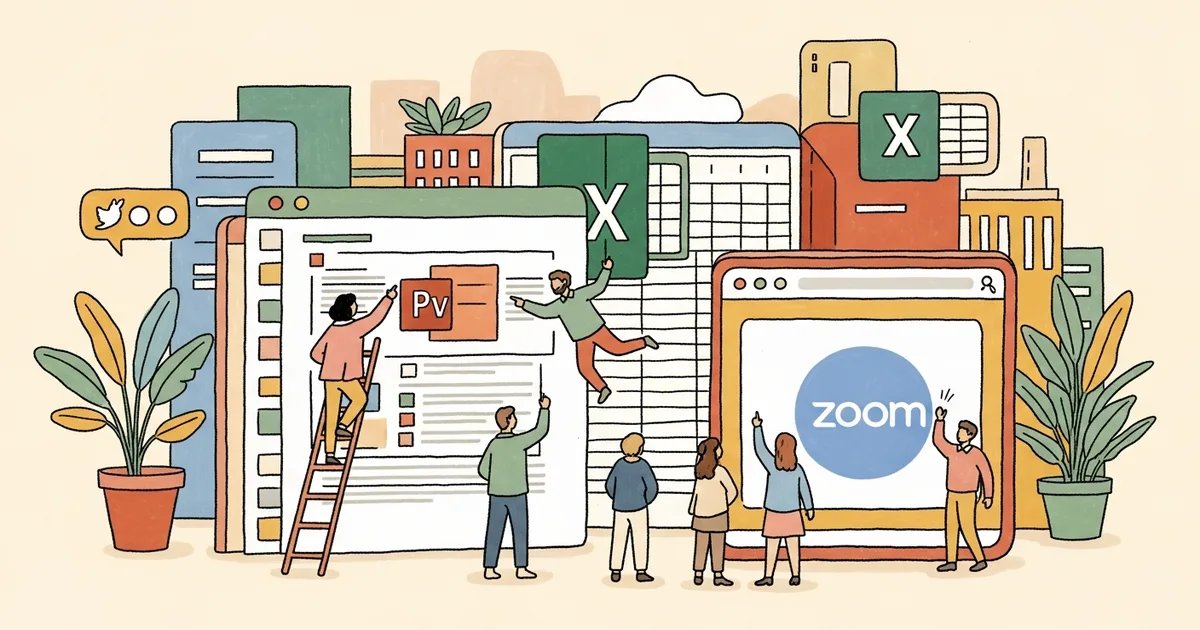
Genspark, the AI productivity platform founded by ex-Baidu and Google engineers, launched AI Workspace 4.0 on April 10, 2026, with one architectural shift that changes everything: the AI employee no longer lives on a cloud computer. It runs on your actual desktop, inside your open PowerPoint files, inside your Excel spreadsheets, and it translates your Zoom calls in real time. Where Workspace 3.0 introduced the cloud-hosted AI employee concept, 4.0 eliminates the virtual layer separating the agent from your actual work.
What Changed From 3.0 to 4.0
Workspace 3.0 gave enterprise users a browser-based AI agent operating on a cloud-hosted machine — capable of autonomous web tasks but isolated from the applications most knowledge workers spend their day in. The median knowledge worker spends 2.5 hours daily inside Microsoft Office applications, according to Microsoft’s 2025 Work Trend Index, and another 1.8 hours on video calls. Workspace 3.0 couldn’t operate in either environment.
Workspace 4.0 uses computer-use capabilities to interact with native Windows and macOS applications directly. The agent reads your Excel data, edits PowerPoint slides, and drafts or rewrites Word documents without requiring you to copy content into a separate chat interface. The workflow stays where you already work.
The jump from cloud computer to desktop agent mirrors a broader shift in agentic AI: the first wave automated tasks in sandboxed environments; the current wave automates tasks in the environments where real work actually happens. Anthropic’s accelerating agent SDK development and OpenAI’s deepening enterprise integrations are moving along the same vector — every major AI lab now treats the professional desktop as the primary battleground.
Inside Office: PowerPoint, Excel, and Word
In PowerPoint, the agent takes a plain-language prompt — “build a 10-slide deck from this Q1 report” — and produces a structured presentation using data from a source file already open on your desktop, with formatting and speaker notes applied. It doesn’t generate a generic AI template; it operates on your actual content in context.
In Excel, Workspace 4.0 handles instructions like “show month-over-month revenue variance for Q1” and returns the corresponding formulas, pivot tables, and conditional formatting. For analysts who know what analysis they need but move faster in natural language than formula syntax, this removes a genuine bottleneck — not a convenience, a speed constraint.
Word integration centers on drafting, rewriting, and summarization. The agent can compress a 40-page contract into a structured executive summary or expand bullet points into full report sections. The critical differentiator: Genspark’s agent executes cross-application, multi-step workflows — moving from an Excel data file to a PowerPoint deck to a Word summary in sequence, with no manual handoffs between steps. That’s the capability Microsoft 365 Copilot still doesn’t offer.
Live Meeting Translation Inside Zoom
Workspace 4.0 adds real-time translation for Zoom, Microsoft Teams, and Google Meet calls. The feature covers 45 languages with sub-200ms latency, according to Genspark’s product announcement — fast enough that translated audio overlaps the original speaker with no perceptible lag. The agent joins as a background participant, delivers translated audio or on-screen captions in real time, and logs a timestamped multilingual transcript automatically.
For multinational teams running cross-border sales calls, product reviews, or executive briefings, this replaces both third-party interpreter services and the post-call translation pass that typically delays documentation by hours. The business case is direct: organizations spending on per-session interpretation services at enterprise rates can consolidate that cost into a per-seat AI employee subscription.
Real-time translation is not an empty field. Microsoft Teams Premium includes it at $7/user/month as a standalone add-on; Wordly and Interprefy serve enterprise events at higher per-session rates. Genspark’s angle is that translation is one capability inside a persistent AI employee — not a separate product line, not a line item on a separate SaaS contract. Whether that bundling argument holds in procurement decisions depends on whether enterprises want unified AI employees or specialized point solutions, a debate actively reshaping how AI productivity tools compete in 2026.
Genspark Workspace 4.0 vs. Microsoft Copilot
Microsoft 365 Copilot, priced at $30/user/month on top of existing Microsoft 365 licensing, is the most direct structural comparison. Copilot is natively embedded in Office and benefits from deep integration with calendar, SharePoint, and organizational identity data. What it doesn’t do: coordinate tasks across multiple Office applications simultaneously, translate live meetings natively, or operate as a persistent desktop agent with computer-use capabilities outside the Microsoft 365 environment.
| Feature | Genspark Workspace 4.0 | Microsoft 365 Copilot |
|---|---|---|
| Works inside PowerPoint | Yes | Yes |
| Works inside Excel | Yes | Yes |
| Cross-app multi-step automation | Yes | No |
| Live meeting translation | Yes — 45 languages | No (Teams Premium add-on, $7/user/mo) |
| Desktop computer use | Yes | No |
| Base pricing | Enterprise waitlist (TBD) | $30/user/month + M365 license |
Microsoft’s structural advantage is trust and data integration — Copilot inherits enterprise identity, compliance certifications, and legal frameworks that Genspark is still building. Genspark’s advantage is execution breadth: it completes multi-application workflows autonomously rather than assisting within one app at a time. These are genuinely different value propositions targeting different enterprise bottlenecks, not a straightforward feature comparison.
MegaOne AI tracks 139+ AI tools across 17 categories, and the agentic desktop segment has produced more product launches in Q1 2026 than any other category in our coverage. The pattern is consistent: companies are moving from chat-layer assistants embedded in single applications to agents that manipulate files, execute tasks across systems, and operate persistently in the background.
Pricing and the Build-vs-Buy Calculation
Genspark has not published final Workspace 4.0 pricing at launch. The company is operating an enterprise waitlist, consistent with its Workspace 3.0 rollout, which started at approximately $49/month for individual users with per-seat enterprise pricing negotiated separately.
For IT teams running a build-vs-buy analysis: replicating Workspace 4.0’s core capabilities in-house requires integrating the Microsoft Graph API for Office file access, an LLM with computer-use capabilities for instruction execution, and a real-time speech translation service with sub-second latency — three separate vendor relationships, three separate security reviews, three separate update cycles. Genspark bundles all three into a single persistent agent. The operational cost of managing those integrations doesn’t appear in a per-seat price comparison, but it’s real.
The Governance Gap No One Has Solved
An AI employee that modifies Excel files, rewrites PowerPoint decks, logs meeting transcripts, and executes actions across applications needs the same access controls, permission scoping, and audit trails as a human employee with those system privileges. The accelerating pressure around AI accountability means regulated industries — financial services, healthcare, legal — will require data residency guarantees, granular permission controls, and action logging before deploying any desktop AI agent at scale.
Genspark has not published detailed documentation on these controls for Workspace 4.0 as of launch. That’s the company’s most pressing product gap, and it’s not a feature request — it’s a procurement prerequisite for the enterprise segment Workspace 4.0 is clearly targeting. Microsoft Copilot’s advantage in regulated environments isn’t primarily technical capability. It’s that Microsoft already has the compliance certifications and enterprise agreements that AI-native startups are still accumulating.
Genspark has roughly one product cycle to close that gap before enterprise procurement teams start treating it as a disqualifying condition rather than a roadmap item.
What Workspace 4.0 Actually Represents
The trajectory is compressed: AI assistant in a single app (Copilot, 2023) → AI agent on a cloud computer (Workspace 3.0, 2025) → AI employee on your actual desktop (Workspace 4.0, 2026). Three years. Organizations that deferred AI workforce strategy decisions while waiting for mature products are now evaluating software that autonomously executes multi-application workflows inside their existing tools without a separate interface or manual coordination step.
Workspace 4.0 is the most direct attempt yet to make “AI employee” a literal job description rather than a marketing abstraction. It works inside your files, translates your meetings, and moves between applications without you coordinating the handoffs. The governance gaps are real and will gate enterprise adoption in regulated sectors. But the product is no longer a proof of concept — it’s a business decision, and the question for every enterprise evaluating it is whether they want to make that decision now or in six months when competitors already have.
![Editorial illustration for: OpenAI Killed Sora — Here Are 5 AI Video Generators That Are Actually Better [Ranked 2026]](https://megaoneai.com/wp-content/uploads/2026/04/sora-alternatives-2026-600x450.webp)