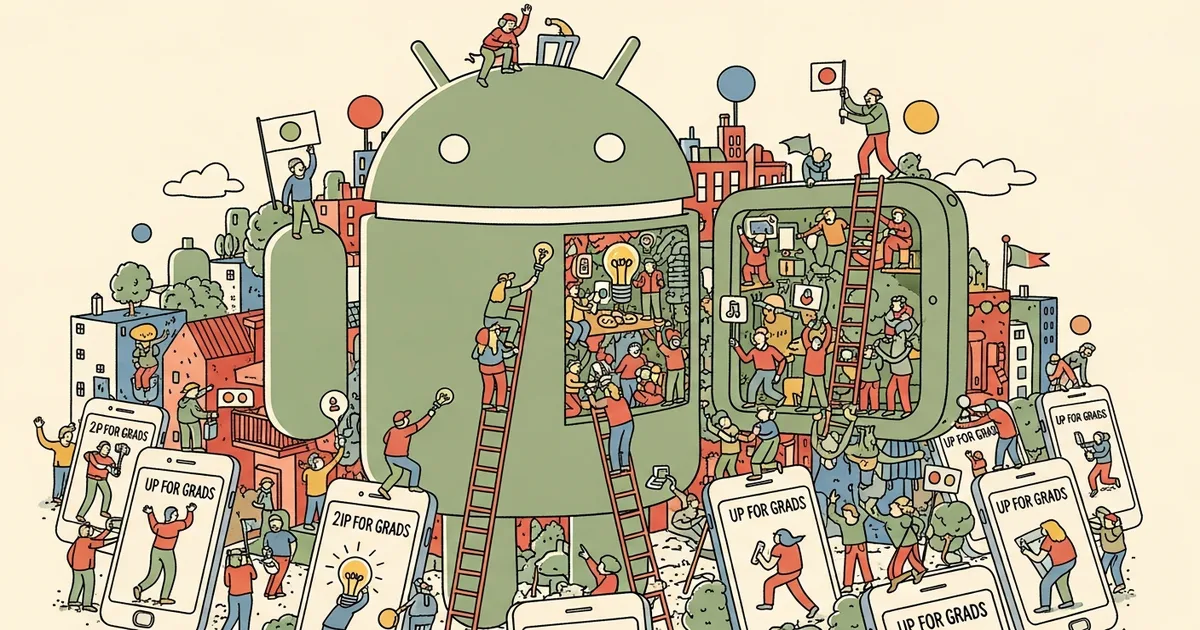
The European Commission has issued binding decisions ordering Google to open Android to rival AI assistants and to share its search data with competing AI developers. The orders reshape who is allowed to reach roughly 2 billion Android devices — a distribution channel no competitor could buy at any price.
The eu google android ai assistants decisions do something antitrust remedies rarely manage: they attack the default, which is the only part of the assistant market that has ever mattered.
What the Commission actually ordered
Two obligations sit at the center of the decisions.
Assistant interoperability. Android must accommodate rival AI assistants — meaning third-party assistants can occupy the positions Gemini currently holds by construction: the long-press gesture, the assistant slot, the setup-flow choice.
Search data sharing. Google must share search data with competing AI developers. This is the more consequential half. Query data is the training and grounding substrate for answer engines, and Google’s is the largest such corpus in existence outside of Microsoft’s.
The pairing is deliberate. Access without data would produce rival assistants that are visible but worse. Data without access would produce better rivals nobody can reach.
Why defaults decide this market
Assistant market share tracks placement, not quality. The evidence has been consistent for a decade: Google paid Apple an estimated $20 billion a year for Safari search default, and Android’s assistant slot has never been won by a competitor on merit because it has never been contestable.
Two billion devices with a genuine choice screen is a different market structure. The beneficiaries, ranked by readiness to exploit it:
| Contender | Position in Europe | Readiness |
|---|---|---|
| Mistral | French, EU-domiciled, sovereignty narrative | Strongest regulatory and political fit |
| OpenAI (ChatGPT) | Largest consumer AI brand | Highest name recognition, existing mobile app |
| Anthropic (Claude) | Enterprise-weighted | Strong model, thinnest consumer mobile presence |
| Perplexity | Search-native answer engine | Best product-market fit for the search-data remedy |
Mistral’s position strengthened considerably this quarter. Samsung took a €1 billion stake in the company, and Microsoft signed a European AI infrastructure deal with it — a handset maker and a hyperscaler both positioning around European distribution before the remedy lands.
Google is defending a slot its model has not filled
The order arrives while Gemini 3.5 Pro has reportedly missed general availability three times: the June I/O promise to ship the following month, a June 30 target, and a third slip in July. It remains in limited Vertex AI preview with no published benchmarks and no pricing.
That sequence is the awkward part of Google’s position. The company is being ordered to share a slot occupied by a product that has not shipped on schedule, while shipping incremental releases around it — including Gemini 3.6 Flash’s token-efficiency gains and Live Translate for real-time speech. Consumers have also been navigating shifting usage limits.
A default is worth most when the alternatives are worse. Three missed GA targets narrow that gap for exactly the competitors the Commission is letting in.
Google’s appeal options, and why they may not help
Google can appeal to the General Court in Luxembourg. Recent history sets the expectation: appeals of Commission decisions take years, and the obligations generally apply during them.
The company’s realistic path is compliance-shaping rather than reversal — implementing the choice architecture in the least disruptive way available, then litigating the interpretation. That playbook has limits in Europe now. Apple tried a narrow reading of the Digital Markets Act and ended up delaying Siri AI for EU iPhone users entirely, blaming the standoff. Withholding the feature is a legal option and a commercial defeat.
Google is also under separate pressure in Germany, where a media law challenge targets AI Overviews and Perplexity. The European exposure is not a single case.
How this collides with the AI Act on August 2
The EU AI Act’s next application date is August 2, 2026. Any assistant that becomes a default on 2 billion devices in Europe lands squarely inside its general-purpose AI obligations — transparency, systemic-risk assessment, and documentation duties that scale with deployment.
The interaction produces an unintuitive result: the competition remedy opens the door, and the AI Act taxes everyone who walks through it. Smaller entrants gain access to a market with higher fixed compliance costs than the market they were previously excluded from.
Practically, that favors well-capitalized entrants — OpenAI, Anthropic, Mistral with Samsung and Microsoft money behind it — over the long tail the remedy nominally serves.
What changes for developers and buyers
Three concrete consequences worth planning around:
- Assistant integration becomes a real distribution channel in Europe. If your product has an assistant surface, the Android slot is contestable for the first time.
- Search-data access lowers the grounding barrier. The hardest part of building a competitive answer engine has been fresh, broad query-linked data. That constraint loosens for firms that qualify.
- Default-driven usage numbers become unreliable. Any European assistant market-share figure from before the remedy measures placement, not preference. Re-baseline after it takes effect.
The Commission publishes its decisions and press materials at ec.europa.eu/commission/presscorner. Watch for the compliance deadline attached to the assistant-choice obligation — that date, not the decision date, is when 2 billion phones actually come into play.