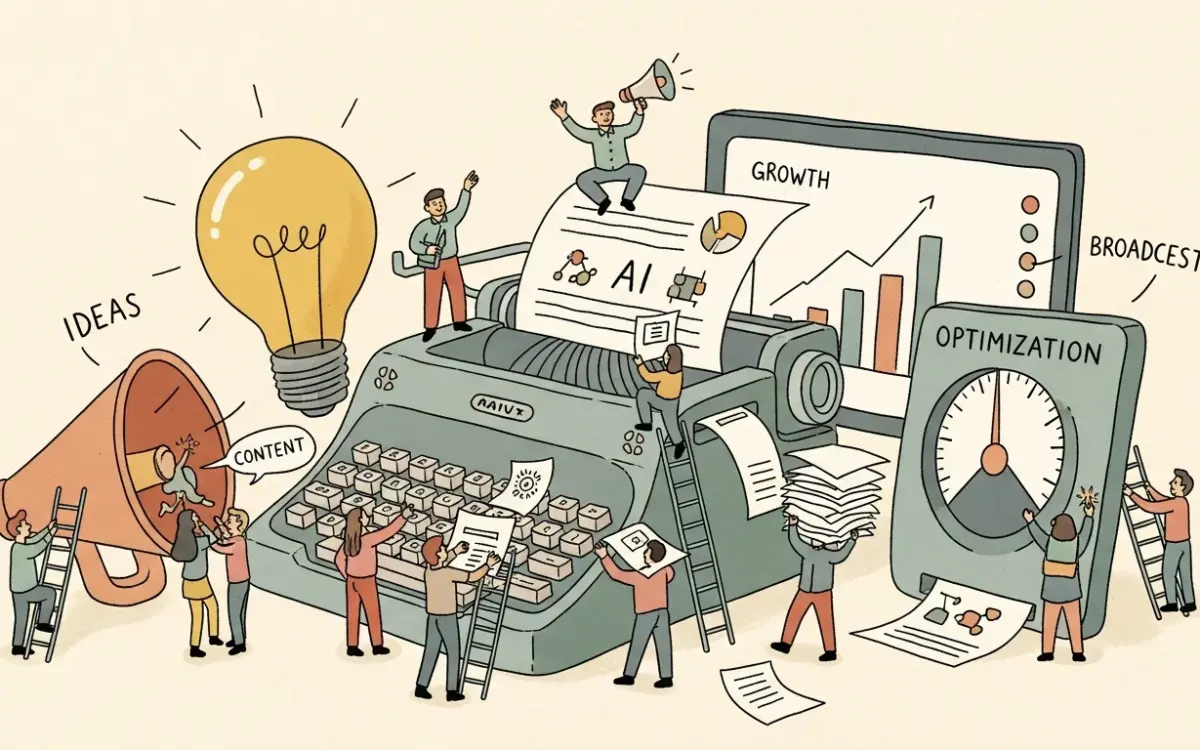
- Copy.ai has evolved from a copywriting tool into a full go-to-market platform with workflow automation, CRM integration, and AI agents spanning sales, marketing, and operations.
- The platform supports multiple LLMs including OpenAI, Anthropic, Google Gemini, and Perplexity, and connects to over 2,000 integrations including Salesforce and HubSpot.
- Enterprise customers report significant ROI — Lenovo claims $16 million in annual savings through automated workflows.
- Long-form content remains a weakness, and the pricing jump from free to Pro ($49/month) creates a gap for individuals and small teams.
What Happened
Copy.ai, founded in 2020 by CEO Paul Yacoubian and co-founder Chris Lu, has repositioned itself as what the company calls “the first AI-native GTM platform.” The tool that started as a short-form copywriting assistant now offers workflow automation, AI agents, CRM enrichment, and a consolidated data layer called Tables. The platform claims over 17 million users across companies including Siemens, Lenovo, Rubrik, Gong, ServiceNow, and Urban Outfitters.
The company released its 2026 Benchmarks Report on the state of go-to-market operations, positioning itself against what it calls “GTM bloat” — the proliferation of disconnected point solutions and AI copilots that marketing and sales teams accumulate over time. The report argues that consolidation into a single AI-native platform reduces both cost and operational friction.
Why It Matters
Copy.ai’s trajectory illustrates a broader pattern in AI tools: what begins as a single-purpose content generator expands into a comprehensive workflow platform. The company now competes less with writing-focused tools like Jasper and more with marketing automation platforms like HubSpot and Outreach.
For marketing teams producing high volumes of content across multiple channels, the platform’s value proposition centers on speed and consistency in first drafts. Jean English, former CMO of Juniper Networks, reported generating “5x more meetings with personalized AI-powered GTM strategy” using the platform. Roman Olney, Head of Global Digital Experience at Lenovo, cited $16 million in annual savings through automated workflows that replaced manual processes across their global marketing operations.
Ashley Levesque, VP of Marketing at Banzai, has specifically praised the workflow automation capabilities for connecting content generation directly to distribution and measurement systems.
Technical Details
Copy.ai operates on a model-agnostic architecture, routing requests to OpenAI, Anthropic, Google Gemini, or Perplexity depending on the task requirements. This approach avoids vendor lock-in and allows the platform to leverage each model’s strengths for different content types. The platform connects to over 2,000 integrations including Salesforce, HubSpot, Gong, Zapier, Outreach, and Salesloft.
The core architecture consists of four components. Workflows codify repeatable processes like prospecting sequences or content approval chains. Actions serve as modular building blocks that non-technical users can assemble without coding. Agents handle autonomous task execution with configurable guardrails. The Infobase acts as a centralized knowledge repository that feeds context into all content generation, ensuring outputs reflect company-specific terminology and positioning.
Brand Voice training allows organizations to enforce consistent tone, style, and terminology across all outputs. Security certifications include AICPA SOC 2, GDPR compliance, and SSO support for enterprise deployments. The platform covers over 90 content templates spanning Google Ads, LinkedIn posts, cold emails, product descriptions, and landing page copy.
Who’s Affected
Sales and marketing teams at mid-market and enterprise companies are the primary audience. The platform spans prospecting, inbound lead processing, deal coaching, account-based marketing, content creation, translation, and CRM enrichment. Individual creators and small businesses face a notable pricing gap: the free tier offers limited functionality, and Pro starts at $49/month with Enterprise pricing available on request.
Teams that need deep long-form content — research reports, whitepapers, detailed technical blog posts — will find Copy.ai’s output requires significant editing to reach publication quality. The platform excels at short-form copy: ad variations, email sequences, social posts, and product descriptions where volume and speed matter more than depth and originality.
What’s Next
Copy.ai’s expansion into AI agents and autonomous workflow execution puts it in direct competition with broader enterprise AI platforms rather than just content generation tools. The company has not disclosed its latest funding round details or revenue figures publicly. Whether the platform can deliver on its promise of replacing multiple disconnected point solutions will depend on the reliability of its AI agents in production environments — a capability that remains challenging to evaluate without extended enterprise deployment and real-world performance data.