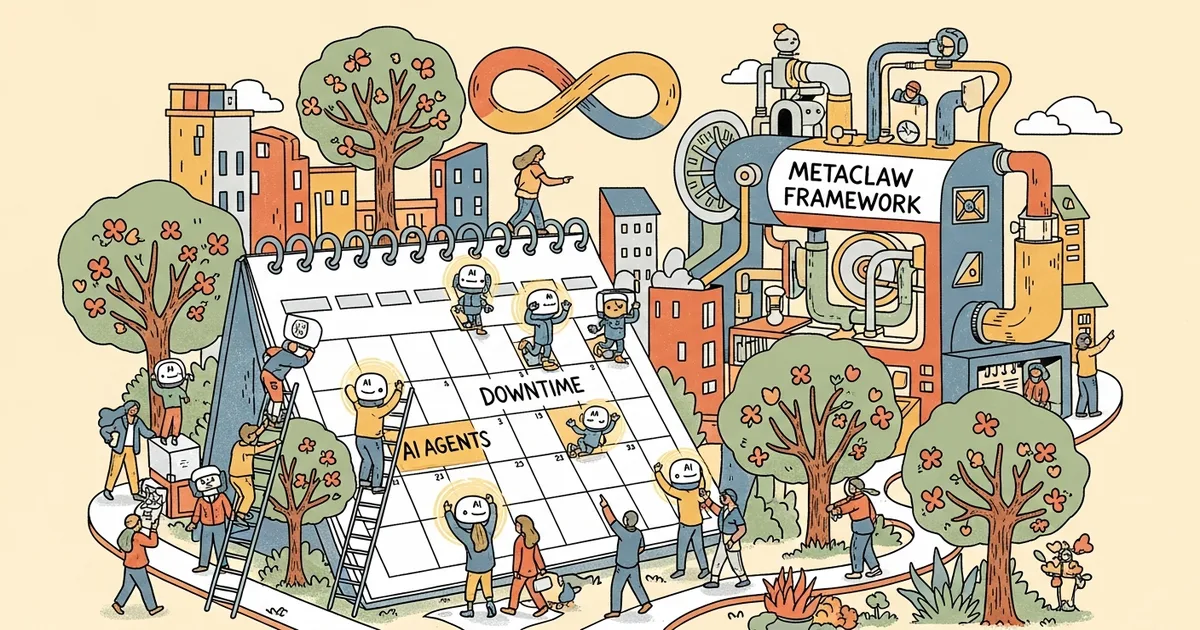
Researchers from four US universities published a framework on March 29, 2026, that enables AI agents to retrain themselves continuously during operation — using the user’s Google Calendar to identify safe training windows. The paper, reported by Jonathan Kemper at The Decoder, describes MetaClaw, a system developed at UNC-Chapel Hill, Carnegie Mellon University, UC Santa Cruz, and UC Berkeley.
- MetaClaw uses two mechanisms: prompt-injected behavioral rules derived from task failures, and reinforcement learning with cloud-based LoRA fine-tuning during idle periods.
- A background scheduler called OMLS monitors Google Calendar events, keyboard and mouse inactivity, and configurable sleep times to open training windows without disrupting the user.
- In testing on a 934-question benchmark spanning 44 simulated workdays, behavioral rules alone substantially boosted the weaker model’s accuracy.
- The full framework nearly brought Kimi-K2.5’s performance up to the level of GPT-5.2, according to the paper by Xia et al.
What Happened
A team of researchers from UNC-Chapel Hill, Carnegie Mellon University, UC Santa Cruz, and UC Berkeley released MetaClaw, a framework that continuously updates AI agents by learning from their own operational failures — without taking the service offline or requiring manual retraining cycles. The paper, authored by Xia et al. and covered by Jonathan Kemper at The Decoder on March 29, 2026, addresses a structural gap in deployed AI agents: they are trained once and shipped unchanged, even as user needs and task types evolve around them.
MetaClaw integrates with LLM providers through a platform called OpenClaw and runs improvement cycles in the background, supporting two distinct update mechanisms — one that applies immediately via system prompt injection, and one that modifies model weights during periods of user inactivity.
Why It Matters
Most production AI agents do not adapt after deployment, leaving accumulated failures unaddressed and behavioral gaps uncorrected regardless of how long the agent has been running — MetaClaw’s event-driven design couples failure detection directly to rule generation and idle-time detection directly to weight updates, removing the dependency on manual intervention or scheduled retraining pipelines.
The framework also addresses a training data contamination problem. When a new behavioral rule is injected, the system enforces strict separation: only data collected after the rule change enters the training pipeline. Data gathered before the change — which may reflect errors the new rule already corrects — is excluded, preventing the model from being penalized for behavior it no longer exhibits.
Technical Details
MetaClaw’s first mechanism triggers on task failure. A secondary language model analyzes the failed interaction, distills a compact behavioral rule, and injects it directly into the system prompt — applying to all future tasks immediately, without modifying model weights or interrupting service. The paper identifies three categories of rules that emerged from testing: correctly normalizing time formats, creating backups before destructive file operations, and following naming conventions. Because these rules are not task-specific, a single failure can produce improvements that carry across unrelated task types later in the agent’s operation.
The second mechanism applies reinforcement learning with cloud-based LoRA (Low-Rank Adaptation) fine-tuning to update model weights directly. Because this step briefly interrupts the agent, it cannot run while the user is active. A background component called OMLS — the Opportunistic Meta-Learning Scheduler — manages timing by monitoring three signals: user-configured sleep schedules, OS-level keyboard and mouse inactivity, and Google Calendar entries. When the calendar shows a meeting in progress, a training window opens. The OMLS trainer is designed to pause and resume across short idle stretches, so even brief gaps contribute to updates.
The researchers evaluated MetaClaw on a custom benchmark of 934 questions distributed across 44 simulated workdays, using two models: GPT-5.2 and Kimi-K2.5. The paper consistently refers to GPT-5.2 — not GPT-5.1. The full framework, combining reinforcement learning with behavioral rule injection, achieved its largest performance lead over baselines in the middle portion of the test window; as simulated task difficulty increased in later days, gains narrowed across all variants. Behavioral rules alone were sufficient to substantially improve Kimi-K2.5’s accuracy. The paper claims the full system nearly brought the weaker model’s performance up to the level of GPT-5.2.
Who’s Affected
MetaClaw targets developers building LLM-based agents for long-running, evolving workflows — productivity tools, enterprise automation pipelines, and coding assistants that operate across persistent user sessions are the most direct use cases. The framework requires integration with the OpenClaw platform and OS-level access to calendar and activity data, meaning it needs developer configuration before deployment. Users with structured, predictable schedules — regular meeting blocks and defined working hours — will produce the most consistent idle windows for OMLS to schedule training against.
What’s Next
MetaClaw’s results come from a simulated 44-workday environment; the paper does not demonstrate performance across diverse real-world schedules, varied task distributions, or multiple LLM providers at scale. The source material available at time of publication does not address privacy considerations around background monitoring of Google Calendar events and OS-level user activity. Full researcher names beyond the lead attribution of Xia et al. were not available at time of publication, and no public release timeline for MetaClaw or the OpenClaw platform has been announced.