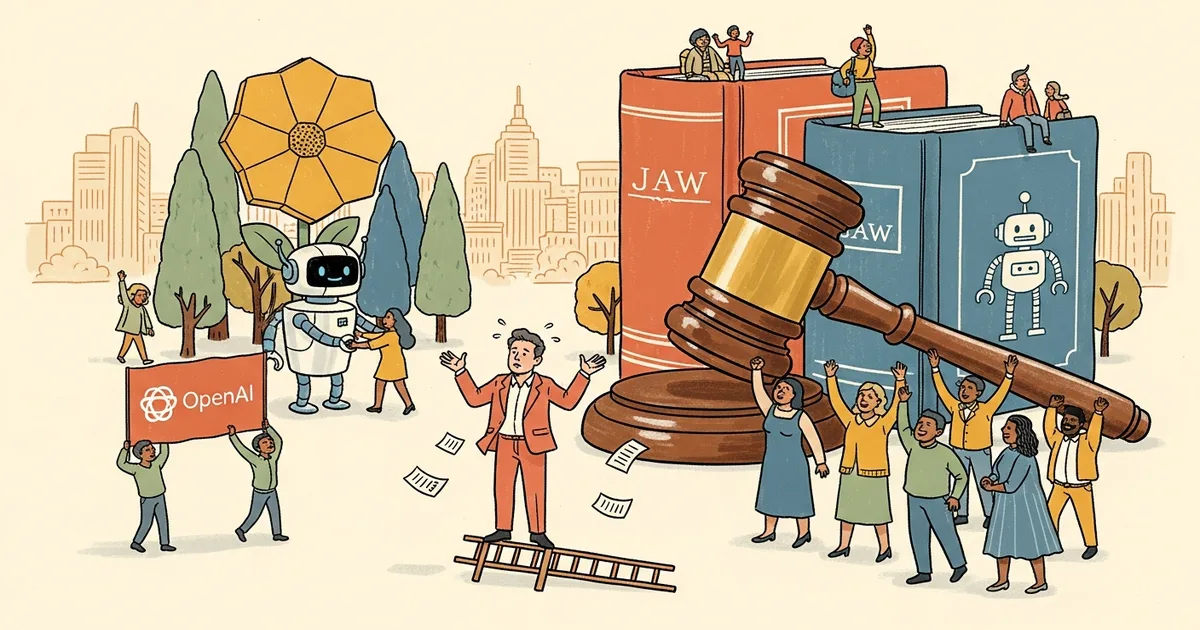
- A federal jury in Oakland unanimously ruled against Elon Musk in his lawsuit against OpenAI, Sam Altman, Greg Brockman, and Microsoft on Monday.
- The nine-member panel deliberated for under two hours and found Musk’s claims were filed after the statute of limitations expired.
- U.S. district judge Yvonne Gonzalez Rogers immediately accepted the jury’s nonbinding recommendation as her own, making the result final.
- Musk’s lawyer Marc Toberoff said one word leaving the courtroom: “Appeal.”
What Happened
Elon Musk lost his federal lawsuit against OpenAI, CEO Sam Altman, President Greg Brockman, and Microsoft, Wired reported Monday. A nine-member jury in an Oakland, California courtroom delivered a unanimous verdict in under two hours, finding that the statutes of limitations on Musk’s claims had expired well before he filed the suit in 2024. The jury’s verdict was a nonbinding recommendation; U.S. district judge Yvonne Gonzalez Rogers immediately accepted it as her own, making the result final.
Why It Matters
The verdict ends the most prominent legal challenge to OpenAI’s transition from nonprofit research lab to for-profit corporate structure. Because the jury found the case untimely, it never ruled on Musk’s three substantive claims: breach of charitable trust, unjust enrichment, and (against Microsoft) aiding and abetting. The merits of OpenAI’s nonprofit-to-for-profit conversion remain legally unsettled at the federal level, though Musk’s particular vehicle for challenging it is now closed.
For OpenAI, the result clears the most aggressive private-litigation threat hanging over the company’s planned 2026/2027 IPO. For Musk, the result is the cleanest possible loss — barred at the threshold of timeliness, not on the merits. His lawyer Marc Toberoff signalled appeal immediately.
Technical Details
The case was filed by Musk in 2024, alleging that Altman and Brockman — with Microsoft’s substantial cash backing — transformed OpenAI into a corporate vehicle well beyond what was envisioned when Musk, Altman, Brockman, and others co-founded the company as a nonprofit in 2015. The jury deliberated approximately under two hours before delivering the unanimous verdict. The trial spanned several weeks, with testimony from Microsoft CEO Satya Nadella, former OpenAI chief scientist Ilya Sutskever (who disclosed a roughly $7 billion personal stake), and current OpenAI chairman Bret Taylor.
The Wired report quoted William Savitt, an attorney for OpenAI, who had described the trial last week as a “gloriously” played-out “pageant of hypocrisy.” Musk, under court order not to tweet during the trial, was largely silent in recent weeks. He attended the courtroom for about three days early in the trial before never returning, and flew to China for President Donald Trump’s state visit during a portion of the proceedings.
Who’s Affected
OpenAI’s investors — including Microsoft, SoftBank, Nvidia, Tiger Global, Sequoia, and Thrive Capital — gain certainty as the company moves toward an anticipated public listing. Microsoft, named as defendant, exits the case without liability. Sam Altman, freed from one of the largest distractions of the past two years, continues to navigate parallel House Oversight Committee scrutiny ahead of his May 22 testimony deadline. Greg Brockman, recently elevated to product strategy lead, continues consolidation of OpenAI’s product surface. The broader AI-industry watch on nonprofit-to-for-profit governance transitions remains live: state attorneys general in California and Delaware continue separate review.
What’s Next
Toberoff’s announced appeal will proceed through the Ninth Circuit Court of Appeals; appellate review of statute-of-limitations dismissals tends to be highly deferential to the trial court. The trial nonetheless produced substantial public-record disclosures about Brockman’s wealth (approximately $30 billion in OpenAI shares per his own testimony), Sutskever’s $7 billion stake, and details of Altman’s alleged history of dishonesty raised in pretrial filings. Those disclosures may shape ongoing regulatory and political scrutiny independent of the litigation outcome.