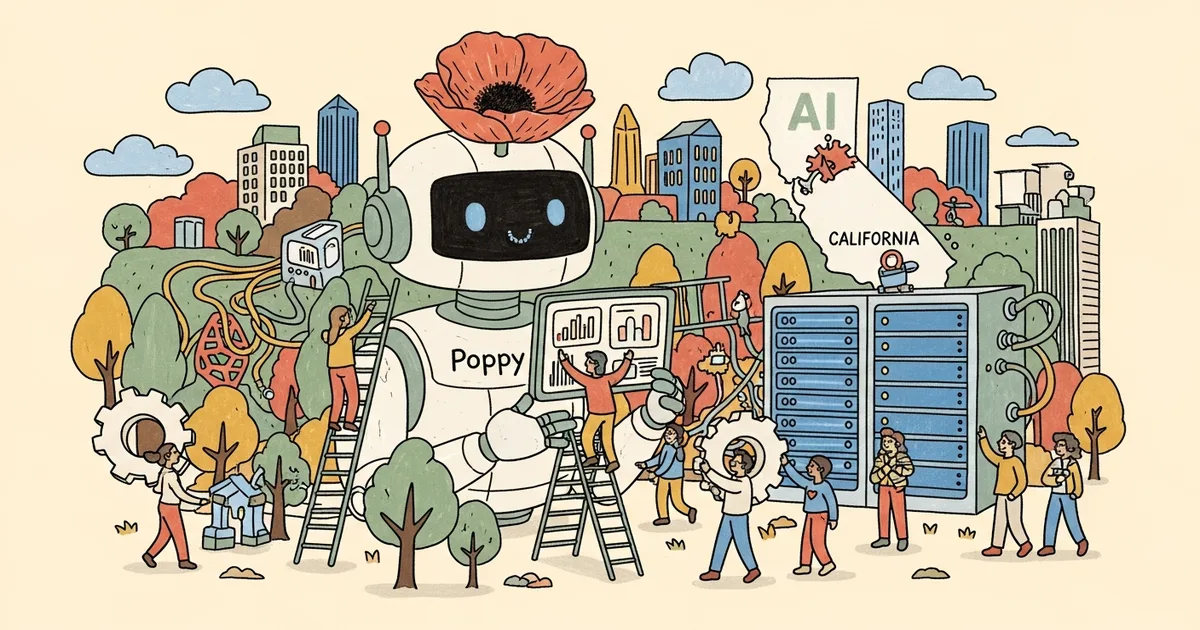
California Governor Gavin Newsom announced a set of AI governance initiatives on December 16, 2025, establishing the California Innovation Council, an Emerging Technology Accelerator, and a generative AI assistant called Poppy built specifically for state government employees. The initiatives extend an executive order Newsom issued in 2023 directing state agencies to begin adopting generative AI responsibly.
The Innovation Council assembles tech policy experts to advise on the state’s technology strategy, while the Emerging Technology Accelerator partners with academic institutions including the Stanford Institute for Human-Centered AI, UC Berkeley’s School of Information, and Stanford’s McCoy Family Center for Ethics in Society. Additional partners include the Mozilla Foundation, the Tech Talent Project, US Digital Response, and Nava Labs.
Poppy, developed by the California Department of Technology with input from over 20 state departments, utilizes 11 different AI models and is designed to assist state employees with routine tasks rather than replace human decision-making. The assistant runs within the state’s existing technology infrastructure and is subject to the AI usage policies established under Newsom’s 2023 executive order.
The timing is notable given ongoing tension between state and federal approaches to AI regulation. The White House has issued an executive order aimed at limiting states’ regulatory authority over AI, while California has moved ahead with its own legislative framework. Many of California’s new AI laws took effect on January 1, 2026, including provisions carrying civil penalties of $5,000 per violation per day.
The initiatives affect multiple stakeholder groups. State employees gain access to AI tools and training programs. The California Chamber of Commerce and the Brookings Institute are participating in policy development, suggesting an attempt to balance business interests with public protection. The state’s Government Operations Agency and Office of Data and Innovation are coordinating implementation across departments.
California’s approach — building internal AI capacity while simultaneously establishing regulatory guardrails — represents one model for government AI adoption. Whether the Innovation Council produces actionable policy recommendations or serves primarily as a signaling mechanism will become clearer as its advisory outputs are published in the coming months.