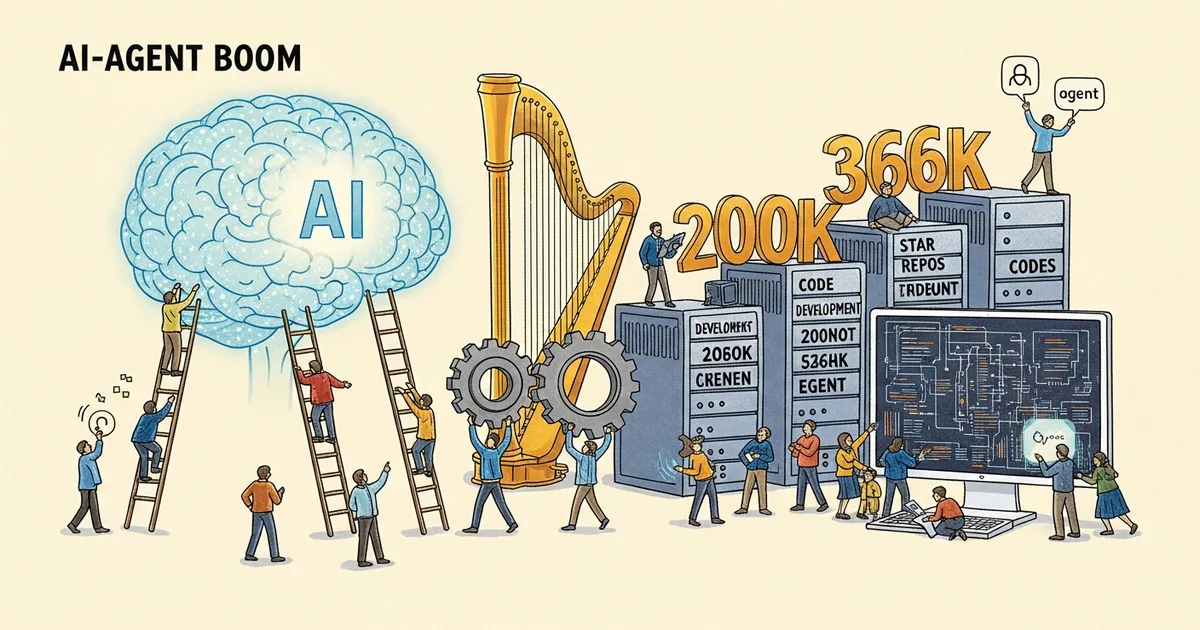
- Wired published a deep-dive on the AI-agent boom, tracing it from August 2025 — when Peter Steinberger started Claude Code Anonymous meetups in London — to today’s 366K-star OpenClaw repository.
- Anthropic claimed Claude Opus 4.5 ‘scored higher than any human candidate ever’ on its take-home engineering exam.
- OpenClaw — a personal AI-agent launcher built by Steinberger in November 2025 — hit 100,000 GitHub stars in two weeks and 366,000 stars by early May.
- The piece chronicles both the productivity wins and the operational/safety chaos as agents scaled.
What Happened
Wired published a long-form chronicle of how AI agents went from research-lab demos to running unattended on millions of machines. The piece opens with Peter Steinberger introducing himself to a London meetup in August 2025: “Hi, my name is Peter, and I’m a Claudeholic.” Steinberger and fellow agent-builders had organised the event — called Claude Code Anonymous — to network with people swept up by Anthropic’s Claude Code.
Why It Matters
The Wired piece is the first major mainstream-press narrative of the agentic-AI cycle. Where Bloomberg has framed individual moments — Karpathy joining Anthropic, OpenAI’s IPO, Nvidia’s earnings — Wired’s piece connects the dots. The narrative arc is straightforward: a small community of power users discovered Claude Code in early 2025; Anthropic released Opus 4.5 with breakthrough capability; one of those power users (Steinberger) built OpenClaw on top; the project went viral; the entire developer ecosystem reorganised around agentic workflows in months.
The same arc has direct implications for the cyber-vulnerability category covered separately this week — the Starlette/BadHost flaw is consequential precisely because of how many production agent deployments now run on the relevant stack.
Technical Details
Per the Wired narrative, Claude Opus 4.5 introduced four step-change capabilities: handling more complicated programming tasks, retaining much more memory, running for many hours on end, and managing a team of AI subagents. Anthropic’s internal benchmark — described as “notoriously difficult” — pitted Opus 4.5 against human candidates on Anthropic’s engineering take-home; Opus 4.5 “scored higher than any human candidate ever,” per the company.
OpenClaw, launched by Steinberger in November 2025, conjures personal AI agents that exploit Claude Code or other coding tools. Users grant the agent access to their data, apps, and optionally credit cards; the agent scours cloud accounts and browses the web autonomously. The GitHub repository accumulated more than 100,000 stars in less than two weeks of public availability. As of early May 2026, it stood at 366,000 stars — placing it among the fastest-growing repositories in the platform’s history.
Who’s Affected
Working software engineers — described in the piece as feeling like “becoming Spider-Man” when using Claude Code — are the primary cohort. Anthropic itself is the central commercial beneficiary. OpenAI’s Codex, Cursor, Codeium, and competing tools have ridden the same wave. The broader DevOps and CI/CD ecosystem has been reshaped around agent-driven workflows. Universities and bootcamps face the credentialing question — Stanford reintroduced handwritten exams in spring 2026 specifically because of agentic-AI coding. Cybersecurity teams face the agent-amplified attack surface that Wired documents in subsequent passages.
What’s Next
Wired’s piece extends across multiple subsequent sections that cover specific incidents — the Starlette BadHost flaw, agentic-AI misuse cases, the Stanford academic-integrity story, and the broader policy response. The full chronicle is available behind Wired’s subscription. The agent-boom narrative will continue through 2026’s OpenAI DevDay, Anthropic developer events, and the various AI-policy hearings scheduled for the second half of the year.