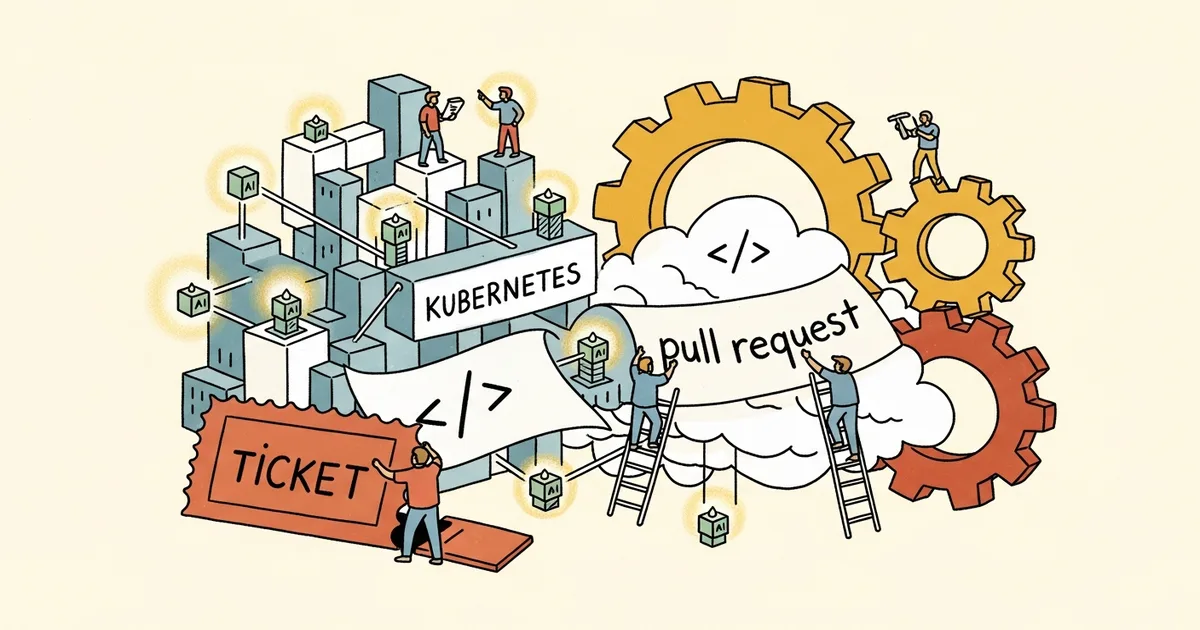
An open-source project called Optio, showcased on Hacker News on March 25, 2026, orchestrates AI coding agents within Kubernetes pods to autonomously convert tickets into merged pull requests. The system accepts tasks from GitHub Issues or Linear, provisions isolated K8s pods, and executes AI agents including Claude Code and OpenAI Codex within git worktrees to generate code, create PRs, and iterate until the code passes CI and review.
Optio’s distinguishing feature is its autonomous feedback loop. The system polls pull requests every 30 seconds, monitoring CI status, review state, and merge readiness. When CI checks fail, merge conflicts arise, or reviewers request changes, Optio automatically resumes the AI agent with the relevant context. The agent then self-corrects and resubmits, repeating the cycle until the PR merges successfully or hits a configured retry limit.
The architecture reflects a broader industry shift toward treating AI agents as managed infrastructure rather than interactive tools. Gartner reported a 1,445 percent surge in multi-agent system inquiries from Q1 2024 to Q2 2025. By 2026, 92 percent of U.S. developers use AI coding tools daily, and 40 percent of enterprise applications are predicted to include task-specific AI agents. GitHub reported developers merging nearly 45 million pull requests per month in 2025, a 23 percent year-over-year increase.
Kubernetes is becoming the default runtime for these workflows. Nearly 20 million developers now operate within the cloud-native AI ecosystem. The Cloud Native Computing Foundation released stricter Kubernetes AI Requirements and expanded its conformance program to validate AI inference and agentic workloads. Red Hat contributed the llm-d framework to CNCF specifically for deploying AI workloads across K8s clusters.
The practical appeal of Optio lies in the elimination of context-switching. A developer assigns a ticket, and the system handles code generation, testing, review response, and merging without human intervention until completion. McKinsey research indicates developers can complete coding tasks up to twice as fast with generative AI, but that metric assumes interactive use. Fully autonomous ticket-to-merge systems like Optio represent the next step: removing the developer from the loop entirely for well-defined tasks.
Trust remains the central challenge. Stack Overflow’s 2025 Developer Survey found that 46 percent of developers distrust the accuracy of AI tools, while only 33 percent trust it. Automated code generation that bypasses human review introduces risks around code quality, security vulnerabilities, and technical debt that accumulate silently. Optio’s value depends on whether its self-correction loop can maintain the quality bar that human developers would apply.