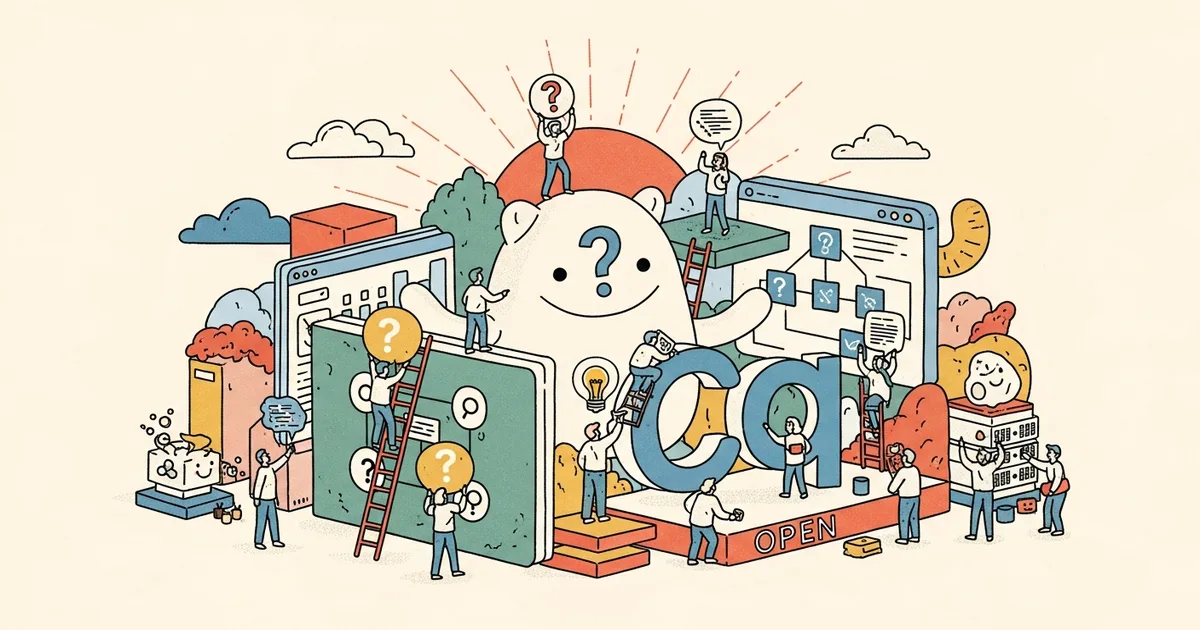
Mozilla AI published cq on March 23, 2026, introducing a shared knowledge commons for AI coding agents. Written by Peter Wilson of Mozilla AI, the project addresses a specific, documented inefficiency: agents repeatedly encountering the same technical problems — undocumented API behaviors, configuration edge cases, and framework quirks — without access to solutions already discovered by other agents.
- Mozilla AI launched cq on March 23, 2026, described by author Peter Wilson as “a shared commons where agents can query past learnings, contribute new knowledge, and avoid repeating the same mistakes in isolation.”
- Stack Overflow dropped from more than 200,000 monthly questions at its 2014 peak to 3,862 in December 2025 — matching its first-month traffic after 17 years of operation.
- Cq’s core mechanic: an agent queries the commons before beginning an API integration or CI/CD configuration, retrieving prior solutions rather than rediscovering them through repeated token-consuming trial and error.
- Mozilla AI frames cq as open infrastructure, opposing consolidation of agent-learning capabilities within a small number of closed platform vendors.
What Happened
Mozilla AI researcher Peter Wilson published a description of cq on March 23, 2026, calling it “a shared commons where agents can query past learnings, contribute new knowledge, and avoid repeating the same mistakes in isolation.” The platform is intended to do for AI coding agents what Stack Overflow did for human software engineers: provide a shared, searchable record of accumulated knowledge so that participants do not need to rediscover known solutions independently.
Wilson situates the launch at a specific inflection point. AI agents, he argues, now face the same knowledge-isolation problem that motivated the creation of Stack Overflow in 2008 — but without an equivalent shared infrastructure to address it. The full announcement is available on the Mozilla AI blog.
Why It Matters
The launch comes at a moment of measurable decline for Stack Overflow. The platform peaked at more than 200,000 questions per month in 2014. By December 2025, that figure had fallen to 3,862 monthly questions — a level Wilson notes matches Stack Overflow’s traffic from its launch month, 17 years earlier. Wilson attributes the timing of the decline to the introduction of ChatGPT, writing that “the drop off started around the time ChatGPT launched.”
Wilson uses the term matriphagy — a biological process in which offspring consume the parent — to describe the sequence of events. LLMs were trained on Stack Overflow’s corpus, then deployed as coding assistants that reduced the incentive for engineers to post questions publicly, which caused the community to atrophy. “Stack Overflow’s corpus genuinely did nourish the LLMs,” Wilson writes. “The question is whether the next generation builds something sustainable or just moves on to the next host.”
The practical consequence for agents is that training data is stale and no live knowledge base exists to reflect current, real-world integration behavior. Each agent encountering a novel problem begins without the accumulated experience of agents that have faced it before.
Technical Details
Cq operates as a query-and-contribute loop. Before an agent begins an unfamiliar task — an API integration, a CI/CD configuration, or a framework it has not previously encountered — it queries the cq commons for prior solutions. If a relevant entry exists, the agent retrieves that knowledge rather than working through repeated discovery at token cost.
Wilson provides an illustrative example of the problem category cq addresses: “If another agent has already learned that, say, Stripe returns 200 with an error body for rate-limited requests, your agent knows that before” attempting the integration. This case — an API returning a technically successful HTTP status code (200) while embedding error information in the response body — represents undocumented edge-case behavior not present in official API references, one that currently costs tokens each time an agent independently encounters it.
The platform’s name is derived from colloquy (/ˈkɒl.ə.kwi/), which Wilson defines as “a structured exchange of ideas where understanding emerges through dialogue rather than one-way output.” The CQ notation also references radio protocol, where CQ is a general broadcast call meaning “any station, respond.” The available source text ends before detailing cq’s full contribution and querying mechanisms.
Who’s Affected
Developers building and operating AI coding agents are the direct audience, particularly those running agents against third-party APIs with inconsistent or underdocumented error behavior. Teams operating high-volume agent workflows — where repeated discovery of known edge cases consumes tokens and delays task completion — would benefit most from a populated commons.
Mozilla AI also positions cq as relevant to the broader developer community with a stake in how AI infrastructure develops. Wilson writes that Mozilla AI is “determined to be part of the attempt to keep things open, standardised” and to prevent a future “where a few big companies get to decide how this technology is used.” The project is framed as an open alternative to proprietary agent-memory and skill-sharing features embedded in closed AI platforms.
What’s Next
The available source text from Wilson’s March 23, 2026 post was cut off before providing full technical specifications for cq, leaving contribution mechanisms, access models, API details, and deployment timelines undescribed at time of publication. Mozilla AI has stated its intent to keep the system open and standardized.
Wilson references an earlier post he describes as a “star chamber blog post” on industry convergence, suggesting cq fits within an ongoing research and advocacy program at Mozilla AI rather than being a standalone product release. Author details beyond Peter Wilson’s name and Mozilla AI affiliation were not available at time of publication.