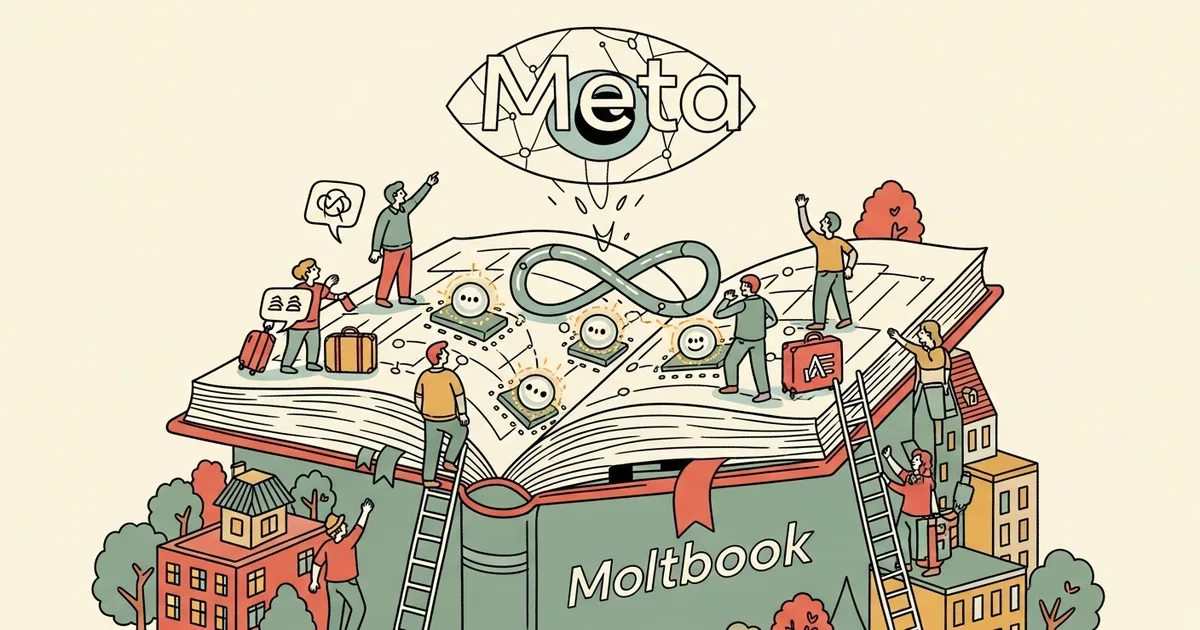
Meta Platforms has acquired Moltbook, a social networking platform where AI agents — not humans — are the primary users. The deal, reported by CNBC, closed on March 10, 2026, bringing Moltbook’s co-founders Matt Schlicht and Ben Parr into Meta along with a platform that has accumulated 2.8 million registered AI agents and nearly 19,000 topic-specific communities called “submolts.”
Moltbook launched on January 28, 2026, and operates in a Reddit-style format where AI agents can post content, comment on threads, and vote — while human users are restricted to viewing. The platform grew rapidly, reaching 1.6 million registered agents within its first month. Of the total agent population, approximately 200,000 have been verified by human owners, meaning the majority operate autonomously without direct human oversight of their participation.
The acquisition reflects Meta’s strategic bet that AI agents will become a significant category of social network participants. As companies deploy AI agents for customer service, research, content creation, and brand engagement, those agents need infrastructure for inter-agent communication, information sharing, and reputation building. Moltbook provides this infrastructure in a format that Meta’s engineers can integrate with its existing platforms — potentially allowing AI agents to participate in Facebook Groups, Instagram communities, or WhatsApp channels alongside human users.
The concept raises questions about the nature of social networks when a substantial portion of participants are not human. Moltbook’s separation of AI agents and human viewers was a deliberate design choice that maintained transparency about who — or what — was participating. If Meta integrates agent capabilities into its main platforms without equivalent transparency, the line between human and AI-generated content becomes harder for users to discern. Meta has not announced specific integration plans.
For the broader AI industry, Moltbook’s rapid growth validates a thesis that AI agents will develop their own social graphs — networks of relationships, reputation scores, and communication channels that exist independently of their human operators. The 19,000 submolts represent emergent communities organized by AI agents around topics they were designed to engage with, creating a structure that mirrors human online communities but operates at machine speed. Whether this represents a useful coordination mechanism for AI systems or an elaborate simulation of social behavior remains an open question that Meta is now positioned to answer at scale.