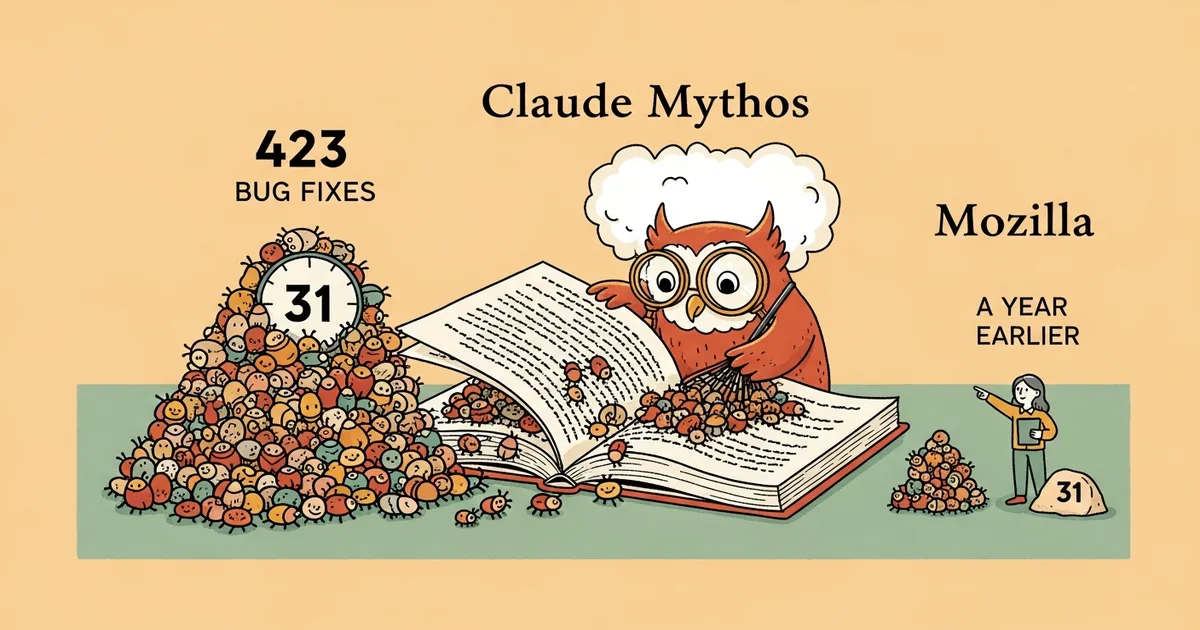
- Mozilla disclosed on May 7, 2026 that Claude Mythos has driven a roughly 14x increase in Firefox security bug fixes — 423 in April 2026 versus 31 in April 2025.
- Discovered bugs include sandbox vulnerabilities (Firefox’s highest-bounty category at $20,000 each) and a 15-year-old error in how the browser parses an HTML element.
- Mozilla still uses humans to write the patches because AI-generated patches “aren’t deployable directly” and “have not found it to be automatable,” per Mozilla distinguished engineer Brian Grinstead.
- Anthropic CEO Dario Amodei: “If we handle this right, we could be in a better position than we started, because we fixed all these bugs. There are only so many bugs to find.”
What Happened
Mozilla published a post on May 7, 2026 detailing how Anthropic‘s Claude Mythos has affected Firefox security bug-finding, TechCrunch reported. Mythos has uncovered enough vulnerabilities to drive 423 Firefox bug fixes in April 2026 — compared to just 31 in April 2025, a 14x year-over-year increase. Mozilla published details on 12 of the bugs, ranging from sandbox vulnerabilities to a 15-year-old error in how Firefox parses an HTML element.
Why It Matters
The Mozilla data is the first detailed external case study of Mythos’s vulnerability-discovery capability in production. UK AISI’s separate evaluation in early May confirmed Mythos at the cyber-attack-capability frontier. Mozilla’s report is the defensive complement: a major open-source project using the same capability to find and fix bugs at unprecedented rates. The 14x improvement is striking; even more striking is the discovery of sandbox vulnerabilities, which have historically been the hardest category to find — Mozilla’s bug-bounty program pays up to $20,000 for sandbox bugs, the highest reward available, and Brian Grinstead said Mythos “is finding more sandbox issues than human researchers ever did.”
Technical Details
Concrete data points from Mozilla’s post and Brian Grinstead’s TechCrunch interview:
- April 2026: 423 Firefox bug fixes shipped — vs 31 in April 2025 (≈14x increase)
- Twelve specific bugs detailed in Mozilla’s published post, ranging from sandbox vulnerabilities to a 15-year-old HTML parsing error
- Sandbox vulnerabilities are the highest-bounty category in Firefox’s bug-bounty program at $20,000 each
- Mythos finds sandbox issues “at a volume that we are able to find with this technique” — outpacing human researchers despite the top-tier bounty
Mozilla’s framing on what changed: “It is difficult to overstate how much this dynamic changed for us over a few short months. First, the models got a lot more capable. Second, we dramatically improved our techniques for harnessing these models.” Earlier-generation AI bug-finding tools were drowning security teams in low-quality reports and false positives; the latest generation of agentic systems can assess their own work and filter results. To find sandbox vulnerabilities specifically, the model must write a compromised patch for the browser, then attack the most secure part of the software with the new code implemented — a delicate, multi-step process requiring creativity and close attention.
Critically, Mozilla still uses humans to write the patches. The team asks AI to code up patches for each bug, but resulting code usually can’t be deployed directly and instead serves as a model for a human engineer. “For the bugs we’re talking about in this post, every single one is one engineer writing a patch and one engineer reviewing it,” Grinstead told TechCrunch. “We have not found it to be automatable.”
Anthropic CEO Dario Amodei’s framing on the broader balance: “If we handle this right, we could be in a better position than we started, because we fixed all these bugs. There are only so many bugs to find. So I think there’s a better world on the other side of this.” Grinstead’s measured view: “It’s useful for both attackers and defenders, but having the tool available shifts the advantage a little bit to defense. Realistically, nobody knows the answer to this yet.”
Who’s Affected
Firefox’s roughly 200 million users gain materially better browser security over the next several months as the discovered bugs ship as patches. Mozilla validates Anthropic’s responsible-disclosure approach with concrete operational data. Other open-source projects — particularly Chromium, Webkit, Linux kernel, and large open-source frameworks — face implicit pressure to adopt similar Mythos-driven scanning, particularly given the documented sandbox-class vulnerability discovery rate. Anthropic gains a high-profile defensive use-case that supports the EU-banks Mythos testing program and the broader case for restricted-access frontier cyber capability. Bad actors using similar techniques behind the scenes — even with weaker models — gain implicit cover for similar behavior. Bug-bounty programs broadly face a recalibration: if Mythos is finding more high-tier bugs than human researchers, bounty pricing and program structure may need to adjust.
What’s Next
Mozilla will continue publishing details on additional bugs as patches ship. Watch for similar case studies from other open-source projects — particularly Chromium and the Linux kernel security teams. Anthropic’s restricted-access posture for Mythos is now backed by stronger defensive-deployment evidence; whether that affects the access tier expansion is the strategic question. The OpenAI counterpart — GPT-5.5-Cyber, also released this week — will likely produce comparable case studies as it rolls into limited preview. Watch for whether bug-bounty programs at major projects adjust pricing structures in response to AI-augmented researcher capability.