- Former Treasury Secretary Hank Paulson and former US Ambassador to China Nicholas Burns argue China’s electricity buildout could shape the US-China AI race, Bloomberg reported on Sunday.
- Paulson warns the US still leads in AI technology but electricity shortages could become a major constraint as data-centre demand surges.
- Burns cites China’s enormous investments in transmission, generation, and grid infrastructure as the basis for the AI-edge claim.
- The framing shifts the US-China AI competition from chip-level controls toward power-system scale.
What Happened
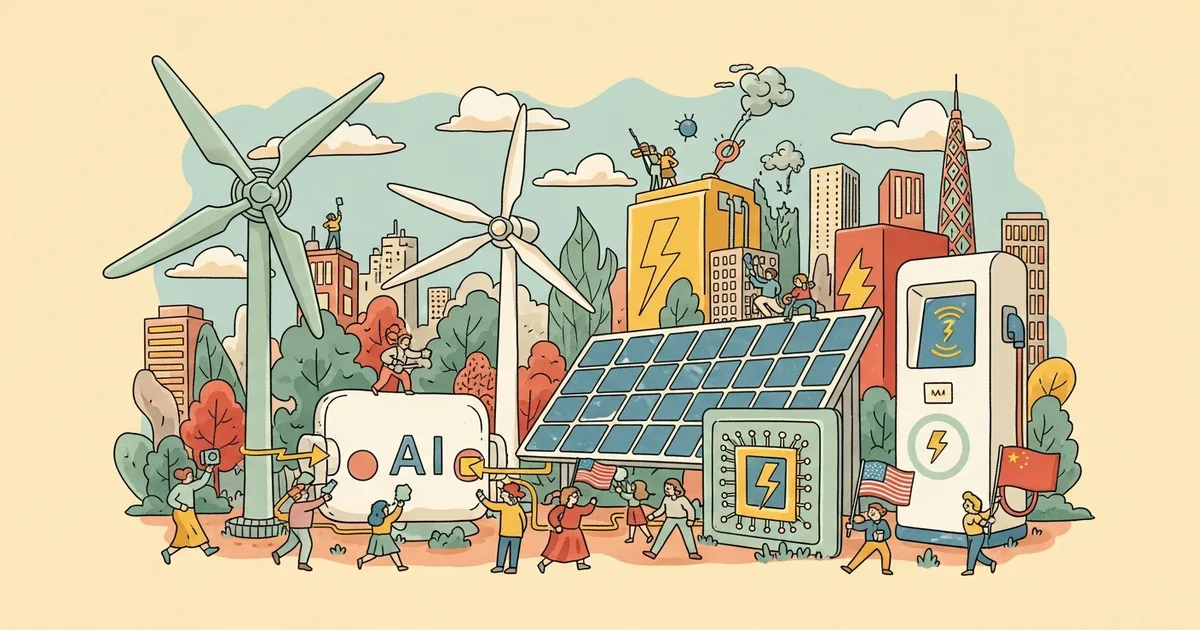
Former US Treasury Secretary Hank Paulson and former US Ambassador to China Nicholas Burns argued that China’s electricity buildout — not its chip access — may determine the outcome of the US-China AI race, Bloomberg reported in a segment published Sunday. Paulson warned that while the US still leads in AI technology, electricity shortages could become a major constraint as data-centre demand surges. Burns cited China’s investments in transmission, generation, and grid infrastructure as the basis for the AI-edge claim.
Why It Matters
The Paulson-Burns argument reframes the US-China AI competition. Through 2023-2025 the policy framing has been dominated by chip-export controls: who can build the most capable training and inference systems given access to Nvidia H100/H200/B100/B200 chips and TSMC manufacturing capacity. The new framing centres power-system scale: who can build, operate, and energise the data centres at all.
The shift is operationally significant. AI-data-centre electricity demand has emerged as the single fastest-growing category in US grid demand projections. Microsoft, Meta, Alphabet, Amazon, and Oracle have all increased 2026 capex guidance materially. The bond market has begun to saturate with AI-infrastructure issuance — Alphabet was reported May 13 to be looking overseas for next-round bond capacity. The cumulative effect is that grid constraints, not chip constraints, are emerging as the binding US-side input.
Technical Details
China’s grid expansion through 2024-2026 has included substantial investment in ultra-high-voltage transmission lines, nuclear capacity additions, solar and wind manufacturing dominance, and centrally planned data-centre site allocation. The State Grid Corporation of China operates the world’s largest single transmission network. China’s State Council has explicitly prioritised AI computing-power hubs in its national-development planning. The combined effect, per Paulson and Burns, is a substantially lower marginal cost and a substantially shorter lead-time for adding AI-data-centre power capacity in China relative to the United States.
US grid constraints are the converse case: Texas’s ERCOT grid, the PJM Interconnection covering the mid-Atlantic, and California’s CAISO have all flagged AI-data-centre demand as a near-term reliability risk. Interconnection-queue lead times for new data-centre projects in major US markets now exceed 5-7 years.
Who’s Affected
The hyperscalers — Microsoft, Meta, Alphabet, Amazon, Oracle — face the question of where to physically site future AI training and inference capacity. Some have already shifted incremental capex toward markets with available power: Wisconsin, Iowa, the Texas Panhandle, and increasingly overseas sites. Frontier AI labs — OpenAI, Anthropic, Google DeepMind, xAI — depend on hyperscaler capacity allocations to train next-generation models. Power utilities and grid operators in the US gain unprecedented strategic leverage. Chinese AI labs — Alibaba Cloud, Baidu, ByteDance, DeepSeek, Moonshot, Zhipu — gain a structural advantage if the Paulson-Burns thesis holds.
What’s Next
The Bloomberg segment is part of broader strategic-competition coverage that is expected to continue through 2026. US policy responses are anticipated in upcoming Department of Energy guidance on data-centre interconnection prioritisation. Industry analysts at Wood Mackenzie, Rystad Energy, and S&P Global Commodity Insights have flagged 2026-2028 as the critical window during which the US grid either expands fast enough to support AI capex or constrains it. The Paulson-Burns commentary lands as one of the more pointed political articulations of that constraint risk.