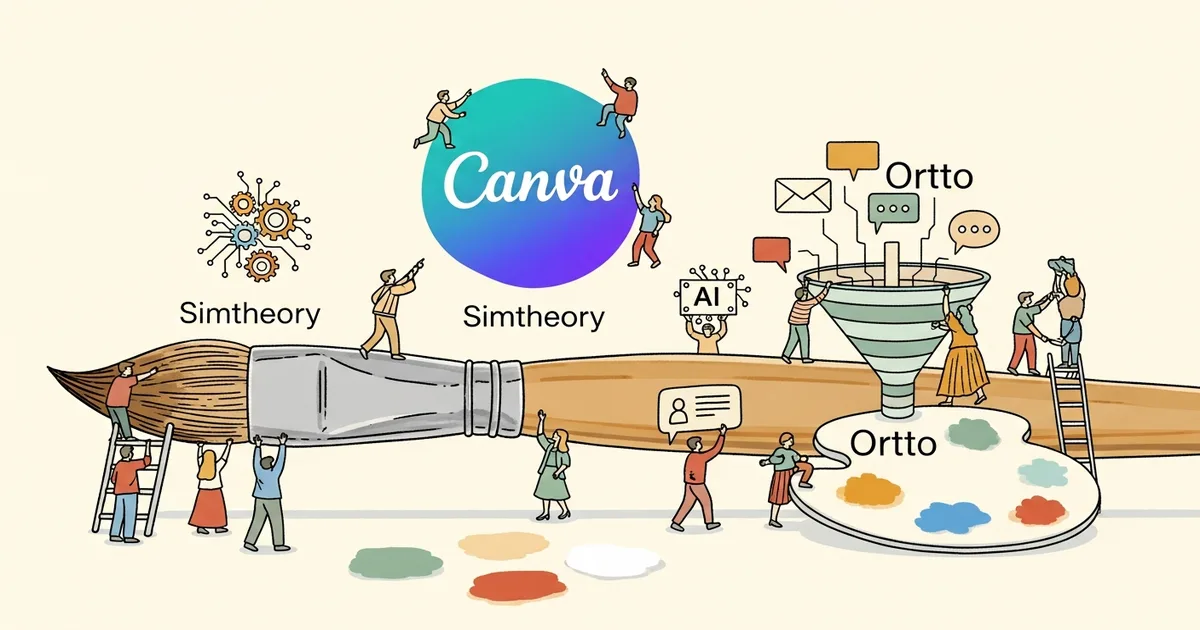
- Canva has acquired Simtheory, an AI company, and Ortto, an Australian marketing automation platform formerly known as Autopilot.
- The dual acquisitions signal Canva’s push beyond graphic design into AI-powered campaign creation and customer journey automation.
- Ortto provides a customer data platform with journey automation, email, SMS, and push notification channels used by B2B SaaS teams.
- The deals put Canva in more direct competition with Adobe’s marketing cloud and HubSpot’s all-in-one platform.
What Happened
Canva, the Australian design platform co-founded by Melanie Perkins, has agreed to acquire two companies in a single strategic move: Simtheory, an artificial intelligence startup, and Ortto, a marketing automation platform headquartered in Sydney, according to TechCrunch reporting published April 11, 2026. Financial terms for both deals were not disclosed. The acquisitions follow Canva’s 2024 purchase of Affinity, the professional design suite, and represent a further expansion of the company’s product ambitions beyond its core visual editor.
Why It Matters
Canva has long positioned itself as a design tool for non-designers, but its product roadmap has increasingly targeted marketing and communications workflows that overlap with Adobe, HubSpot, and Mailchimp. The addition of Ortto’s customer journey engine and Simtheory’s AI capabilities would give Canva a native layer of campaign automation sitting directly alongside its template library and brand management tools.
Ortto, which rebranded from Autopilot in 2021, built its reputation on visual journey mapping for B2B SaaS customer lifecycle workflows, with a customer data platform that unifies behavioral, CRM, and product usage data to trigger automated messaging sequences.
Technical Details
Ortto’s platform operates as a customer data platform combined with a multi-channel messaging engine, supporting email, SMS, in-app messages, and push notifications triggered by event-based rules or time delays. The platform connects to data sources including Salesforce, HubSpot CRM, Stripe, and Segment, allowing marketers to construct branching automation flows without engineering support.
Simtheory’s specific technical architecture has not been publicly detailed in available documentation, but the company has been described as focused on AI-driven content and workflow generation. Canva’s existing Magic Studio suite — which includes Magic Write (text generation), Magic Design (layout generation), and Magic Animate — would be a natural integration surface for AI capabilities from an acquired team.
Canva reported more than 220 million monthly active users as of early 2026, a user base that represents a significant distribution channel for any marketing automation product embedded into the platform.
Who’s Affected
Ortto’s existing customer base, primarily B2B SaaS marketing teams using the platform for lifecycle automation and onboarding sequences, will be watching integration timelines closely. Standalone marketing automation vendors — including ActiveCampaign, Klaviyo, and Customer.io — face incremental pressure as a design platform with a large existing user base adds native automation capabilities.
Adobe, which competes with Canva directly through Adobe Express and more broadly through Marketo Engage, will face a more complete challenger if Canva successfully combines creative production with campaign execution in a single interface at a lower price point.
What’s Next
Canva has not announced a timeline for integrating Ortto or Simtheory into its core product. Based on the company’s handling of the Affinity acquisition — which maintained Affinity as a separate product line through 2025 — a phased integration approach is likely. Both teams are expected to continue operating under Canva’s ownership while product roadmap alignment is worked out.