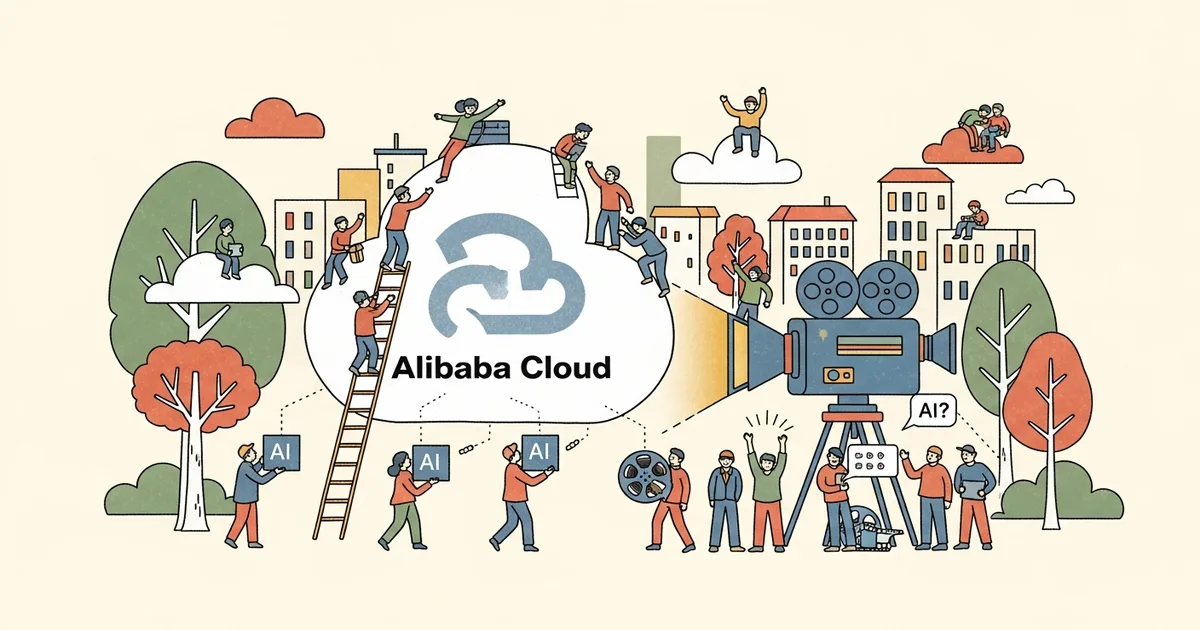
- Alibaba Group’s cloud division led a 2 billion yuan ($293 million) funding round in ShengShu Technology on April 10, 2026, according to Bloomberg.
- The raise is among the largest single investments disclosed in China’s AI video generation sector and gives ShengShu a material compute and commercial advantage over undercapitalized rivals.
- ShengShu competes in a domestic market that includes Kuaishou’s Kling model, ByteDance’s AI video tools, and MiniMax’s Hailuo, alongside international platforms led by OpenAI’s Sora.
- Alibaba Cloud’s participation gives ShengShu potential infrastructure advantages beyond capital, including cloud compute access and distribution into Alibaba’s enterprise customer base.
What Happened
Alibaba Group Holding Ltd.’s cloud division led a 2 billion yuan ($293 million) funding round in ShengShu Technology, a Chinese startup developing AI-powered video generation systems, Bloomberg reported on April 10, 2026. The deal makes Alibaba Cloud one of the largest institutional backers of a company operating in one of China’s most actively funded AI verticals. ShengShu is described by Bloomberg as a young contender in China’s crowded AI video contest — a market that has drawn significant domestic investment since 2024.
Why It Matters
China’s AI video generation sector accelerated sharply in 2024, when a cohort of domestic startups released text-to-video models that drew comparisons to OpenAI’s Sora, which debuted as a research preview in February 2024 and became commercially available later that year. Kuaishou’s Kling model drew international attention in mid-2024 for benchmarking competitively against Sora on multi-second video generation tasks. The competitive dynamic has pushed cloud providers and technology conglomerates to seek ownership or deep partnership stakes in the model-layer companies developing the underlying systems, rather than limit involvement to infrastructure supply.
Alibaba Cloud has been expanding its AI investments across multiple verticals as the company repositions its cloud division as an AI-first platform. A direct equity stake in ShengShu gives Alibaba’s cloud unit a content-layer asset to complement its compute and storage offerings — a structure similar to how Microsoft’s Azure division deepened its relationship with OpenAI beginning in 2019.
Technical Details
ShengShu Technology develops text-to-video and image-to-video synthesis systems aimed at enterprise and creative production workflows. The company’s Vidu model, released in 2024, was among the earliest domestically built Chinese video generation models to demonstrate multi-second, high-consistency clip synthesis from natural language prompts — a capability that had been the exclusive domain of large Western AI laboratories for much of the prior year.
Training large-scale video generation models requires substantially more compute than image or text models, owing to the additional temporal dimension that video synthesis must maintain across frames. Industry estimates place training runs for frontier video models at tens of thousands of GPU-hours per iteration, making capital availability a direct determinant of how quickly a company can iterate on model quality. The 2 billion yuan raise positions ShengShu to scale both training infrastructure and the inference compute required to serve commercial clients at volume, two bottlenecks that have constrained smaller Chinese AI video startups.
The funding round also arrives as video generation model architectures have shifted toward diffusion transformer approaches — the same class of model underlying Sora — rather than earlier recurrent or GAN-based video synthesis methods. Whether ShengShu’s Vidu architecture follows this transition has not been publicly confirmed.
Who’s Affected
Enterprise buyers in Chinese media production, advertising, and e-commerce represent the primary near-term commercial targets. Those sectors collectively account for some of the largest demand pools for AI-generated video in China, where short-form video advertising inventory has grown substantially on platforms operated by ByteDance and Kuaishou. Alibaba Cloud’s existing enterprise customer relationships provide ShengShu with a distribution channel that independent AI video startups typically must build independently.
Competing platforms — including Kuaishou’s Kling unit, MiniMax’s Hailuo model, and any Western AI video services seeking entry into the Chinese market — now face a more heavily capitalized rival. The funding gap between well-backed players and smaller Chinese AI video startups is likely to widen following this round, increasing pressure on undercapitalized competitors to seek their own strategic investors.
What’s Next
ShengShu has not publicly disclosed how the capital will be allocated or announced a product roadmap tied to the raise. The company is expected to expand its research team and increase cloud compute capacity to accelerate model development cycles. Bloomberg’s reporting did not specify whether additional co-investors participated in the round or whether a closing date beyond April 10, 2026, was disclosed. Further details on the round’s structure are likely to emerge through regulatory filings or subsequent company disclosures.