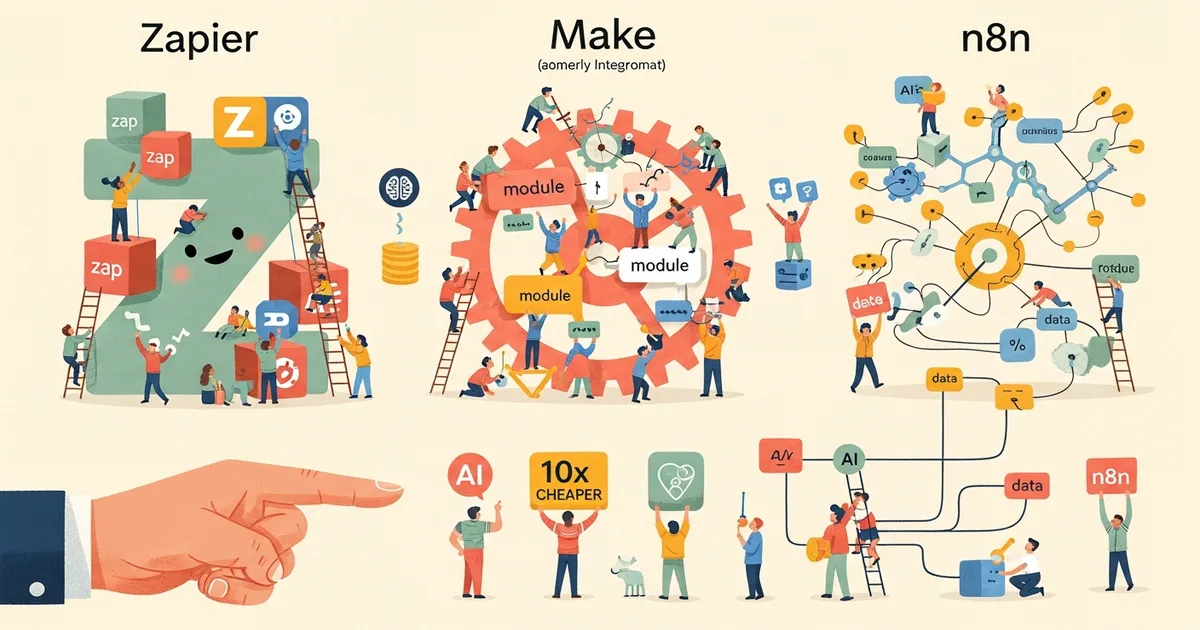
- A 10-step AI workflow running 100 times per month costs 1,000 tasks on Zapier, 1,000 operations on Make, but only 100 executions on n8n — a fundamental pricing model difference that compounds quickly at scale.
- Zapier offers 100 free tasks/month and 8,000+ app integrations, making it the fastest starting point for non-technical users. Make offers 1,000 free operations/month with a more powerful visual builder. n8n’s self-hosted Community Edition is completely free with unlimited executions.
- For AI-native workflows — multi-agent setups, LangChain pipelines, RAG systems — n8n leads with ~70 dedicated AI nodes. Make follows with 350+ AI app integrations. Zapier democratizes AI access without requiring users to manage their own API keys.
- The right tool depends on three variables: technical capability of your team, volume of automations, and whether data sovereignty is a requirement.
What Happened
Three automation platforms — Zapier, Make, and n8n — now occupy clearly distinct positions in the AI workflow market as of 2026. Each has made significant updates to pricing and AI capabilities over the past 12 months, creating meaningful differences in who should use each tool.
Zapier unified its plan structure, bundling Tables, Forms, and its new Zapier MCP feature into a single plan. Make extended AI agent capabilities and bring-your-own-key (BYOK) LLM support to all paid tiers in November 2025. n8n removed active workflow limits across all plans in March 2026, charging solely on execution count.
Why It Matters
AI workflow automation is no longer a niche technical use case. Teams are building lead scoring pipelines, content generation systems, and multi-agent research tools using these platforms. The pricing model each tool uses determines actual cost at scale — and the gap is substantial.
For a 10-step workflow running 100 times per month: Zapier counts 1,000 tasks, Make counts 1,000 operations, and n8n counts 100 executions. At high volume, a marketing team handling tens of thousands of operations monthly pays approximately $145 on Make’s Teams plan versus $299+ on Zapier’s equivalent tier, according to Genesys Growth’s 2026 comparison. Self-hosted n8n on a basic VPS runs roughly $10-20/month in infrastructure alone.
The cost difference is not a bug in how these tools are built — it reflects deliberate product positioning. Zapier optimizes for speed of setup. Make optimizes for visual flexibility. n8n optimizes for technical depth and cost efficiency at scale.
Technical Details
Zapier uses task-based pricing where each action in a Zap consumes one task. The Free plan includes 100 tasks/month. The Professional plan starts at $19.99/month (billed annually) for 750 tasks, scaling up through Team at $69/month for 2,000 tasks. AI is accessible via the built-in “AI by Zapier” powered by OpenAI — no separate API account required. Zapier Copilot helps build and troubleshoot Zaps conversationally. The platform connects to 8,000+ apps, the largest catalog of the three. Self-hosting is not available.
Make uses a credit-based model where each module execution in a scenario consumes one credit. The Free plan includes 1,000 credits/month with 2 active scenarios and a 15-minute minimum run interval. Core starts at $9/month for 10,000 credits, Pro at $16/month, and Teams at $29/month. Since November 2025, all paid plan users can connect their own AI provider keys (OpenAI, Anthropic, etc.) and pay AI providers directly. Make’s AI toolkit includes AI Agents (beta), an AI Content Extractor, AI Web Search (beta), and an MCP Server. The platform integrates 3,000+ apps. Self-hosting is not available.
n8n counts one complete workflow run as one execution, regardless of how many nodes or steps it contains. Cloud plans start at $24/month (Starter, 2,500 executions), $60/month (Pro, 10,000 executions), and $800/month (Business, 40,000 executions with SSO and Git integration). The Community Edition is free and self-hosted with unlimited executions and all 400+ integrations. n8n supports ~70 dedicated AI nodes, LangChain integration, multi-agent architectures, RAG systems, and works with OpenAI, Anthropic Claude, and Google Gemini. JavaScript/TypeScript code nodes allow custom logic unavailable in the other two platforms.
Side-by-Side: The Same AI Workflow in All Three
The test case: an inbound lead processing workflow. A form submission triggers enrichment via Clearbit, an AI step scores the lead using company size and domain data, routes high-score leads to Salesforce, and logs all results to a Google Sheet. Ten steps total, running 500 times per month.
On Zapier: 5,000 tasks consumed. At the Professional plan (750 tasks/month), this requires the $49/month tier (5,000 tasks). Setup time: under an hour using Copilot to map fields. No code required.
On Make: 5,000 credits consumed. The Core plan at $9/month includes 10,000 credits — this workflow fits comfortably. Setup requires building a scenario with routers and iterator modules. Moderate learning curve. The visual canvas makes debugging each step straightforward.
On n8n (self-hosted): 500 executions consumed. Infrastructure cost: roughly $10/month on a basic VPS. The same workflow built in n8n uses code nodes for custom scoring logic and connects directly to any AI model via API key. Setup time is longer — expect 2-4 hours for a non-developer. Total monthly cost: ~$10. Compared to $49 on Zapier, that is roughly a 5x cost difference on this workflow. At higher volumes with more complex logic, the gap widens toward 10x.
The workflow comparison aligns with findings from Digidop’s 2026 analysis and Contabo’s in-depth comparison.
Who’s Affected
Non-technical founders and small teams benefit most from Zapier. The 8,000+ integration catalog, Copilot-assisted setup, and built-in AI steps remove the barrier to getting started. The 100 free tasks/month is limited for production use, but paid tiers are accessible from $19.99/month.
Growth teams and mid-size operations will find Make the best balance. The 1,000 free operations/month is genuinely useful for testing. The visual scenario builder handles conditional logic, iterators, and routers that Zapier cannot match at the same price point. BYOK AI support keeps AI costs under control.
Engineering teams, agencies, and cost-sensitive high-volume users should evaluate n8n. The self-hosted Community Edition eliminates per-execution costs entirely. Regulated industries handling sensitive data benefit from complete data sovereignty. The LangChain-native AI nodes and code execution capabilities support complex agent architectures that the other two platforms cannot replicate.
What’s Next
All three platforms are investing heavily in agentic capabilities. Zapier’s MCP support signals a move toward AI agents that operate across its app catalog. Make’s AI Agents (currently in beta) allow agent construction directly on its visual canvas with step-by-step execution logs. n8n already supports production-grade multi-agent workflows with its LangChain integration.
Concrete next steps for teams evaluating these tools:
- Map your monthly workflow volume and step count before comparing pricing. The billing model difference (per-task vs per-execution) changes the cost calculation entirely.
- If your team has no developers and needs rapid deployment, start with Zapier’s Free plan at zapier.com/pricing.
- If you need more than 100 free tasks/month for testing or want visual scenario building, Make’s Free plan at make.com/en/pricing offers 10x more free operations.
- If you have a developer available and workflows exceed 1,000 runs/month, self-hosting n8n will almost certainly be the most cost-effective path.
- For AI-specific workflows, benchmark the actual token costs separately from platform costs — Make and n8n both support BYOK, which keeps AI API spend transparent and outside the platform pricing.