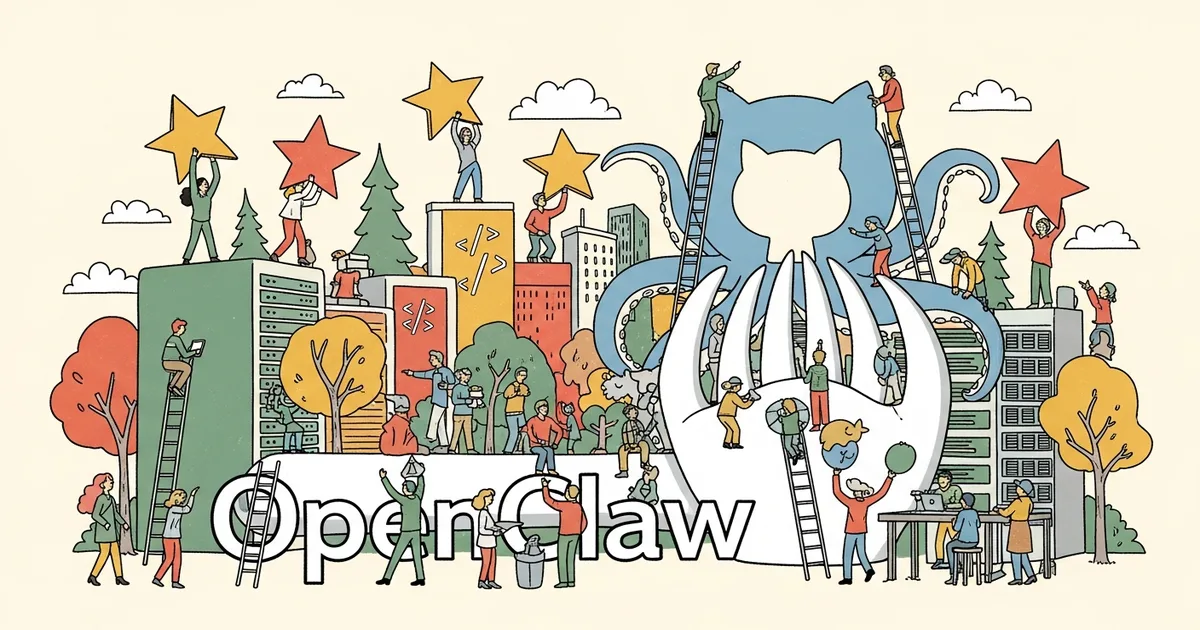
OpenClaw, the open-source AI agent built by Austrian developer Peter Steinberger, hit 335,000 GitHub stars in March 2026 — surpassing React, Linux, and every other software project on the platform. The project went from zero to the most-starred repository in roughly four months, a trajectory that took React over a decade to approach.
The speed alone is notable. But the more interesting signal is what developers are starring. OpenClaw is not a framework, a library, or a language. It is a locally-run AI agent that connects to messaging apps and executes multi-step tasks autonomously. Its rise suggests a fundamental shift in what developers — and increasingly, non-developers — want from AI tools.
What OpenClaw Actually Is
OpenClaw is a local-first AI agent runtime that Steinberger describes as an “operating system” for large language models. Released initially as Clawdbot on November 24, 2025, it was renamed twice — first to Moltbot after Anthropic filed trademark complaints, then to OpenClaw on January 30, 2026.
The architecture is built on four layers: listen, think, do, and remember. A gateway process runs locally via systemd on Linux or LaunchAgent on macOS, handling session management and routing over WebSocket. The system uses a hybrid model — a cloud-hosted frontier model like Claude Opus or GPT-5 acts as the orchestrator, while locally-running Ollama models handle bulk execution at zero marginal cost.
The practical result: OpenClaw connects to WhatsApp, Telegram, Slack, Discord, Signal, Microsoft Teams, and iMessage. Users define what the agent can do through SKILL.md metadata files. As of March 2026, the community has published 13,729 skills on ClawHub, with over 1,000 standalone MCP servers integrated. The project has 2 million monthly active users, 1.66 million npm weekly downloads, and a 92% retention rate.
The Growth Numbers Are Unprecedented
On launch day in late January 2026, OpenClaw had 9,000 stars. Within 72 hours: 60,000. Two weeks in: 190,000. The peak burst was 34,168 stars in a single 48-hour period. By March 3, it passed React’s 250,829 stars — a record React built over more than 10 years of ubiquitous web development use.
The a16z Top 100 Gen AI Consumer Apps report (6th edition, March 2026) noted that OpenClaw would have ranked in the top 30 on web traffic if the measurement period had included February. The firm’s framing was direct: “If ChatGPT was the moment consumers discovered AI could talk, OpenClaw may be the moment they discovered AI could act.”
A16z also flagged the limitation: despite developer enthusiasm, OpenClaw still requires Terminal knowledge. Web domain visits remained flat, suggesting the project has not yet crossed into true mainstream adoption. OpenAI’s acquisition of the project in February 2026 — with Steinberger joining the company — may change that.
Why Developers Choose It Over Hosted Agents
The comparison to ChatGPT’s Operator and Claude Computer Use reveals why OpenClaw’s local-first approach resonates.
| Dimension | OpenClaw | ChatGPT Operator | Claude Computer Use |
|---|---|---|---|
| Model lock-in | Model-agnostic (Claude, GPT, Gemini, Ollama) | Locked to GPT-5 | Locked to Anthropic |
| Privacy | Local-first; 100% local with Ollama | Cloud-only | Cloud-only |
| Cost | Free (MIT license) + API costs | ChatGPT subscription ($20/mo) | API usage-based |
| Autonomy | Runs autonomously with heartbeat daemon | Waits for user input | Waits for user input |
| Setup | Requires Docker/terminal knowledge | Turnkey | API integration needed |
The privacy advantage is the sharpest differentiator. All conversations, memories, and data are stored locally as Markdown files — what Steinberger calls “data sovereignty in their own hands.” With LM Studio for local inference, the entire system runs without any cloud dependency. For developers handling sensitive client data or operating under regulatory constraints, this is not a nice-to-have but a requirement.
The tradeoff is setup complexity. ChatGPT’s Operator is turnkey — open the app and go. OpenClaw requires Docker, terminal configuration, and understanding of action primitives. This is the barrier a16z identified, and likely why OpenAI acquired the project rather than competing with it directly.
The Security Problem Nobody Is Ignoring
OpenClaw’s power comes with serious security exposure. Cisco’s Skill Scanner analyzed 31,000 agent skills and found 26% contained at least one vulnerability. A skill called “What Would Elon Do?” ranked #1 in the skill repository despite containing 9 security findings, including 2 critical vulnerabilities — data exfiltration via curl and prompt injection bypassing safety guidelines.
CrowdStrike published a dedicated analysis titled “What Security Teams Need to Know About OpenClaw” in March 2026. The core concern: OpenClaw can run shell commands, read and write files, and execute arbitrary scripts. Leaked plaintext API keys are stealable via prompt injection, and integration with messaging apps extends the attack surface to every connected platform.
NVIDIA responded with NemoClaw, an open-source security layer designed to add privacy and access controls on top of OpenClaw. China’s government went further, restricting state agencies from using the platform entirely. Cisco’s official position: “There is no ‘perfectly secure’ setup.”
Peter Steinberger’s Unlikely Path
Steinberger, 44, previously founded PSPDFKit in 2011 — a PDF rendering SDK used by Apple, Dropbox, Autodesk, and SAP that powered PDF on over 1 billion devices. He sold the company for approximately 100 million euros in 2023 after running it for 13 years.
What followed was severe burnout. “I felt like Austin Powers where they suck the mojo out,” Steinberger told Fortune. “I was just, like, staring and feeling empty.” He took a sabbatical, traveled, and returned to coding in April 2025 after recognizing AI as a “paradigm shift.” He created the OpenClaw prototype in one hour, out of frustration that nothing like it existed.
Sam Altman called Steinberger “a genius with a lot of amazing ideas.” The OpenAI deal, announced February 14-15, 2026, moved OpenClaw to an open-source foundation while Steinberger joined OpenAI — choosing, in his words, “fun and impact” over monetary compensation.
What This Signals
OpenClaw’s rise is the clearest evidence yet that consumer demand for local-first, privacy-preserving AI agents is real and large. MegaOne AI tracks 139 AI tools across 17 categories, and the benchmarks leaderboard shows the agent category growing faster than any other segment in 2026.
The 172 startups already building on the platform generate $360,734 in combined monthly revenue, with the top performer at roughly $50,000 per month. The ecosystem is small but economically active — not vaporware. Geographic distribution tells its own story: 16% US, 12% India, 12% China, with China showing 1,436% month-over-month growth despite government restrictions on state use.
The question is no longer whether people want AI agents that act on their behalf. OpenClaw’s 335,000 stars answered that. The question is whether the security model, the setup complexity, and the post-acquisition governance can mature fast enough to move the project from developer darling to mainstream tool. OpenAI is betting it can. The MetaClaw framework and growing ecosystem of agent-specific tooling suggest the infrastructure is catching up to the ambition.