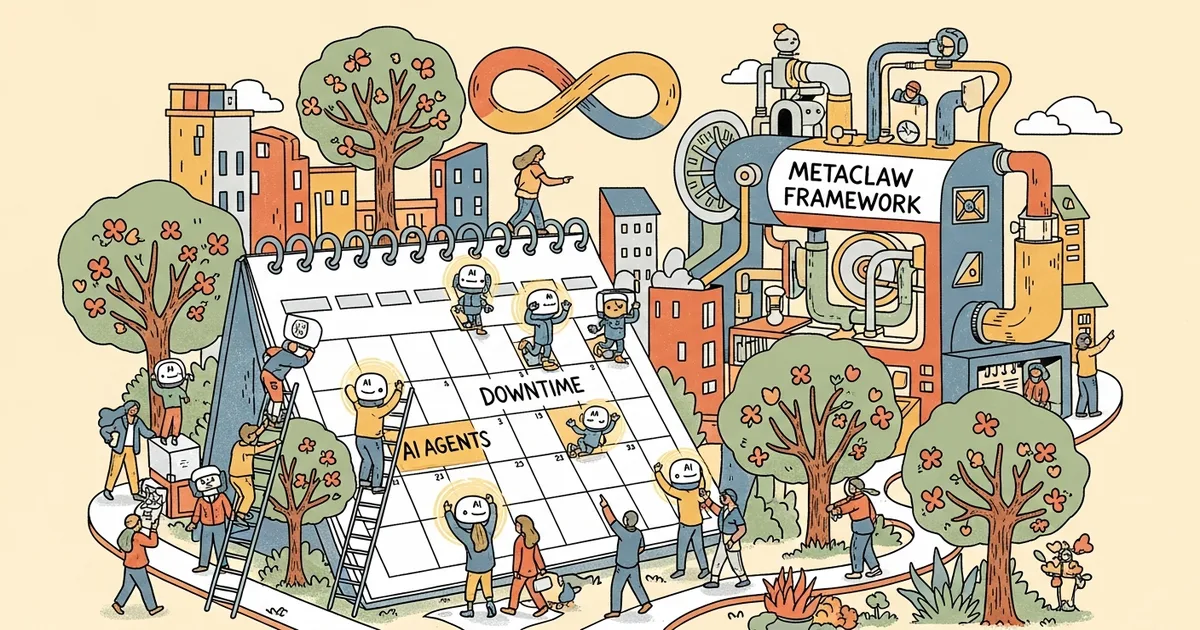
Researchers from UNC-Chapel Hill, Carnegie Mellon University, UC Santa Cruz, and UC Berkeley have developed MetaClaw, a framework that continuously improves AI agents by learning from their mistakes during operation. The system monitors users’ Google calendars, keyboard activity, and sleep schedules to identify training windows without disrupting service.
Unlike traditional AI agents that are trained once and deployed unchanged, MetaClaw adapts to shifting user needs through two complementary mechanisms. When an agent fails a task, a separate language model analyzes the failure and creates a behavioral rule that gets injected directly into the system prompt for immediate application to future tasks.
The framework’s second mechanism updates model weights through reinforcement learning with cloud-based LoRA fine-tuning during idle periods. A background process called OMLS (Opportunistic Meta-Learning Scheduler) monitors three signals: configurable sleep times, keyboard and mouse inactivity at the OS level, and Google calendar events. “If the calendar shows the user is sitting in a meeting, a training window opens up,” according to the research paper.
In testing on a custom benchmark with 934 questions across 44 simulated workdays, MetaClaw demonstrated significant performance improvements. The researchers tested the framework on GPT-5.2 and Kimi-K2.5 models, with behavioral rules alone boosting Kimi-K2.5’s accuracy substantially. The paper notes that “three main types of rules come out of this process: correctly normalizing time formats, creating backups before destructive file operations, and following naming conventions.”
The system maintains strict data separation between pre-rule and post-rule collection periods to avoid penalizing the model for mistakes that new behavioral rules have already addressed. The researchers report that both mechanisms create a feedback loop where better models produce more informative errors, leading to improved rules and higher-quality training data for subsequent updates.