Key Takeaways
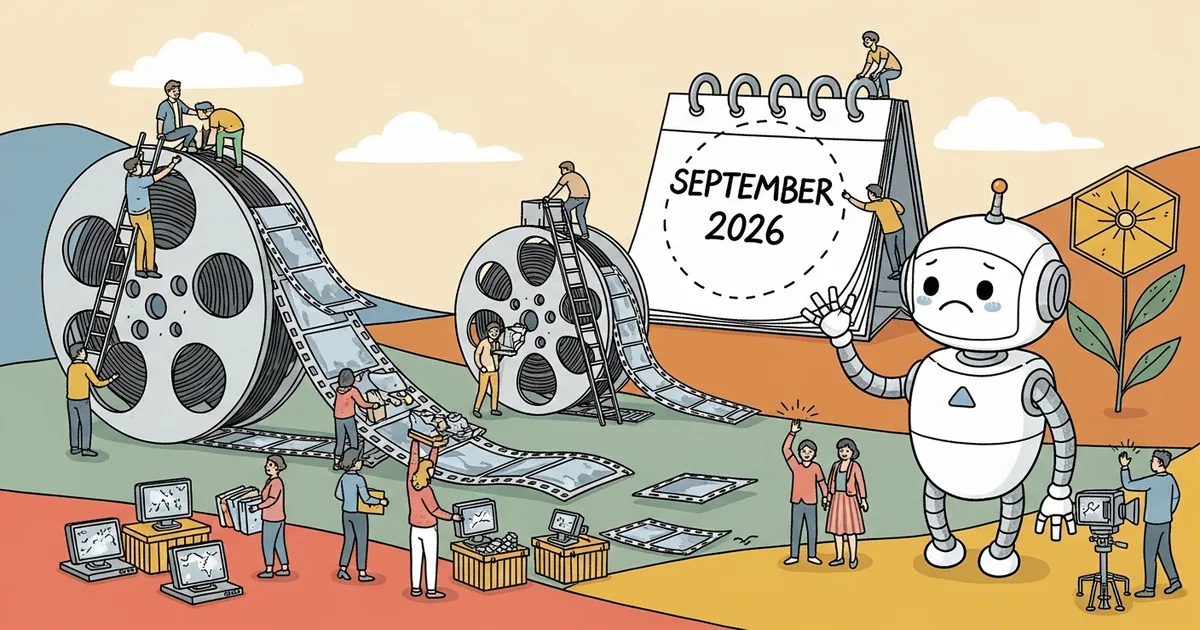
- OpenAI has officially confirmed it will discontinue Sora, its AI video-generation application, with all services ceasing by September 2026.
- Sora was costing OpenAI approximately $1 million per day in operating expenses, driven by the enormous compute required for video generation at scale.
- Disney, which had a $1 billion partnership tied to Sora, was reportedly notified just one hour before the public announcement.
- Active users had dropped from a peak of roughly 1 million to under 500,000, making the unit economics untenable.
What Happened
OpenAI confirmed that Sora, the AI video-generation platform it launched to considerable fanfare, will be shut down by September 2026. The decision follows months of internal deliberation over the product’s financial viability. Sora was consuming approximately $1 million per day in compute costs — roughly $365 million annualized — while generating insufficient revenue to justify the expenditure.
The timing of the announcement created friction with at least one major partner. Disney, which had entered into a $1 billion partnership that included Sora integration for content creation workflows, was reportedly given just one hour of advance notice before OpenAI’s public disclosure. The abruptness of the notification has strained the relationship between the two companies, according to people familiar with the situation.
User engagement had been declining steadily. After an initial surge of interest that brought approximately 1 million active users to the platform, that number fell below 500,000. The drop reflected a pattern common to generative AI products: high initial curiosity followed by limited retention as users discovered the gap between demo-quality outputs and production-ready results.
Why It Matters
Sora’s discontinuation is the most significant product failure in OpenAI’s history and one of the highest-profile shutdowns in the generative AI sector to date. The product was announced in early 2024 with demonstration videos that generated enormous public interest and positioned OpenAI as the leader in AI video generation. The gap between that promise and commercial reality — less than two and a half years — illustrates the difficulty of turning AI research breakthroughs into sustainable products.
The financial math was never favorable. At $1 million per day in operating costs, Sora needed to generate at least that amount in revenue simply to break even on compute, before accounting for engineering staff, infrastructure overhead, and the opportunity cost of GPU capacity that could be allocated to OpenAI’s profitable ChatGPT and API businesses. With fewer than 500,000 active users, each user would have needed to generate roughly $2 per day — or $60 per month — in revenue for the product to approach sustainability. OpenAI’s pricing tiers for Sora fell well below that threshold for most users.
The $1 billion Disney partnership adds a layer of corporate complexity. Disney had been exploring Sora for pre-visualization, storyboarding, and concept development across its film and television divisions. The one-hour notice before public announcement is unusually short for a partnership of that scale and suggests either a rapidly made decision or a deliberate choice to limit the window for leaks. Either way, the handling raises questions about OpenAI’s partner management as it scales its enterprise relationships.
Technical Details
Sora’s compute costs were driven by the fundamental architecture of video diffusion models. Unlike image generation, which produces a single frame, video generation requires producing and maintaining temporal coherence across dozens or hundreds of frames. Each second of generated video at reasonable quality required processing loads orders of magnitude greater than a single image generation request.
OpenAI had attempted to reduce costs through model distillation, quantization, and optimized inference pipelines, but the reductions were insufficient to close the gap between cost and revenue. The company also explored tiered quality options — faster, lower-quality generations at reduced cost — but user testing showed that lower-quality outputs significantly reduced engagement, creating a paradox where the only outputs users wanted were the ones that cost the most to produce.
The video generation market’s compute intensity means that no current provider has solved the unit economics problem. Runway, Pika, and Kling all face similar cost structures, though at smaller scale. Sora’s shutdown does not necessarily indicate a flaw specific to OpenAI’s approach — it may reflect a fundamental market reality that AI video generation at high quality is not yet economically viable as a standalone consumer product.
Who’s Affected
OpenAI’s existing Sora users have until September 2026 to export their projects and generated content. The company has committed to providing data export tools and a transition period, though specific details have not been released.
Disney faces the most significant partner impact. The $1 billion deal encompassed broader AI integration beyond Sora, but the video generation component was a central element. Disney will likely need to evaluate alternatives from Runway, Pika, or internal R&D efforts to fill the gap in its content creation pipeline.
Competing AI video platforms may benefit from Sora’s exit. Runway, which has raised over $400 million, and Pika, backed by approximately $135 million in funding, could absorb displaced Sora users. However, they face the same underlying cost challenges that made Sora unsustainable. China-based Kling, developed by Kuaishou, and ByteDance’s video generation tools operate under different cost structures due to lower compute pricing in China, potentially giving them a path to viability that Western competitors lack.
OpenAI’s investors, including Microsoft, will weigh this shutdown against the company’s broader trajectory. Sora’s failure to reach commercial viability is a data point in the ongoing debate about whether generative AI companies can translate technical capabilities into profitable products across all modalities, or whether some applications — particularly compute-heavy ones like video — will remain economically impractical for years.
What’s Next
OpenAI will redirect the compute capacity and engineering resources currently allocated to Sora toward its core products, primarily ChatGPT, the API platform, and its next-generation reasoning models. CEO Sam Altman has indicated that the company’s priority is strengthening its position in text and multimodal reasoning rather than pursuing every possible AI modality.
The AI video generation market will continue to develop, but Sora’s failure is likely to cool investor enthusiasm for standalone AI video products. Future viable approaches may involve tighter integration with existing creative tools — Adobe, Autodesk, or the major visual effects platforms — rather than standalone consumer applications. The technology works; the economics, at current compute costs, do not.