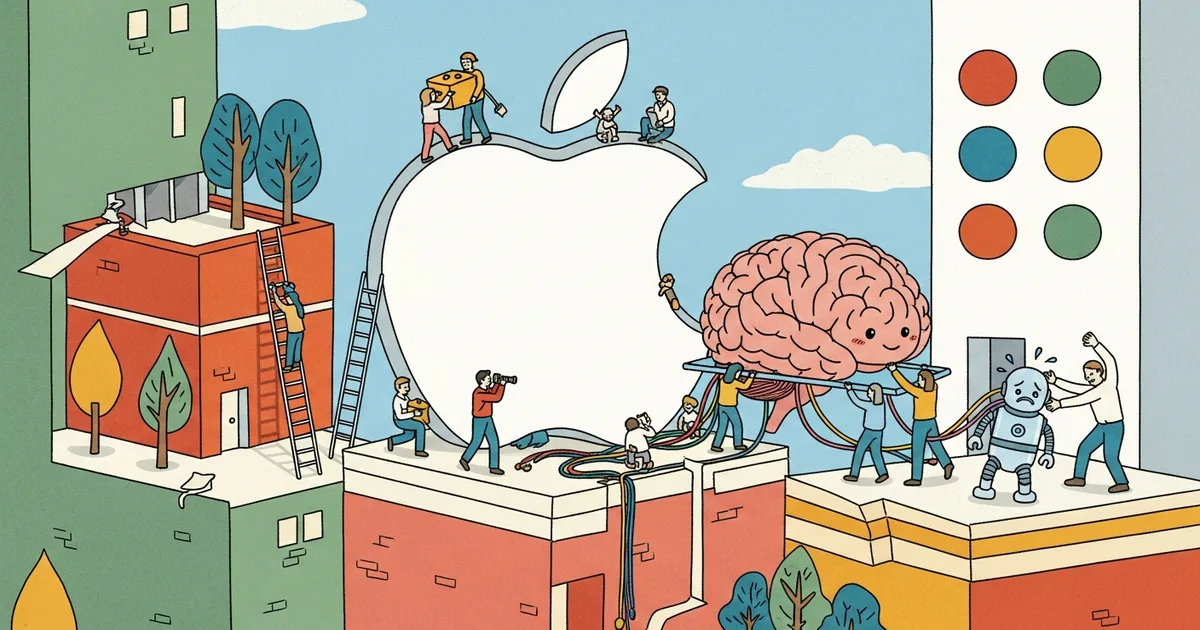
- Apple is paying Google approximately $1 billion annually to use a custom Gemini model as the foundation for a rebuilt Siri, launching with iOS 26.4 in spring 2026.
- The Gemini model will run on Apple’s Private Cloud Compute servers, not on Google’s infrastructure, preserving Apple’s data separation architecture.
- The new Siri supports multi-turn conversations, on-screen awareness, and deep iOS integration — shipping white-labeled with no visible Google branding.
- Apple is reportedly developing its own 1-trillion-parameter foundation model as a longer-term replacement.
What Happened
Apple has partnered with Google in a non-exclusive, multi-year deal to power its rebuilt Siri assistant with a custom version of Google’s Gemini AI model. The arrangement, first reported by CNBC in January 2026, involves Apple paying Google approximately $1 billion per year for access to the model and associated cloud technology.
The new Siri will ship with iOS 26.4, expected in early April 2026, and will be formally showcased at WWDC 2026. It arrives white-labeled — users will interact with Siri as before, with no Google branding visible anywhere in the interface. The upgrade requires an iPhone 15 Pro or later; older devices will remain on the legacy assistant, creating a split in the user experience across Apple’s installed base.
Why It Matters
This deal represents Apple’s most significant concession in its AI strategy. After launching Apple Intelligence in 2024 to mediocre reviews, the company has effectively acknowledged that its in-house AI capabilities are not competitive with Google’s foundation models for complex reasoning tasks.
The partnership also restructures one of the most consequential relationships in technology. Apple and Google have long maintained a search-engine default deal reportedly worth $20 billion annually. Adding an AI model licensing arrangement deepens the companies’ interdependence at a time when both face regulatory scrutiny over their existing business ties. The U.S. Department of Justice has already targeted the search default deal in its antitrust case against Google.
Technical Details
The rebuilt Siri is powered by a custom Gemini model — Google’s most capable AI system — running on Apple’s Private Cloud Compute infrastructure. This architecture means that user data processed by the model stays on Apple’s servers and does not flow to Google’s systems. Apple can also distill smaller on-device models from the Gemini foundation model for tasks that can run locally.
The new assistant supports multi-turn natural conversations with follow-up questions, on-screen awareness that enables contextual actions based on what is displayed, and deep integration across the iOS ecosystem including Safari and Spotlight. Google handles complex planning and reasoning tasks, while Apple’s own models continue to run simpler queries.
The upgrade represents a jump from Apple’s approximately 150-billion-parameter in-house model to Google’s 1.2-trillion-parameter Gemini system — roughly an eightfold increase in model scale.
Who’s Affected
Every iPhone 15 Pro and later user will receive the upgraded Siri through iOS 26.4. Users of older devices will not get the new assistant, creating a two-tier experience within Apple’s ecosystem. Developers building Siri integrations and shortcuts may need to account for significantly expanded capabilities in the Gemini-powered version.
Competitors in the AI assistant space — including OpenAI with ChatGPT‘s voice mode and Amazon with Alexa — now face an Apple product backed by what is arguably the most capable foundation model available, distributed through the world’s largest premium smartphone ecosystem. Microsoft’s Copilot, already powered by OpenAI’s models, competes in a different segment but may feel pressure on mobile as the Gemini-powered Siri narrows the capability gap.
What’s Next
Apple is reportedly developing its own foundation model with approximately 1 trillion parameters that could launch by late 2026. If successful, this would allow Apple to reduce or eliminate its dependence on Google’s model over time. The current Gemini deal appears to be a bridge solution while Apple scales its own AI research.
The main open question is whether running Google’s model on Apple’s servers genuinely preserves the privacy guarantees Apple has built its brand around. The model itself was trained on Google’s data, and the privacy implications of that distinction — Apple’s servers, Google’s model — have not been fully tested in regulatory or public scrutiny. European regulators in particular may scrutinize how user queries processed through a Google-trained model interact with GDPR requirements, even if the data never leaves Apple’s infrastructure. Whether Apple can maintain its “privacy-first” positioning while relying on a model built by the world’s largest advertising company remains the central tension of this partnership.