Key Takeaways
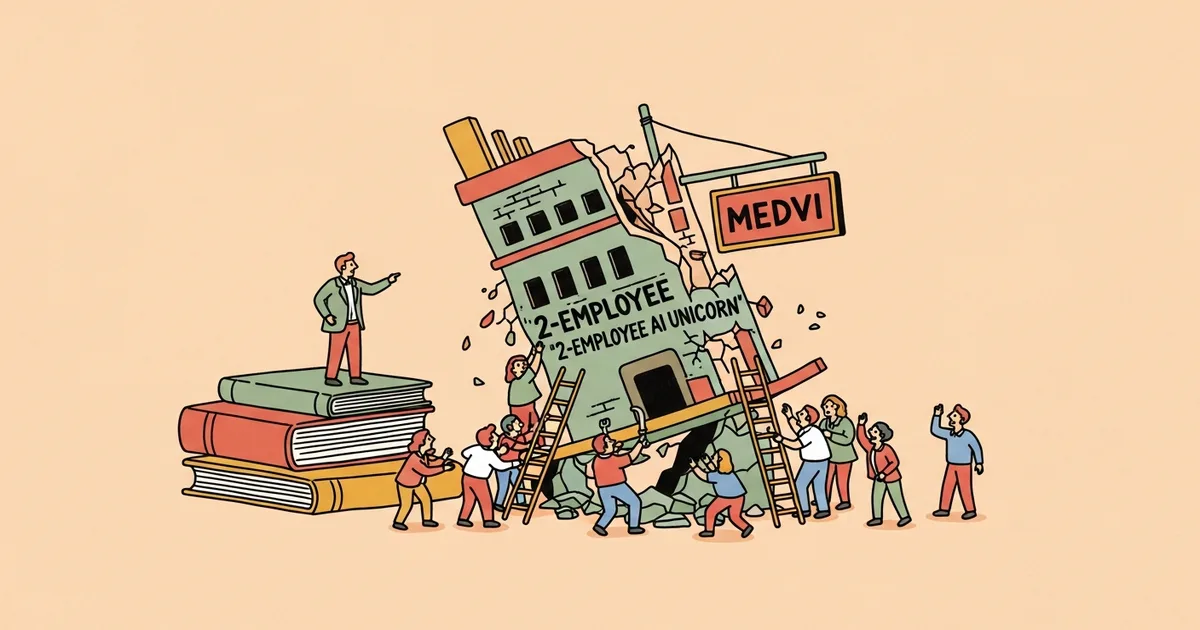
- AI researcher Gary Marcus published a detailed critique of the New York Times’ profile of Medvi, a GLP-1 telehealth company the Times described as a $1.8 billion operation run by just two employees.
- Marcus argues the “2-employee” framing is fundamentally misleading because Medvi relies on hundreds of contracted physicians, pharmacy partners, and outsourced customer service operations.
- The critique highlights broader concerns about how major media outlets cover AI-enabled businesses, often conflating automation with genuine operational leanness.
- Medvi’s business model raises separate regulatory questions about AI-driven prescribing practices in the booming GLP-1 weight-loss drug market.
What Happened
Gary Marcus, the New York University professor emeritus and prominent AI critic, published a detailed rebuttal to a New York Times feature that profiled Medvi as a paradigm of AI-powered business efficiency. The Times article portrayed the company — a telehealth platform specializing in GLP-1 weight-loss medications like semaglutide and tirzepatide — as generating approximately $1.8 billion in annual revenue with a staff of just two full-time employees.
Marcus’s critique, published on his Substack, methodically challenged the central premise. “The story the Times told is not the story of a two-person company,” Marcus wrote. “It’s the story of a two-person holding company that sits on top of a vast network of contractors, partner pharmacies, and outsourced labor. That’s not the same thing, and the Times should know the difference.”
The original Times piece had framed Medvi as evidence that AI could compress entire corporate structures into minimal headcounts, a narrative that fit neatly into the prevailing discourse about AI replacing human workers. Marcus argued this framing obscured more than it revealed.
Why It Matters
The Medvi story touches on two intersecting issues: the accuracy of AI hype journalism and the regulatory landscape of telehealth prescribing. Marcus’s critique matters because the New York Times’ framing was widely amplified. The article was shared hundreds of thousands of times on social media, cited in investor presentations, and referenced by AI advocates as proof that lean, AI-first companies could generate billion-dollar revenues.
But the “2-employee” characterization omits critical operational infrastructure. Medvi contracts with networks of licensed physicians who conduct the telehealth consultations required before GLP-1 prescriptions can be issued. The company partners with compounding pharmacies that manufacture and ship the medications. Customer service, billing, and compliance functions are handled by outsourced teams. By categorizing all of this labor as external to the company, the revenue-per-employee ratio becomes artificially extraordinary.
“If you don’t count your contractors as employees, you can make any company look like a miracle of efficiency,” Marcus noted. “A McDonald’s franchise owner could claim to run a million-dollar business with one employee if they didn’t count the people actually making the hamburgers.”
Technical Details
Marcus identified several specific claims in the Times article that he characterized as misleading or under-examined. First, the article credited AI with handling the majority of Medvi’s patient interactions, but Marcus pointed out that regulatory requirements in most U.S. states mandate a licensed physician’s involvement in prescribing decisions — meaning AI could assist with intake forms and scheduling but could not legally replace the prescriber.
Second, Marcus highlighted the compounding pharmacy relationship. GLP-1 medications like semaglutide are in such high demand that Medvi and similar telehealth platforms have turned to compounding pharmacies, which produce custom formulations of the drugs. The FDA has raised concerns about the safety and consistency of compounded GLP-1 products, and several states have tightened regulations around their sale through telehealth channels.
Third, Marcus questioned the revenue figure itself. He noted that the $1.8 billion number appeared to represent gross transaction volume rather than net revenue, a distinction the Times article did not clearly make. If Medvi takes a margin on transactions processed through its platform — with the bulk of the money flowing to pharmacies and contracted physicians — the actual revenue captured by the two-person entity is likely a fraction of the headline number.
Who’s Affected
The critique has implications for multiple constituencies. For journalists covering AI-enabled businesses, Marcus’s analysis serves as a case study in how easily operational complexity can be flattened into a misleading narrative. The Times has not issued a correction or response as of this writing.
For investors and venture capitalists, the Medvi story had become a reference point for the “AI-native company” thesis — the idea that AI enables businesses to scale revenue without proportionally scaling headcount. Marcus’s deconstruction complicates that thesis by demonstrating that the labor still exists; it has simply been reclassified.
For the GLP-1 telehealth market specifically, the scrutiny is unwelcome. Companies like Medvi, Ro, Hims & Hers, and Calibrate are competing for a share of the weight-loss drug market that Goldman Sachs has projected could reach $100 billion annually by 2030. Regulatory attention to their prescribing practices, contractor structures, and marketing claims is intensifying.
Patients using these platforms face the most direct consequences. If the AI-assisted intake process substitutes for thorough medical evaluation, the risk of inappropriate prescribing increases — a concern the FDA and state medical boards are actively investigating.
What’s Next
Marcus’s critique is part of a broader pattern in his work: using specific, high-profile examples to illustrate systemic problems in how AI capabilities are communicated to the public. His previous targets have included OpenAI’s claims about GPT-4’s reasoning abilities and Google’s medical AI demonstrations.
The Medvi case may accelerate regulatory scrutiny of the telehealth-to-pharmacy pipeline for GLP-1 drugs. The FTC has already opened inquiries into deceptive marketing practices by telehealth weight-loss companies, and congressional hearings on compounded GLP-1 safety are scheduled for later in 2026.
For the media, the episode underscores a persistent challenge: AI companies have strong incentives to present their operations as more automated than they actually are, and newsrooms under resource pressure may lack the expertise or time to interrogate those claims. Marcus’s work fills that gap, but the structural incentives that produce misleading coverage remain intact.