Key Takeaways
- Intuit’s GenOS is a proprietary generative AI operating system that provides reusable infrastructure for building AI features across TurboTax, QuickBooks, Credit Karma, and Mailchimp.
- GenOS enabled 9,800 model deployment events last fiscal year, with over 1,300 engineers actively building agents on the platform.
- P&G has taken a similar centralized approach with its AI Factory and ChatPG tool, now reaching 30,000 internal users.
- MIT Sloan Management Review researchers argue that companies without a centralized AI platform force every team to reinvent the wheel, deploying models 38% slower than organizations with cross-functional AI infrastructure.
What Happened
Intuit has spent the past two years building and iterating on GenOS, a proprietary generative AI operating system that serves as shared infrastructure across the company’s entire product portfolio. First introduced in June 2023, GenOS now powers AI features in TurboTax, QuickBooks, Credit Karma, and Mailchimp, reaching approximately 100 million consumers and businesses.
In a September 2025 announcement, the company said it had “rapidly advanced” GenOS over the prior 90 days to accelerate agentic AI development at scale. CEO Sasan Goodarzi described the ambition plainly: “By rapidly advancing GenOS, we’ve dramatically stepped up the pace of our innovation to further unleash the power of this data, of the AI and the human intelligence on our platform to truly become this system of intelligence for our customers.”
Intuit also signed a $100 million-plus multi-year contract with OpenAI to deepen the use of frontier models within GenOS, alongside existing integrations with Anthropic Claude, Google Gemini, Meta LLaMA, and Mistral.
Why It Matters
The concept of a company-wide AI operating system tackles a problem that MIT Sloan Management Review columnists Thomas H. Davenport and Randy Bean have been tracking closely. In their April 2025 analysis of Intuit, they described GenOS as “the analog of Windows, macOS, or Linux for AI, allowing developers of AI use cases to employ advanced and reusable resources to build their applications.”
The alternative is fragmentation. Without a centralized coordination layer, AI initiatives across business units operate in isolation. They don’t share data, don’t learn from one another, and each introduce unique security vulnerabilities. Research compiled by enterprise AI analysts found that organizations with cross-functional AI teams deploy models 38% faster than those with siloed setups.
Davenport and Bean, writing in their 2026 trends report, identified “AI factories” as a defining investment pattern: centralized infrastructure that lets companies build, test, and iterate AI applications at high velocity rather than starting from scratch with every project.
Technical Details
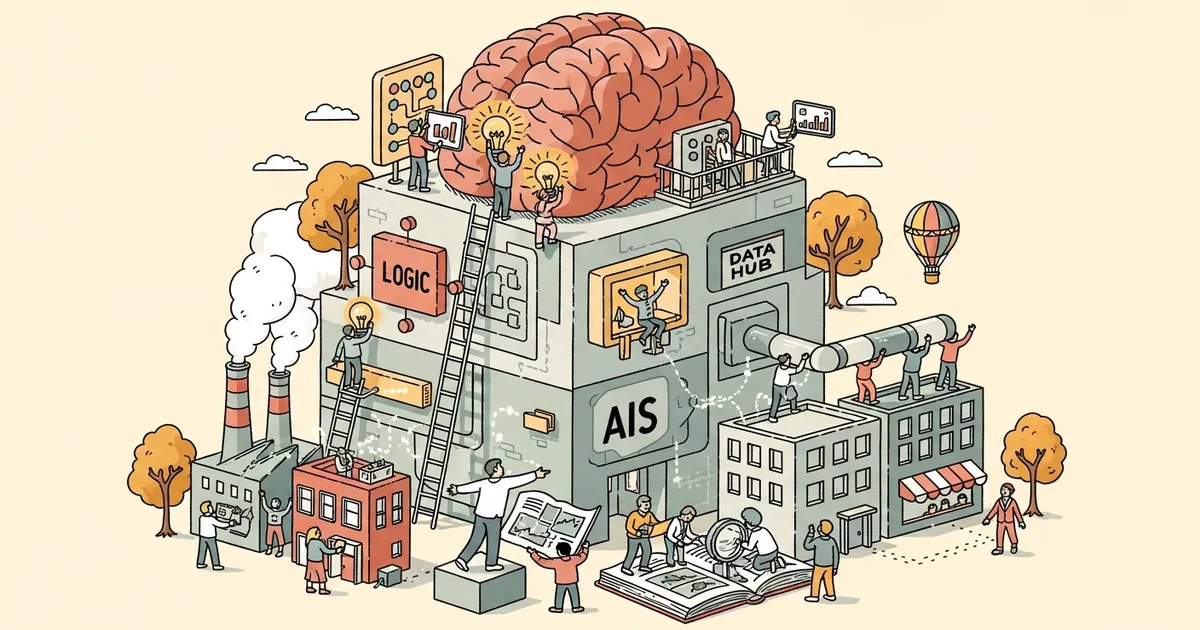
GenOS is built around four core components. GenStudio is an environment where engineers train and refine large language models, with new models introducible in a matter of days. GenRuntime is an intelligent orchestration layer that routes requests to the right model, retrieves relevant data, and grounds commercial LLMs in Intuit’s domain-specific financial knowledge. GenUX offers more than 150 user experience components, widgets, and patterns with built-in LLM connections for consistent front-end design. The fourth layer is Intuit’s custom-trained financial LLMs, fine-tuned on proprietary financial data.
The AI Workbench within GenOS manages selection across 13 base models and up to 70 modified variants, choosing the most appropriate model for each task. Intuit’s custom financial LLMs have demonstrated 5% improved accuracy and 50% reduced latency for certain accounting workflows compared to general-purpose off-the-shelf models.
The platform’s customer-facing expression is Intuit Assist, a generative AI assistant embedded across all four products. CTO Alex Balazs said the approach “combines the speed and scale of AI with human judgment and accountability.”
Who’s Affected
Intuit’s roughly 100 million users across TurboTax, QuickBooks, Credit Karma, and Mailchimp are the immediate beneficiaries. Goodarzi has stated that the company’s AI agents could eventually do the work of a CFO, CMO, or sales officer for a midsize business.
Intuit is not alone in pursuing this model. Procter & Gamble has built a comparable centralized approach through its AI Factory, which supports 80% of its global business operations and has cut AI model development time by approximately six months. P&G’s internal generative AI tool, ChatPG, has reached 30,000 users, with AI upskilling now part of standard employee onboarding. The company invests an estimated $1.1 billion annually in AI, cloud computing, and robotics.
For the broader software industry, GenOS represents an argument that the companies most likely to extract value from AI are those that build shared infrastructure rather than bolting on features product by product.
What’s Next
Intuit had over 1,300 engineers actively building agents on GenOS as of its most recent disclosure, with 9,800 model deployment events in the last fiscal year. The OpenAI partnership will expand the range of frontier models available within the system.
The broader trend is moving toward what Davenport and Bean call the “factory” model for AI. Companies that build this shared infrastructure now will compound their advantage over time, while those still running siloed AI projects face mounting costs and coordination overhead. Goodarzi framed the stakes directly: “Every SaaS company, anybody that makes software, is either going to get disrupted or they’re going to be the disruptors. And that’s because of what’s possible with AI.”